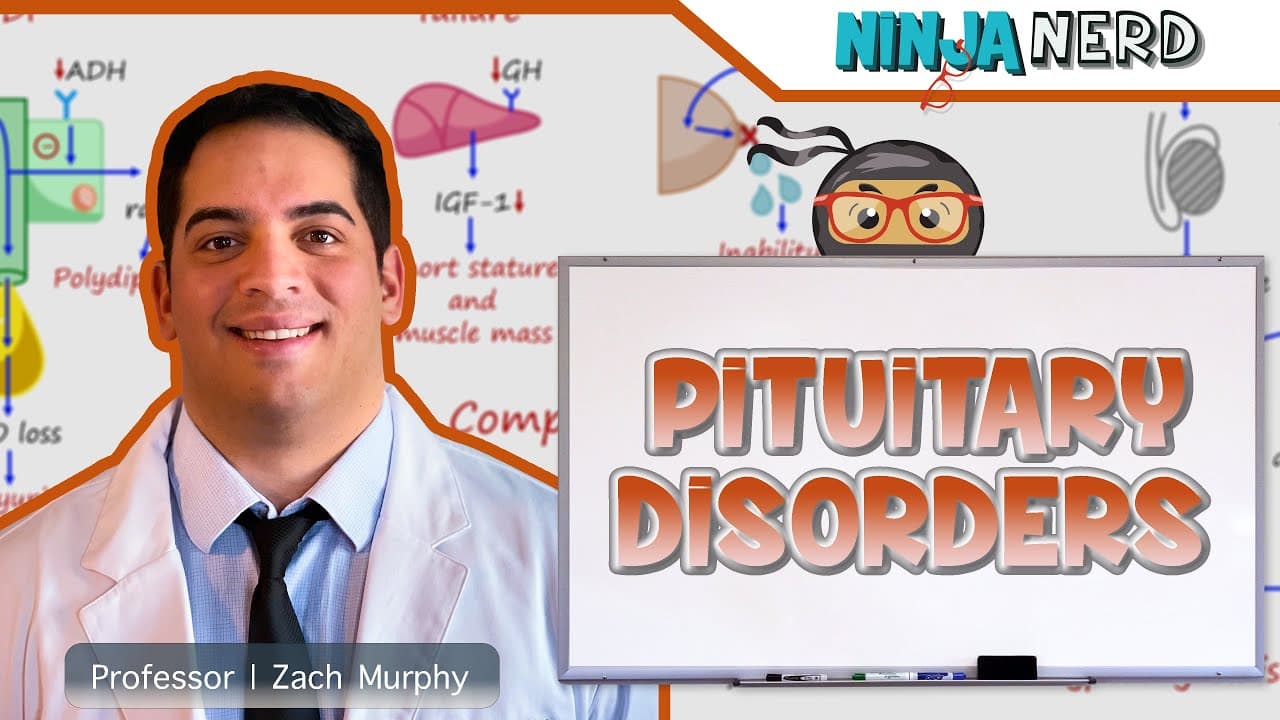
How Do Pituitary Disorders Affect Hormones? | Clinical Medicine
TL;DR
Pituitary disorders can reduce hormone production when compression or direct destruction damages the anterior or posterior pituitary. Deficiencies may affect growth hormone, prolactin, follicle-stimulating hormone, luteinizing hormone, thyroid-stimulating hormone, adrenocorticotropic hormone, and vasopressin. A pituitary macroadenoma greater than 10 millimeters can also compress the optic chiasm and cause bitemporal hemianopia. Read on to connect each affected hormone with its clinical consequences.
Transcript
what's up Ninja nerds in this video today we're going to be talking about pituitary disorders this is part of our clinical medicine section if you guys enjoy these videos they make sense they help you please support us you can do that by hitting the like button commenting down the comment section and also subscribing additionally what I really reco... Read More
Key Insights
- • Hypopituitarism is a state of inadequate pituitary hormone production caused primarily by compression or direct destruction of pituitary tissue. Both mechanisms can impair blood flow and reduce the gland's ability to produce hormones from the anterior pituitary and, in some cases, the posterior pituitary.
- • Growth hormone deficiency is caused by impaired somatotrope function and can result in growth failure. Somatotropes are anterior pituitary cells responsible for producing growth hormone, so compression or destruction of these cells directly reduces the hormone available to support normal growth.
- • Prolactin deficiency is caused by damage to lactotropes and can lead to lactation failure. This finding is particularly important when evaluating pituitary dysfunction because an inability to produce prolactin reflects loss of a specific anterior pituitary cell population.
- • Gonadotropin deficiency is caused by damage to gonadotropes, which normally release follicle-stimulating hormone and luteinizing hormone. Reduced production can cause hypogonadism by interfering with spermatogenesis, ovulatory and menstrual cycles, testosterone production, and progesterone production.
- • Thyroid-stimulating hormone and adrenocorticotropic hormone deficiencies result from damage to thyrotropes and corticotropes. These losses can produce secondary hypothyroidism and secondary adrenal insufficiency, respectively, demonstrating how pituitary failure disrupts downstream endocrine glands.
- • Central diabetes insipidus can occur when compression or destruction extends to the posterior pituitary and interferes with vasopressin, also called antidiuretic hormone. Posterior pituitary involvement therefore adds a water-balance disorder to the multiple anterior pituitary hormone deficiencies.
- • A pituitary macroadenoma is defined in the lecture as a pituitary tumor greater than 10 millimeters. Its mass can compress hormone-producing tissue, the optic chiasm, and nearby structures, causing reduced pituitary hormones, bitemporal hemianopia, and secondary headaches associated with space-occupying pressure.
- • Sheehan syndrome is direct pituitary injury associated with postpartum hemorrhage, reduced blood volume, hypotension, and possible disseminated intravascular coagulation. Low pressure can reduce tissue perfusion, while widespread clot formation can obstruct vessels supplying the pituitary and contribute to destructive injury.
Install to Summarize YouTube Videos and Get Transcripts
Explore YouTube Video Summarizer or Get YouTube Transcript Extractor
Questions & Answers
Q: What is hypopituitarism, and what causes it?
Hypopituitarism is inadequate production of pituitary hormones. The two mechanisms described are compression and direct destruction of pituitary tissue, both of which reduce its ability to produce hormones. The anterior pituitary is affected, and sufficiently extensive damage may also involve the posterior pituitary.
Q: Which hormones can decrease in hypopituitarism?
Damage to the anterior pituitary can reduce growth hormone, prolactin, follicle-stimulating hormone, luteinizing hormone, thyroid-stimulating hormone, and adrenocorticotropic hormone. If damage extends to the posterior pituitary, vasopressin, also called antidiuretic hormone, can also be impaired.
Q: What problems can pituitary hormone deficiencies cause?
Growth hormone deficiency can cause growth failure, while prolactin deficiency can cause lactation failure. Reduced follicle-stimulating hormone and luteinizing hormone can cause hypogonadism, and deficiencies of thyroid-stimulating hormone and adrenocorticotropic hormone can cause secondary hypothyroidism and secondary adrenal insufficiency. Impaired vasopressin can lead to central diabetes insipidus.
Q: What defines a pituitary macroadenoma?
A pituitary macroadenoma is described as an abnormal pituitary tumor greater than 10 millimeters. It can compress the anterior pituitary and, in some cases, the posterior pituitary, reducing hormone production.
Q: How can a pituitary macroadenoma affect vision?
A pituitary macroadenoma can compress the nearby optic chiasm. This may cause bitemporal hemianopia, meaning loss of the lateral visual fields in both eyes.
Q: Why can a pituitary tumor cause headaches?
A large pituitary tumor occupies space within the skull and may increase intracranial pressure. This space-occupying pressure can produce a secondary headache.
Q: What is Sheehan syndrome, and how does it damage the pituitary?
Sheehan syndrome is direct pituitary injury associated with postpartum hemorrhage. Blood loss greater than one liter within 24 hours after delivery, or enough blood loss to cause hemodynamic instability, can produce low blood volume and hypotension that reduce pituitary perfusion. Associated disseminated intravascular coagulation can further obstruct blood delivery to pituitary tissue.
Q: How are pituitary disorders diagnosed and treated?
The described diagnostic approach includes hormone measurements, MRI imaging to identify pituitary adenomas, and visual field testing for possible optic chiasm compression. Treatment may include medication to normalize hormone levels, radiation therapy, or surgical removal of a pituitary tumor. The approach depends on the hormonal abnormality and whether a mass is present.
Summary & Key Takeaways
-
Hypopituitarism occurs when compression or destruction prevents pituitary tissue from producing adequate hormones. Damage can reduce growth hormone, prolactin, follicle-stimulating hormone, luteinizing hormone, thyroid-stimulating hormone, adrenocorticotropic hormone, and vasopressin, producing complications involving growth, lactation, reproductive function, thyroid activity, adrenal activity, and water regulation.
-
A pituitary macroadenoma is an abnormal pituitary tumor greater than 10 millimeters that can compress pituitary tissue and lower hormone production. A sufficiently large mass may also compress the optic chiasm, causing loss of the lateral visual fields called bitemporal hemianopia, and may contribute to increased intracranial pressure and secondary headaches.
-
Direct pituitary destruction can occur in Sheehan syndrome after postpartum hemorrhage. Losing greater than one liter of blood within 24 hours after delivery, or losing enough blood to cause hemodynamic instability, can produce low blood volume and hypotension. Associated disseminated intravascular coagulation can further impair blood delivery to pituitary tissue.
Read in Other Languages (beta)
Share This Summary 📚
Summarize YouTube Videos and Get Video Transcripts with 1-Click
Try YouTube Summary with ChatGPT & Claude or YouTube Transcript Generator
Explore More Summaries from Ninja Nerd 📚





Summarize YouTube Videos and Get Video Transcripts with 1-Click
Try YouTube Summary with ChatGPT & Claude or YouTube Transcript Generator