How does Michaelis-Menten enzyme kinetics work?
TL;DR
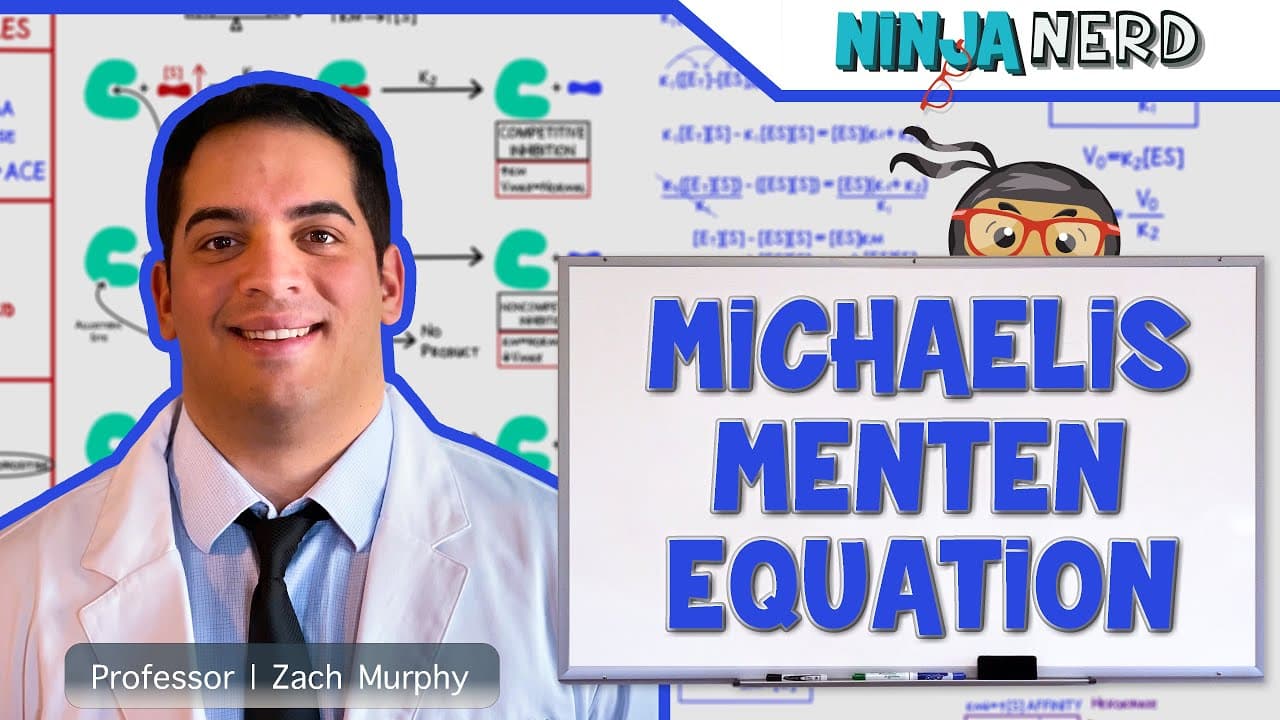
The Michaelis-Menten equation links reaction velocity to substrate concentration using Km and Vmax. It is derived from the enzyme-substrate complex formation and breakdown under a steady-state assumption, then rearranged to explain how velocity saturates with increasing substrate. The video also covers Lineweaver Burk plots and different inhibition types like competitive, noncompetitive, and uncompetitive.
Transcript
all right n gener ner in this video we're going to talk about enzyme kinetics but enzyme kinetics what is it basically well kinetics is referring to basically the rate of a reaction or the speed of a reaction so it's basically just turning the rate or the speed of a reaction with respect to an enzyme but it's kind of an umbrella term for a lot of d... Read More
Key Insights
- The steady state assumption equates the rate of enzyme-substrate formation with the rate of its breakdown, keeping the enzyme-substrate complex concentration roughly constant during the reaction.
- Km is defined as the ratio of the rate constants for disassociation to formation, linking substrate affinity to the catalytic process while guiding interpretation of enzyme efficiency.
- Vmax represents the fastest possible rate when the substrate is in excess, illustrating saturation behavior where increasing substrate no longer speeds up the reaction.
- The enzyme total equals the sum of free enzyme and the enzyme-substrate complex, a fundamental balance used to derive Michaelis-Menten kinetics.
- Derivation often uses the assumption that the reverse reaction from enzyme-product back to enzyme-substrate is negligible at time zero, simplifying the model.
- Lineweaver-Burk plots provide a linearized form of the Michaelis-Menten equation, aiding visual interpretation of Km and Vmax from experimental data.
- Competitive, noncompetitive, and uncompetitive inhibitors alter the velocity curve in characteristic ways, revealing how inhibitors interact with enzyme or substrate and how inhibition is quantified.
- The Michaelis-Menten framework yields a hyperbolic velocity vs substrate curve, contrasting with allosteric enzymes that show sigmoidal kinetics and cooperative effects.
Install to Summarize YouTube Videos and Get Transcripts
Explore YouTube Video Summarizer or Get YouTube Transcript Extractor
Questions & Answers
Q: How does the Michaelis-Menten equation relate velocity to substrate concentration?
The Michaelis-Menten equation describes how reaction velocity depends on substrate concentration by balancing the formation and breakdown of the enzyme-substrate complex under steady-state conditions. It introduces Km as the substrate concentration at half maximum velocity and Vmax as the maximum achievable rate when the enzyme is saturated with substrate. This framework standardizes how researchers compare enzymes and their efficiencies across conditions.
Q: What is the steady-state assumption in enzyme kinetics?
The steady-state assumption states that the rate of formation of the enzyme-substrate complex equals the rate of its breakdown, keeping the concentration of the complex roughly constant during the reaction. This assumption simplifies the mathematics of enzyme kinetics, allowing the derivation of the Michaelis-Menten equation and enabling predictions of how changes in substrate concentration affect velocity.
Q: How is Km defined in Michaelis-Menten kinetics?
Km is defined as the ratio of the rate constants for substrate disassociation to formation, mathematically expressed as (K2 + K-1) / K1 in simple models. Physically, Km reflects the substrate concentration at which the reaction rate is half of Vmax, serving as a measure of substrate affinity and catalytic efficiency under the conditions of the experiment.
Q: What does Vmax tell us about an enzyme?
Vmax tells us the maximum rate of the reaction when the enzyme is saturated with substrate, representing the fastest possible turnover under the given conditions. It indicates the catalytic speed in the limiting case of abundant substrate and a fully utilized enzyme population, providing a baseline to gauge how efficiently an enzyme operates.
Q: What happens to Km and Vmax under competitive inhibition?
Under competitive inhibition, Km increases because more substrate is needed to reach half-maximum velocity while Vmax remains unchanged. The inhibitor competes with the substrate for the active site, effectively reducing apparent substrate affinity and requiring higher substrate concentrations to achieve similar reaction rates.
Q: What happens to Km and Vmax under noncompetitive inhibition?
Noncompetitive inhibition lowers Vmax because the inhibitor binds to the enzyme or enzyme-substrate complex, reducing the total amount of active enzyme available for turnover. Km can remain unchanged if the inhibitor does not affect substrate binding, but in mixed cases both parameters may shift, altering the velocity curve.
Q: What is the lineweaver-burk plot used for?
The lineweaver-burk plot linearizes the Michaelis-Menten equation by plotting 1/v against 1/[S]. This transformation yields a straight line where the y-intercept equals 1/Vmax and the slope equals Km/Vmax, making it easier to estimate kinetic parameters from experimental data and to compare different enzymes or conditions.
Q: What distinguishes uncompetitive inhibition from other types?
Uncompetitive inhibition occurs when the inhibitor binds only to the enzyme-substrate complex, not to the free enzyme. This reduces both Vmax and Km proportionally, shifting the apparent kinetic parameters in a way that lowers the observed velocity and affinity simultaneously, and it can only occur in the presence of substrate.
Summary & Key Takeaways
-
The Michaelis-Menten framework explains how enzymes convert substrates to products by forming an enzyme-substrate complex. It uses the steady-state concept to balance formation and breakdown of the complex, leading to a simple expression that connects velocity to substrate concentration. This model applies to typical enzyme reactions and clarifies efficiency and affinity.
-
Km and Vmax are key parameters abundant in enzyme studies. Km reflects substrate affinity for the enzyme, while Vmax represents the maximum rate when the enzyme is saturated. The relationship between these values helps interpret how efficiently an enzyme works and how changes in conditions affect activity.
-
Inhibitors modify enzyme activity by changing how the enzyme interacts with the substrate. Competitive inhibitors raise Km without changing Vmax, noncompetitive inhibitors lower Vmax, and uncompetitive inhibitors modify both parameters, shaping the velocity curve and the interpretation of enzyme regulation in pharmacology.
Read in Other Languages (beta)
Share This Summary 📚
Summarize YouTube Videos and Get Video Transcripts with 1-Click
Try YouTube Summary with ChatGPT & Claude or YouTube Transcript Generator
Explore More Summaries from Ninja Nerd 📚






Summarize YouTube Videos and Get Video Transcripts with 1-Click
Try YouTube Summary with ChatGPT & Claude or YouTube Transcript Generator