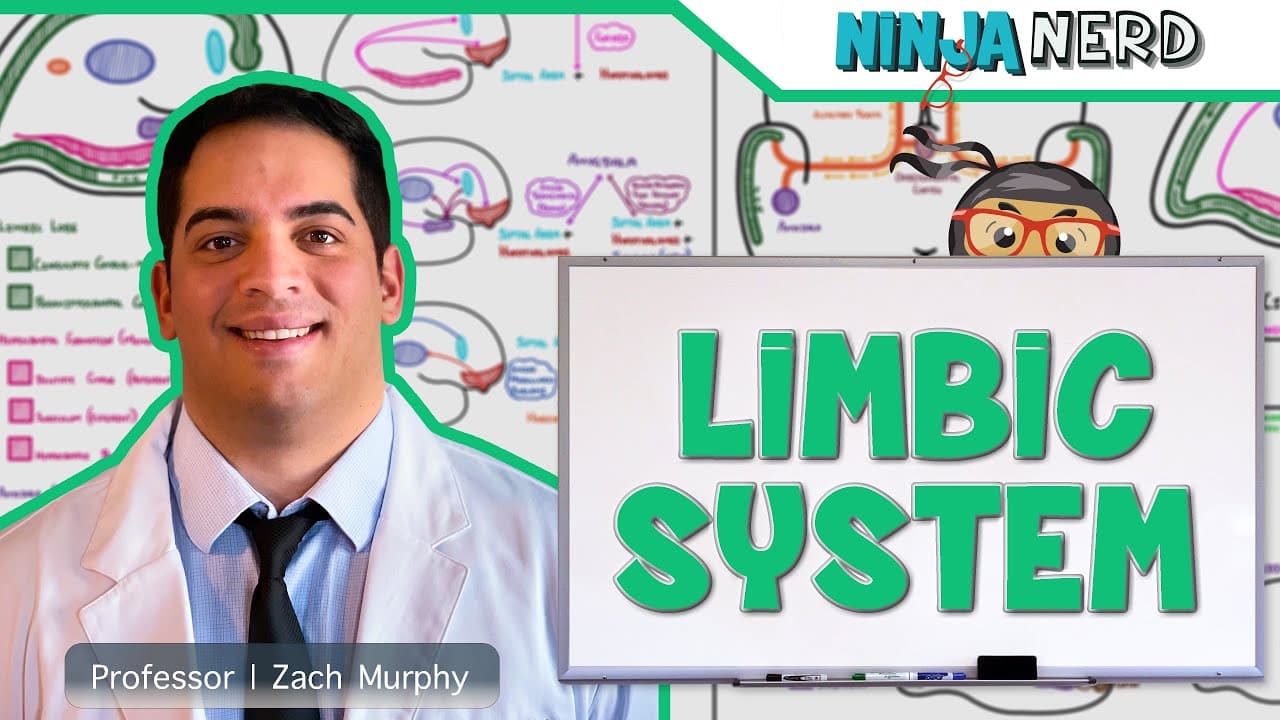
Neurology | Limbic System Anatomy & Function
TL;DR
Explores limbic system's role in emotion, memory, and behavior.
Transcript
Read and summarize the transcript of this video on Glasp Reader (beta).
Key Insights
- The limbic system comprises gray and white matter structures deep in the cerebrum, involved in olfaction, emotions, behavior, and memory.
- Key gray matter structures include the limbic lobe, hippocampal formation, amygdala, hypothalamus, and thalamus, each with distinct roles in memory and emotional processing.
- White matter structures like the fornix and ventral amygdalofugal pathway connect limbic nuclei, facilitating communication between these components.
- The Papez circuit is crucial for integrating memory and emotional experiences, linking the hippocampus, mammillary bodies, thalamus, and cingulate gyrus.
- The limbic system processes olfactory inputs, associating smells with memories and emotions through the parahippocampal gyrus and amygdala.
- Emotional responses and behaviors, including feeding, sexual, and motivational behaviors, are regulated by the limbic system, particularly the amygdala and hypothalamus.
- The limbic system connects with the prefrontal cortex, influencing executive functions, decision-making, and social behavior.
- Clinical conditions like Kluver-Bucy syndrome and Wernicke’s encephalopathy highlight the limbic system's role in emotional and memory disorders.
Install to Summarize YouTube Videos and Get Transcripts
Explore YouTube Video Summarizer or Get YouTube Transcript Extractor
Questions & Answers
Q: What are the main components of the limbic system?
The limbic system includes the hippocampus, amygdala, hypothalamus, cingulate gyrus, parahippocampal gyrus, fornix, and parts of the thalamus. Each plays a unique role, such as memory consolidation by the hippocampus and emotional processing by the amygdala.
Q: How does the limbic system influence memory?
The limbic system influences memory through the Papez circuit, which integrates emotional experiences with memory and decision-making. This circuit involves the hippocampus, mammillary bodies, thalamus, and cingulate gyrus, facilitating the processing and recall of memories.
Q: What role does the amygdala play in the limbic system?
The amygdala is central to processing emotions and behaviors, including fear and threat responses. It communicates with the hypothalamus and other structures to mediate emotional responses and is involved in behaviors like feeding and sexual activities.
Q: How does the limbic system connect with the autonomic nervous system?
The limbic system connects with the autonomic nervous system through structures like the hypothalamus, which regulates physiological states in response to emotional stimuli. This integration allows for adaptive responses to emotional experiences, such as stress or fear.
Q: What is the significance of the Papez circuit?
The Papez circuit is significant for its role in memory and learning. It links the hippocampus, mammillary bodies, thalamus, and cingulate gyrus, integrating emotional experiences with memory and influencing decision-making processes.
Q: How does the limbic system affect behavior?
The limbic system affects behavior by regulating emotional responses and behaviors such as feeding, sexual activities, and motivation. The amygdala and hypothalamus play key roles in mediating these behaviors, often in response to emotional stimuli.
Q: What clinical conditions are associated with limbic system dysfunction?
Clinical conditions like Kluver-Bucy syndrome and Wernicke's encephalopathy are associated with limbic system dysfunction. Kluver-Bucy syndrome involves damage to the amygdala, affecting emotional responses, while Wernicke's encephalopathy impacts the mammillary bodies, affecting memory.
Q: How does the limbic system influence executive functions?
The limbic system influences executive functions through its connections with the prefrontal cortex, affecting decision-making, reasoning, and social behavior. By integrating emotional experiences, the limbic system helps guide complex cognitive processes and adaptive behaviors.
Summary & Key Takeaways
-
The limbic system is a network of brain structures managing emotions, memory, and behavior. It includes structures like the hippocampus and amygdala, each contributing to specific functions such as memory consolidation and emotional processing.
-
Functional pathways like the Papez circuit integrate emotional experiences with memory and decision-making, demonstrating how the limbic system influences executive functions and social behavior.
-
The limbic system connects physiological states with emotional experiences, underpinning complex behaviors like bonding and learning, and is involved in clinical conditions affecting memory and emotions.
Read in Other Languages (beta)
Share This Summary 📚
Summarize YouTube Videos and Get Video Transcripts with 1-Click
Try YouTube Summary with ChatGPT & Claude or YouTube Transcript Generator
Explore More Summaries from Ninja Nerd 📚






Summarize YouTube Videos and Get Video Transcripts with 1-Click
Try YouTube Summary with ChatGPT & Claude or YouTube Transcript Generator