How Do Salivary Glands Work in Digestion?
TL;DR
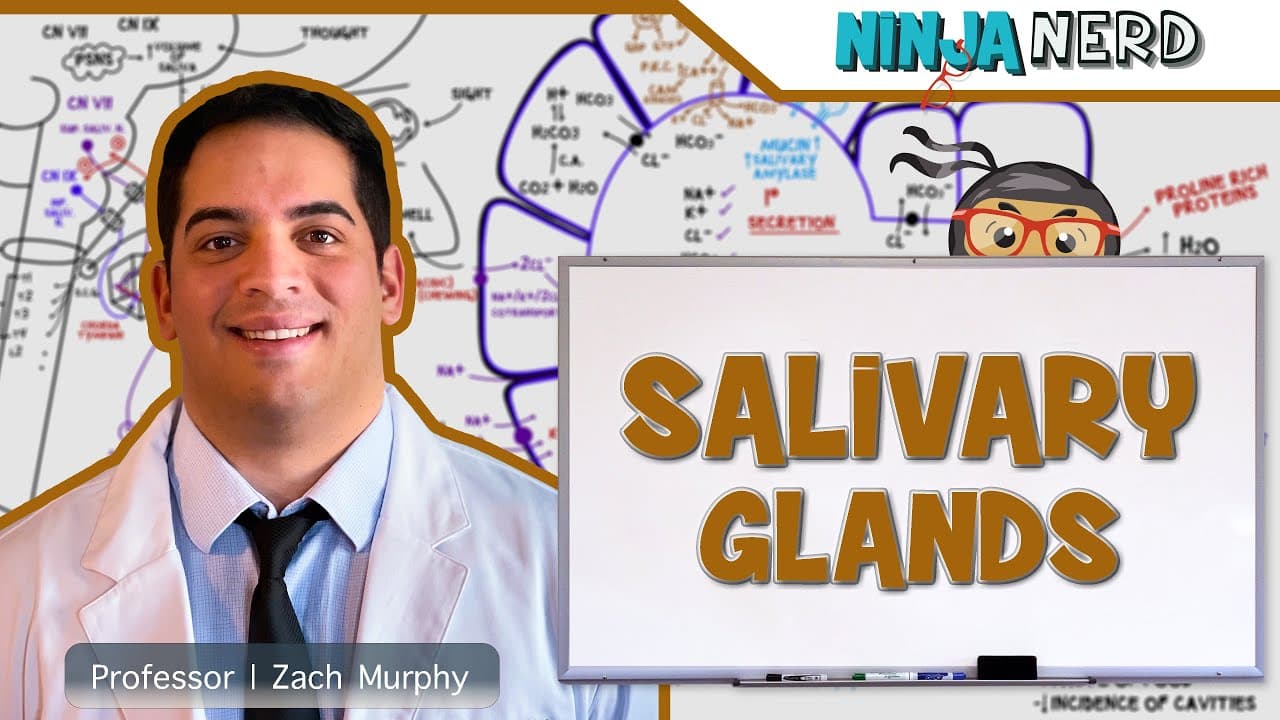
Salivary glands, including parotid, submandibular, and sublingual, produce saliva essential for oral health, digestion, and lubrication. Saliva contains enzymes like amylase and lipase for breaking down food, and proteins for antimicrobial defense. These glands are controlled by parasympathetic and sympathetic nervous systems, responding to stimuli like taste and smell.
Transcript
iein innards in this video we are going to talk about salivation soul I've asked so many important functions so many alright when I talk about some of the few and we'll talk about them in more detail but saliva is actually really important for being able to hydrate the oral cavity rays what hydrates the oral cavity it helps to lubricate the food th... Read More
Key Insights
- Saliva hydrates and lubricates the oral cavity, aiding in food ingestion and digestion.
- Salivary glands include extrinsic (parotid, submandibular, sublingual) and intrinsic glands, each with specific roles.
- Extrinsic glands secrete saliva based on stimuli, while intrinsic glands secrete continuously.
- Salivary enzymes include amylase for polysaccharides and lipase for lipids, aiding in chemical digestion.
- Parasympathetic and sympathetic systems regulate saliva production, affecting its volume and composition.
- Saliva plays a crucial role in oral hygiene, containing antimicrobial proteins and enzymes.
- The parotid gland primarily secretes watery, enzyme-rich saliva, while sublingual glands secrete thicker, mucous-rich saliva.
- Salivary secretion is stimulated by taste, smell, sight, and thought of food, enhancing digestive readiness.
Install to Summarize YouTube Videos and Get Transcripts
Explore YouTube Video Summarizer or Get YouTube Transcript Extractor
Questions & Answers
Q: How do salivary glands aid in digestion?
Salivary glands produce saliva, which contains enzymes like amylase and lipase that begin the process of chemical digestion by breaking down carbohydrates and fats. Saliva also moistens food, forming a bolus that is easier to swallow, and provides lubrication to facilitate the movement of food through the esophagus.
Q: What are the main types of salivary glands?
The main types of salivary glands are extrinsic and intrinsic glands. Extrinsic glands include the parotid, submandibular, and sublingual glands, which are located outside the oral cavity and secrete saliva in response to stimuli. Intrinsic glands are located within the oral cavity and secrete saliva continuously, although they contribute less to overall saliva volume.
Q: What enzymes are found in saliva and what are their functions?
Saliva contains enzymes such as salivary amylase and lingual lipase. Salivary amylase begins the chemical digestion of carbohydrates by breaking down polysaccharides into simpler sugars. Lingual lipase, although less active in the mouth, starts the digestion of lipids. These enzymes facilitate the digestive process by initiating the breakdown of food components.
Q: How is salivary secretion regulated?
Salivary secretion is regulated by the autonomic nervous system, with the parasympathetic system increasing the volume of watery, enzyme-rich saliva and the sympathetic system promoting the secretion of thicker, protein-rich saliva. This regulation is influenced by stimuli such as taste, smell, sight, and thought of food, which activate specific receptors and pathways.
Q: What role does saliva play in oral hygiene?
Saliva contributes significantly to oral hygiene by containing antimicrobial proteins and enzymes that help control bacterial growth, prevent infections, and reduce the risk of dental caries. Proteins like immunoglobulin A, lysozymes, and histatins provide a defense mechanism against pathogens, while maintaining the health of teeth and gums.
Q: Where are the major salivary glands located?
The major salivary glands are located outside the oral cavity. The parotid glands are situated anterior to the ears, the submandibular glands are located beneath the jaw, and the sublingual glands are found under the tongue. Each gland has ducts that carry saliva into the oral cavity, aiding in digestion and oral health.
Q: What is the difference between serous and mucous cells in salivary glands?
Serous cells in salivary glands produce a watery, enzyme-rich secretion that aids in digestion, while mucous cells produce a thicker, mucin-rich secretion that lubricates and protects the oral cavity. The parotid gland predominantly contains serous cells, the submandibular gland has a mix of both, and the sublingual gland primarily contains mucous cells.
Q: How does the sympathetic nervous system affect saliva composition?
The sympathetic nervous system influences saliva composition by promoting the secretion of protein-rich saliva, which is thicker and more viscous. This is achieved through the release of norepinephrine, which stimulates the exocytosis of protein granules, including mucin, and causes vasoconstriction, reducing blood flow and the secretion of watery, electrolyte-rich saliva.
Summary & Key Takeaways
-
Salivary glands are vital for digestion and oral health, producing saliva that hydrates, lubricates, and aids in food breakdown. Saliva contains enzymes like amylase and lipase for digesting carbohydrates and fats, respectively. It also includes antimicrobial proteins that help maintain oral hygiene and prevent cavities.
-
The main salivary glands—parotid, submandibular, and sublingual—have distinct anatomical locations and secretory functions. They are regulated by the parasympathetic and sympathetic nervous systems, which influence the volume and composition of saliva based on various stimuli, including taste and smell.
-
Saliva's production is a complex process involving different cell types and ducts. The glands respond to mechanical and chemical stimuli, and their activity can be modulated by the sight, smell, and thought of food, preparing the digestive system for food intake and enhancing the taste of food.
Read in Other Languages (beta)
Share This Summary 📚
Summarize YouTube Videos and Get Video Transcripts with 1-Click
Try YouTube Summary with ChatGPT & Claude or YouTube Transcript Generator
Explore More Summaries from Ninja Nerd 📚
Summarize YouTube Videos and Get Video Transcripts with 1-Click
Try YouTube Summary with ChatGPT & Claude or YouTube Transcript Generator