How does the pineal gland regulate sleep with melatonin?
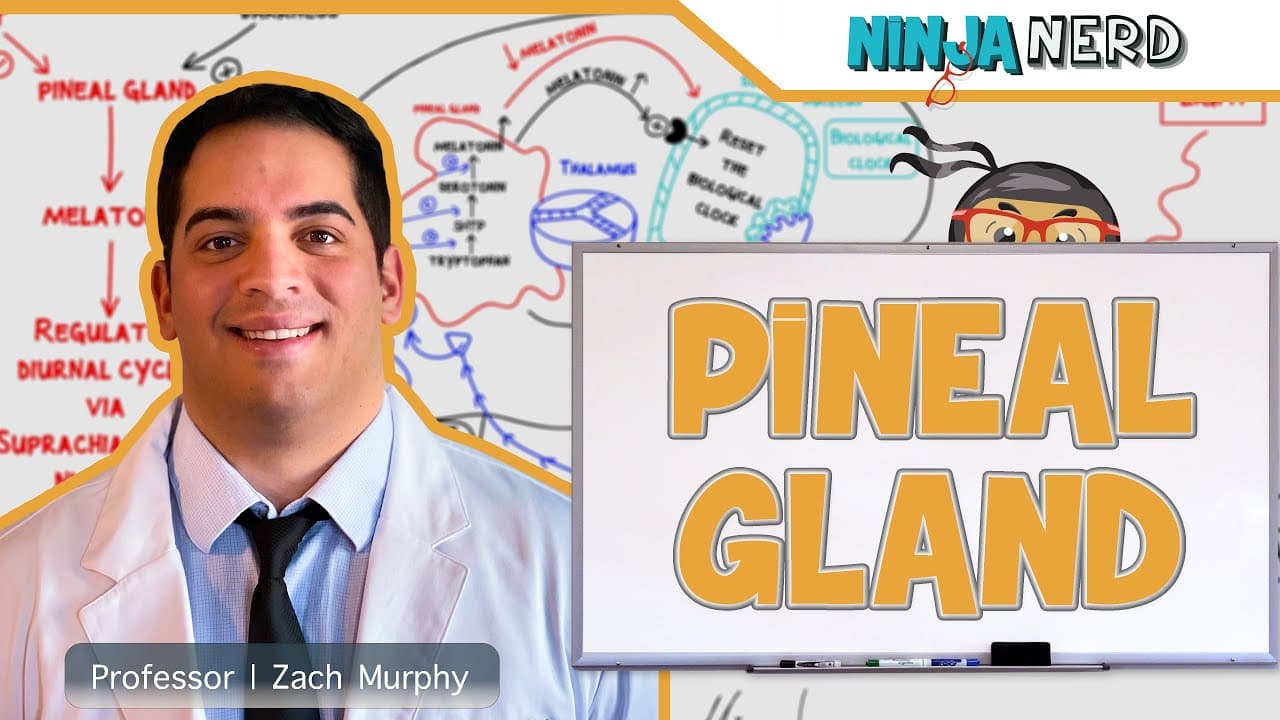
TL;DR
Melatonin is produced by pinealocytes when darkness signals the biological clock through the suprachiasmatic nucleus and the superior cervical ganglion. This leads to higher melatonin levels that promote sleep and reset the circadian clock, while light suppresses melatonin production to promote wakefulness. The pathway links the retina to endocrine output controlling sleep timing.
Transcript
Alright Ninja Nerds! What we're going to do in this video is, we're going to talk about the pineal gland. Alright, so the pineal gland is really cool a little gland. It's located in what's called the diencephalon. So what's the diencephalon? A little bit nothing crazy, a little bit into a neuro anatomy here. The diencephalon is actually consisting ... Read More
Key Insights
- The pineal gland is located in the diencephalon and is anatomically connected to the habenula within the epithalamus.
- Light exposure suppresses melatonin production by reducing norepinephrine release from the superior cervical ganglion to pinealocytes.
- Darkness increases norepinephrine signaling to pinealocytes, boosting melatonin synthesis from tryptophan through serotonin.
- The suprachiasmatic nucleus acts as the biological clock and modulates melatonin output via downstream pathways including the paraventricular nucleus.
- Norepinephrine acts on adrenergic receptors in pinealocytes to trigger intracellular pathways that convert tryptophan to melatonin.
- Melatonin helps regulate the sleep-wake cycle by signaling the brain to initiate sleep and align circadian rhythms with day-night cycles.
- Besides sleep, melatonin has roles in puberty timing and seasonal reproductive patterns, according to the description.
- Clinical relevance includes considerations for jet lag and insomnia, with melatonin supplements discussed as aids.
Install to Summarize YouTube Videos and Get Transcripts
Explore YouTube Video Summarizer or Get YouTube Transcript Extractor
Questions & Answers
Q: How does the pineal gland fit into the brain's circadian system?
The pineal gland is part of the epithalamus in the diencephalon and receives regulatory input from the suprachiasmatic nucleus, which is the brain's master clock. Light signals influence this pathway via the retina, the SCN, the paraventricular nucleus, and the superior cervical ganglion, ultimately controlling melatonin release from pinealocytes. This integration coordinates sleep-wake cycles with the environment.
Q: What triggers melatonin production in the pineal gland?
Melatonin production is triggered by darkness. The absence of light leads to reduced signaling to the pineal gland, allowing norepinephrine release from the superior cervical ganglion to stimulate pinealocytes. This adrenergic signaling activates intracellular pathways that convert tryptophan to 5-hydroxytryptamine, then to serotonin, and finally to melatonin, increasing at night to promote sleep.
Q: What role does norepinephrine play in melatonin synthesis?
Norepinephrine released from postganglionic neurons of the superior cervical ganglion binds to adrenergic receptors on pinealocytes. This binding activates intracellular cascades that push the metabolic conversion of tryptophan to serotonin and then to melatonin. The level of norepinephrine is higher in darkness, driving more melatonin production.
Q: Why is the suprachiasmatic nucleus important for melatonin?
The suprachiasmatic nucleus serves as the biological clock that senses light information via the retina and coordinates downstream signals. It influences the paraventricular nucleus and the sympathetic pathway to the pineal gland, modulating norepinephrine release and melatonin synthesis. This synchronization ensures melatonin is secreted at night when wakefulness should decrease.
Q: What is the sequence of chemical conversions to melatonin in the pineal gland?
The sequence starts with tryptophan, which is converted to 5-hydroxytryptamine (serotonin precursor), then serotonin, and finally melatonin. Norepinephrine signaling to pinealocytes initiates these intracellular pathways, promoting the enzymatic steps that transform these substrates into melatonin, the hormone responsible for signaling sleep readiness.
Q: What happens to melatonin levels during the day versus night?
During the day, light inhibits the pineal gland and melatonin production, resulting in low melatonin levels and wakefulness. At night, darkness increases norepinephrine signaling to pinealocytes, raising melatonin levels, which acts on the brain to promote drowsiness and help reset the biological clock through the SCN.
Q: What secondary roles are associated with melatonin beyond sleep?
Melatonin is noted to have potential roles in puberty onset and seasonal reproductive patterns, as described in the material. While the primary function is sleep-wake regulation via the SCN, these secondary roles suggest melatonin may influence developmental and seasonal physiological processes, although the details would require further study beyond the basic sleep axis.
Q: What clinical contexts involve melatonin according to the description?
Clinical relevance includes jet lag and insomnia, with melatonin supplements discussed as sleep aids in these contexts. The description emphasizes that melatonin supports circadian alignment, helping individuals adapt to time-zone changes or sleep disturbances by reinforcing the natural night signal to the brain, thus facilitating sleep onset and maintenance.
Summary & Key Takeaways
-
The pineal gland sits in the diencephalon and is linked to the habenula region, forming part of the epithalamus and the brain's circadian system.
-
Light signals travel from the retina to the suprachiasmatic nucleus, which then influences the paraventricular nucleus and ultimately the pineal gland to modulate melatonin.
-
Melatonin synthesis starts from tryptophan, converting through 5-hydroxytryptamine and serotonin to melatonin under adrenergic control from the superior cervical ganglion.
Read in Other Languages (beta)
Share This Summary 📚
Summarize YouTube Videos and Get Video Transcripts with 1-Click
Try YouTube Summary with ChatGPT & Claude or YouTube Transcript Generator
Explore More Summaries from Ninja Nerd 📚






Summarize YouTube Videos and Get Video Transcripts with 1-Click
Try YouTube Summary with ChatGPT & Claude or YouTube Transcript Generator