How does the adrenal medulla release catecholamines during stress
TL;DR
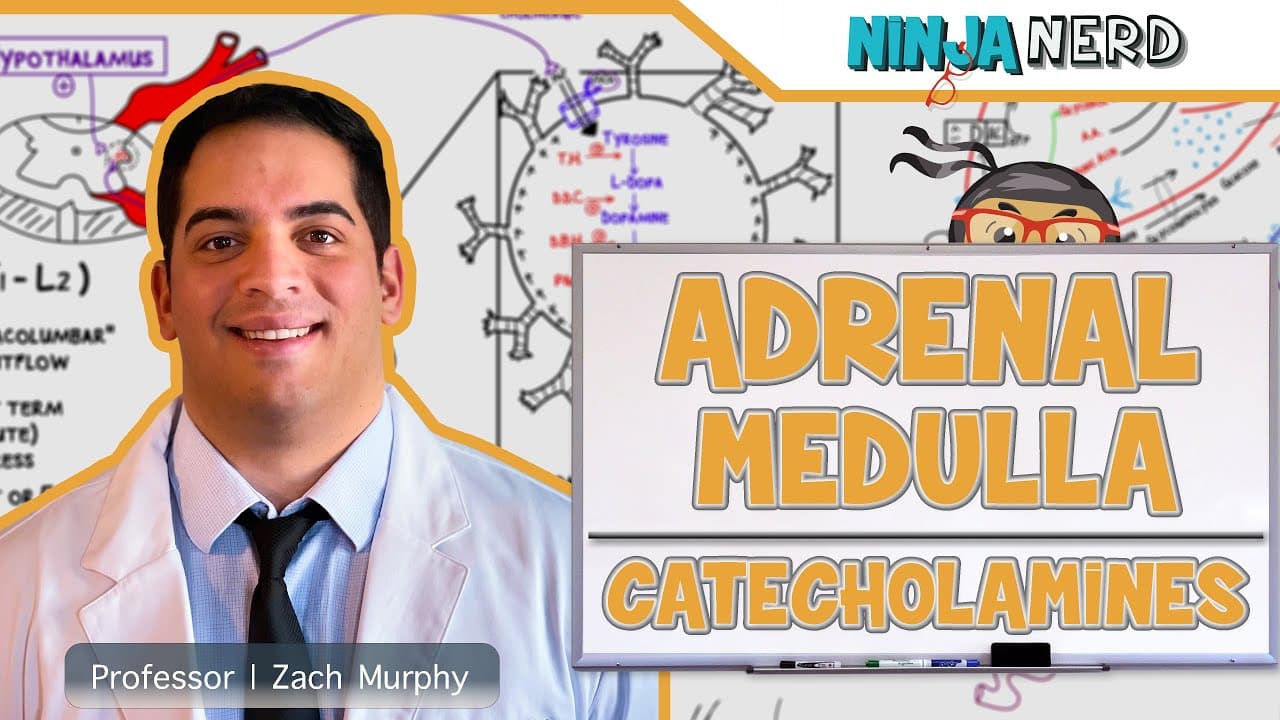
The adrenal medulla contains chromaffin cells that act as postganglionic sympathetic neurons and release epinephrine and norepinephrine into the bloodstream during acute stress. Acetylcholine from preganglionic sympathetic fibers stimulates these cells, which synthesize catecholamines from tyrosine through several enzymes, and the hormones are released via exocytosis in response to calcium signals.
Transcript
all right Niner in this video we're going to talk about the adrenal gland if you guys haven't already seen it go into our uh Endocrinology playlist and watch all of the videos up until this point first one was on the zone of glosa second one was on the zone of facula third one was on the zone of reticularis in this video we're going to specifically... Read More
Key Insights
- The adrenal medulla is neural tissue containing chromaffin cells that function as postganglionic sympathetic neurons, releasing catecholamines into the bloodstream during acute stress.
- Preganglionic sympathetic fibers release acetylcholine onto chromaffin cells, which triggers depolarization and calcium-dependent exocytosis of catecholamines.
- The sympathetic pathway to the adrenal medulla is unique because preganglionic neurons have long fibers that bypass a traditional chain ganglion and act on intramural chromaffin cells.
- Tyrosine is the starting amino acid for catecholamine synthesis, which is converted to L-DOPA and then to dopamine before forming norepinephrine and epinephrine.
- Epinephrine and norepinephrine release is stimulated by enzymes including tyrosine hydroxylase, DOPA decarboxylase, dopamine beta hydroxylase, and PNMT, with PNMT activity upregulated by cortisol.
- In adrenal chromaffin cells, epinephrine is released predominantly with about 80 percent epinephrine and 20 percent norepinephrine, directly into the bloodstream.
- Calcium entry at the axon terminal triggers vesicle fusion via SNARE proteins, causing exocytosis of catecholamines to mediate rapid systemic effects.
- Chromaffin cells’ innervation bridges nervous and endocrine systems, enabling rapid, life-saving responses during fight or flight.
- More videos from this channel:
- More from this channel: Ninja Nerd
Install to Summarize YouTube Videos and Get Transcripts
Explore YouTube Video Summarizer or Get YouTube Transcript Extractor
Questions & Answers
Q: What is the adrenal medulla and its primary role in stress response?
The adrenal medulla is the inner part of the adrenal gland composed of neural tissue and chromaffin cells that act as postganglionic sympathetic neurons. Its primary role during stress is to release catecholamines, mainly epinephrine and norepinephrine, into the bloodstream to trigger rapid physiological changes supporting the fight or flight response.
Q: How do preganglionic sympathetic neurons stimulate chromaffin cells?
Preganglionic sympathetic neurons release acetylcholine onto chromaffin cells in the adrenal medulla. This acetylcholine binds to nicotinic receptors on chromaffin cells, causing depolarization and opening of voltage-gated calcium channels. The resulting calcium influx triggers exocytosis of catecholamine-containing vesicles, releasing epinephrine and norepinephrine into the blood.
Q: Why are chromaffin cells considered intramural ganglion cells?
Chromaffin cells are considered intramural ganglion cells because they receive signals directly from preganglionic sympathetic fibers without forming a separate postganglionic neuron ganglion outside the adrenal gland. The preganglionic fibers pass through sympathetic chain ganglia and terminate within the adrenal medulla, where chromaffin cells serve as the postganglionic component inside the organ.
Q: What is the basic catecholamine synthesis pathway in chromaffin cells?
Catecholamine synthesis in chromaffin cells starts with the amino acid tyrosine, which is converted to L-DOPA, then to dopamine, then to norepinephrine, and finally to epinephrine. This sequence is mediated by specific enzymes, including tyrosine hydroxylase, DOPA decarboxylase, dopamine beta-hydroxylase, and phenylethanolamine N-methyltransferase, which converts norepinephrine to epinephrine.
Q: What portion of epinephrine and norepinephrine is released from the adrenal medulla?
From the adrenal medulla, the majority of released catecholamines are epinephrine, with about 80 percent, and norepinephrine comprising about 20 percent. These catecholamines are preformed and stored in vesicles, ready for rapid release when the adrenal medulla is stimulated during stress.
Q: What triggers the calcium-dependent release of catecholamines from chromaffin cells?
Calcium-dependent release is triggered when acetylcholine from preganglionic sympathetic fibers binds to nicotinic receptors on chromaffin cells, causing depolarization and opening voltage-gated calcium channels. The resulting calcium influx facilitates vesicle fusion with the cell membrane through SNARE proteins, leading to exocytosis of epinephrine and norepinephrine.
Q: Which enzyme converts norepinephrine to epinephrine and what regulates its activity?
The enzyme responsible for converting norepinephrine to epinephrine is phenylethanolamine N-methyltransferase (PNMT). Its activity is upregulated by cortisol released from the adrenal cortex, coordinating with the overall stress response to increase epinephrine production during acute stress.
Q: How do epinephrine and norepinephrine affect the body during the fight or flight response?
Epinephrine and norepinephrine act on adrenergic receptors to mediate rapid systemic effects during the fight or flight response. They increase heart rate and force of contraction, dilate airways, redirect blood flow to muscles, increase glucose availability, and mobilize energy stores, all of which enhance the body's ability to respond to acute stress.
Summary & Key Takeaways
-
The adrenal medulla is composed of neural tissue and contains chromaffin cells that serve as postganglionic sympathetic neurons, directly releasing catecholamines into the blood in response to acute stress.
-
Preganglionic sympathetic neurons release acetylcholine onto chromaffin cells, triggering calcium-dependent exocytosis and the release of epinephrine and norepinephrine, which mediate the fight or flight response.
-
The biosynthesis pathway starts with tyrosine, proceeds through L-DOPA and dopamine, and ends with norepinephrine and epinephrine, with PNMT converting norepinephrine to epinephrine under cortisol influence.
Read in Other Languages (beta)
Share This Summary 📚
Summarize YouTube Videos and Get Video Transcripts with 1-Click
Try YouTube Summary with ChatGPT & Claude or YouTube Transcript Generator
Explore More Summaries from Ninja Nerd 📚





Summarize YouTube Videos and Get Video Transcripts with 1-Click
Try YouTube Summary with ChatGPT & Claude or YouTube Transcript Generator