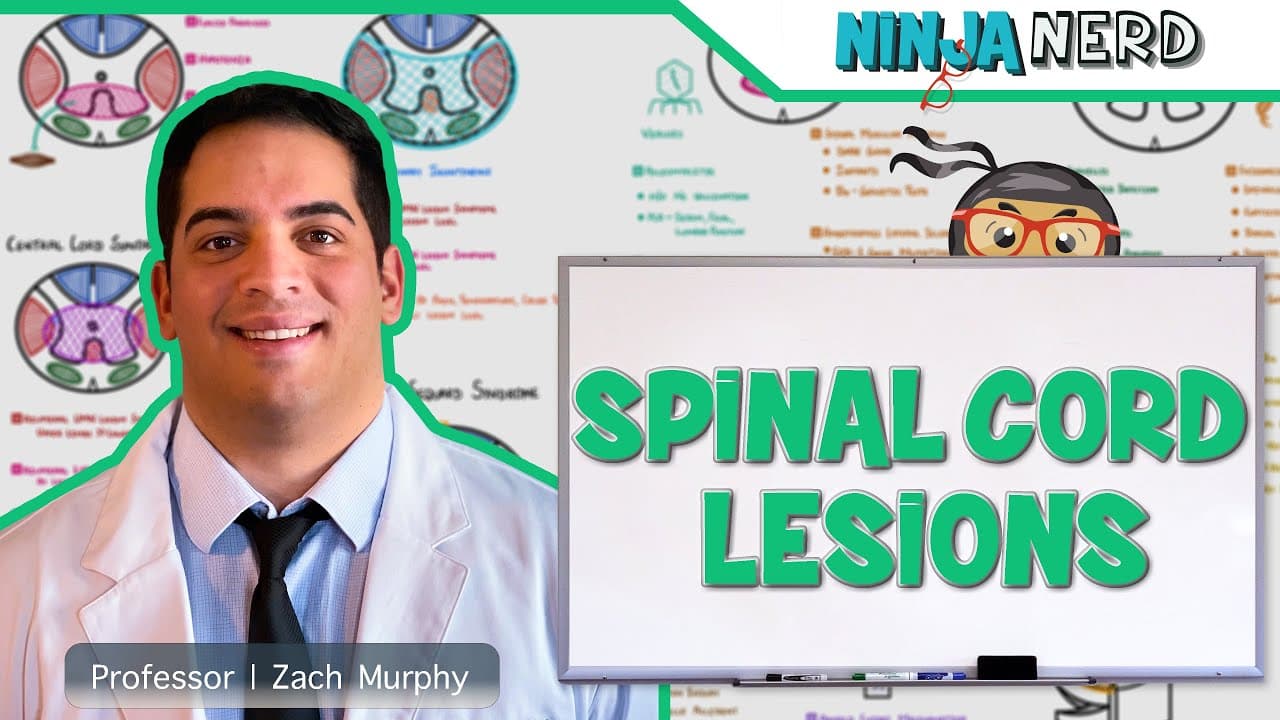
How to identify anterior, posterior, central cord syndromes
TL;DR
Anterior cord syndrome causes bilateral motor and pain loss below the lesion with preserved vibration and proprioception. Posterior cord syndrome mainly impairs proprioception and vibration while motor and pain pathways are often spared. Central cord syndrome shows greater upper limb weakness than lower, with variable sensory deficits and possible Horner syndrome.
Transcript
all right ninja nerds in this video today we are going to talk about spinal cord lesions both incomplete spinal cord lesions and complete spinal cord lesions so let's go and get started all right engineer so what we got to do first is the tougher aspects of spinal cord lesions is the incomplete spinal cord lesions they can be a little bit trickier ... Read More
Key Insights
- Anterior horn lesions damage lower motor neurons leading to flaccid paralysis and hypotonia at the affected level.
- Lower motor neuron signs include fasciculations and fibrillations on EMG, along with decreased deep tendon reflexes at the lesion level.
- Complete spinal cord lesions cause bilateral loss of motor, sensory, and autonomic functions below the injury level.
- Central cord syndrome commonly involves the cervical region and may spare some motor and sensory pathways depending on tract involvement.
- Bilateral upper motor neuron signs can occur in central cord syndrome when corticospinal tracts are affected on both sides.
- Horner syndrome can accompany central cord syndrome due to disruption of descending autonomic fibers in cervical to thoracic regions.
- Spinothalamic tract involvement in anterior white commissure can lead to loss of pain and temperature sensation near the lesion.
- Differentiating cord syndromes relies on pattern of motor loss, sensory modalities affected, and the spinal levels involved.
- More videos from this channel:
- More from this channel: Ninja Nerd
Install to Summarize YouTube Videos and Get Transcripts
Explore YouTube Video Summarizer or Get YouTube Transcript Extractor
Questions & Answers
Q: What is anterior cord syndrome and what functions are lost below the lesion?
Anterior cord syndrome involves damage to the anterior gray horn and surrounding pathways, resulting in bilateral motor paralysis and loss of pain and temperature sensation below the lesion, while vibration and proprioception are often spared. This pattern helps localize injury to the anterior spinal cord structures and dysfunction of the corticospinal and spinothalamic pathways with preserved dorsal column modalities.
Q: How does posterior cord syndrome typically present?
Posterior cord syndrome presents with impaired proprioception and vibration sense due to damage to the dorsal columns, while motor function and pain pathways may be preserved. This creates a distinct deficit profile where patients have coordination and sensory position sense issues but retain voluntary movement and pain perception.
Q: What deficits are expected in central cord syndrome?
Central cord syndrome usually shows greater motor weakness in the upper extremities than the lower extremities, with variable sensory deficits. It often involves cervical region injury and may involve autonomic signs such as Horner syndrome depending on tract involvement of descending autonomic fibers.
Q: What characterizes Brown-Séquard syndrome?
Brown-Séquard syndrome results from a hemisection of the spinal cord, leading to ipsilateral motor loss and proprioceptive loss below the lesion along with contralateral pain and temperature loss due to disruption of the corticospinal tract and spinothalamic tract on opposite sides, respectively, with preserved modalities on other pathways.
Q: How can Horner syndrome appear in spinal cord lesions?
Horner syndrome can appear when cervical to thoracic lesions affect descending autonomic fibers. It presents as ptosis, meiosis, and anhidrosis on the affected side, reflecting disruption of sympathetic pathways that travel within the spinal cord and adjacent structures during injury.
Q: What is the role of the anterior white commissure in sensory loss?
The anterior white commissure carries pain, temperature, crude touch, and pressure signals across the midline. Damage here can produce loss of these sensations at and around the level of the lesion, contributing to the distinctive loss pattern seen in certain spinal cord injuries.
Q: How does an incomplete spinal cord lesion differ from a complete one?
Incomplete spinal cord lesions spare some functions on at least one side or modality, so there may be partial sensory or motor loss rather than total bilateral loss below the lesion. In contrast, complete lesions result in bilateral loss of motor and sensory function below the lesion with autonomic deficits.
Q: What are the common tract associations you should review for lesion localization?
Key tract associations include the corticospinal tract for motor control, dorsal columns for proprioception and vibration, the spinothalamic tract for pain and temperature, and descending autonomic fibers that may influence Horner syndrome. Understanding their somatotopic arrangement helps localize the lesion and predict deficit patterns.
Summary & Key Takeaways
-
Anterior cord syndrome produces bilateral motor paralysis and loss of pain and temperature below the lesion, with spared vibration and proprioception, guiding localization to anterior gray and related pathways.
-
Posterior cord syndrome mainly disrupts dorsal columns affecting proprioception and vibration sense, while motor and pain pathways may remain intact, helping distinguish it from other cord injuries.
-
Central cord syndrome is characterized by greater upper extremity weakness, often due to cervical involvement, with variable sensory deficits and potential autonomic signs like Horner syndrome, reflecting selective tract involvement.
Read in Other Languages (beta)
Share This Summary 📚
Summarize YouTube Videos and Get Video Transcripts with 1-Click
Try YouTube Summary with ChatGPT & Claude or YouTube Transcript Generator
Explore More Summaries from Ninja Nerd 📚
Summarize YouTube Videos and Get Video Transcripts with 1-Click
Try YouTube Summary with ChatGPT & Claude or YouTube Transcript Generator