How to identify brain lobes and key landmarks
TL;DR
The central sulcus separates the frontal and parietal lobes, while the parieto-occipital sulcus marks the boundary with the occipital lobe. The lateral sulcus separates the temporal lobe from the parietal lobe, and the insula lies beneath the temporal lobe. The primary motor and somatosensory cortices sit near the central sulcus, and the hippocampus is linked to memory.
Transcript
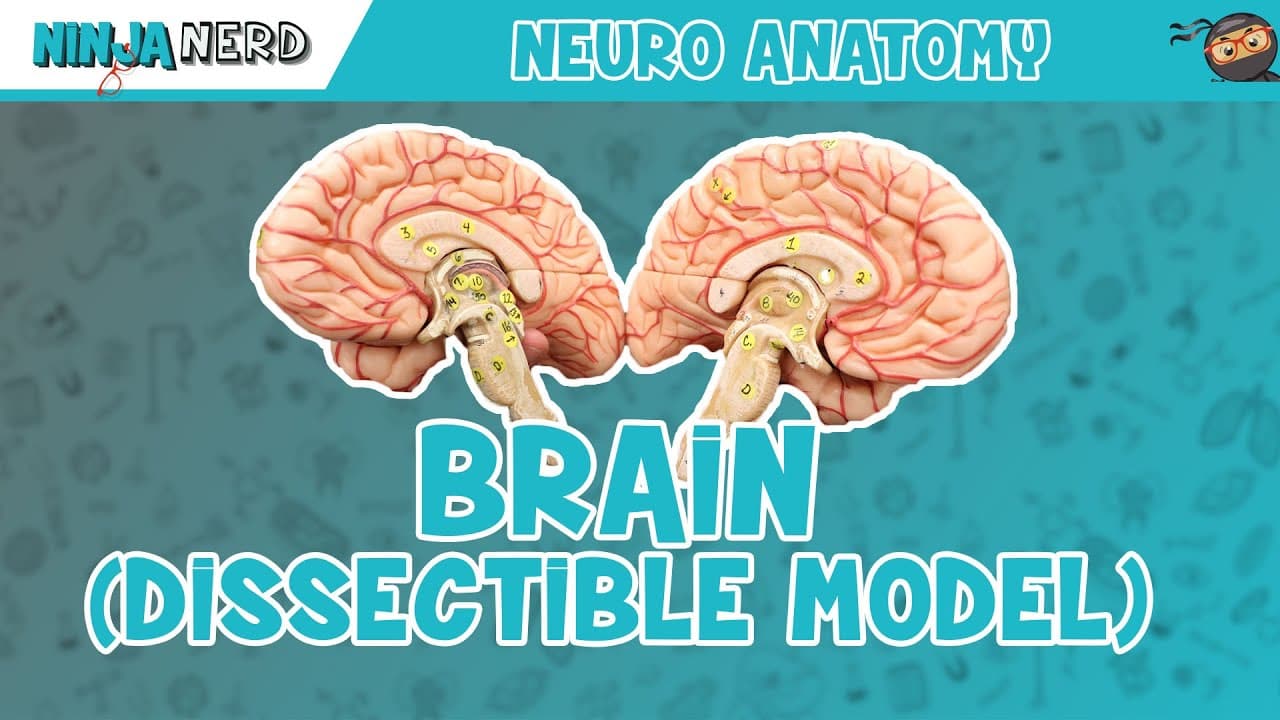
All right, ninja nerds, what we're gonna do in this video is we're gonna take a look here at the brain. So if you look here, we have the outer, uh, part here, which is the outer gray matter. This is actually the cerebrum, or they call it the telencephalon. And so the cerebrum is this top part of the brain up here, right? And it was derived from the... Read More
Key Insights
- The longitudinal fissure separates the two cerebral hemispheres.
- The central sulcus divides the frontal and parietal lobes.
- The postcentral gyrus houses the primary somatosensory cortex.
- The precentral gyrus is the primary motor cortex.
- The premotor cortex lies in front of the primary motor cortex.
- The parieto-occipital sulcus marks the boundary between parietal and occipital lobes.
- The lateral sulcus separates the temporal lobe from the parietal lobe.
- The insula is a hidden lobe beneath the lateral sulcus.
- More videos from this channel:
- More from this channel: Ninja Nerd
Install to Summarize YouTube Videos and Get Transcripts
Explore YouTube Video Summarizer or Get YouTube Transcript Extractor
Questions & Answers
Q: What is the primary landmark that separates the frontal and parietal lobes?
The central sulcus is the main landmark that separates the frontal lobe from the parietal lobe. It runs from near the top of the brain and continues along the lateral surface, creating a clear boundary between these two major regions. This landmark helps identify functional areas such as the primary motor cortex and primary somatosensory cortex. It is essential for orienting dissections and understanding cortical localization.
Q: Which sulcus marks the boundary between the parietal and occipital lobes?
The parieto-occipital sulcus marks the boundary between the parietal and occipital lobes. It helps outline the extent of the parietal lobe from the central sulcus to this separator, and then delineates the occipital lobe behind it. This sulcus is a key guide in neuroanatomy for differentiating sensory processing areas from visual processing regions.
Q: Where is the insula located in relation to the lateral sulcus?
The insula, or Island of Reil, lies deep within the brain and is separated from the outer cortex by the lateral sulcus. It is not readily visible on the surface and requires dissection to reveal its position beneath the temporal lobe. The insula is commonly described as a fifth lobe with roles in diverse functions.
Q: What is the function of the postcentral gyrus?
The postcentral gyrus is the location of the primary somatosensory cortex, responsible for processing sensory information from the body including touch, proprioception, temperature, and pain. It sits just behind the central sulcus and is crucial for mapping bodily sensations to specific cortical regions, enabling accurate perception and response to bodily stimuli.
Q: What is the function of the precentral gyrus?
The precentral gyrus houses the primary motor cortex, which governs voluntary control of skeletal muscles. Located in front of the central sulcus, it coordinates motor commands across the body. Its activity is essential for initiating and planning voluntary movements, and it sits adjacent to the premotor cortex which assists in motor preparation.
Q: What structure separates the two cerebral hemispheres and what protects it?
The longitudinal fissure separates the two cerebral hemispheres. Within this fissure, the falx cerebri, a dural septum, dips into the space to help protect cerebral vessels and preserve vascular compartments. This anatomical arrangement supports stable blood flow and structural integrity during brain activity and movements.
Q: What characterizes gray matter versus white matter in the cerebral cortex?
Gray matter consists of unmyelinated cell bodies forming the cerebral cortex, giving it a gray appearance. White matter lies beneath and contains myelinated axons that connect different cortical regions and deeper brain structures. The distinction underpins how information travels within the brain, with gray matter handling processing and white matter enabling communication between regions.
Q: Which structure is associated with memory and appears in the hippocampal region?
The hippocampus is associated with memory formation and retrieval. It is located in the medial temporal lobe region and is involved in converting sensory experiences into short-term and long-term memories. This deep structure plays a key role in spatial navigation and memory consolidation, linking perception to memory storage.
Summary & Key Takeaways
-
The brain is divided into lobes with clear landmarks. The central sulcus, parieto-occipital sulcus, and lateral sulcus help define frontal, parietal, temporal, and occipital regions. The insula remains hidden beneath the lateral sulcus, and deep structures like the hippocampus relate to memory processing. The cerebral cortex consists of gray matter and white matter tracks.
-
Surface gyri increase cortical area, while sulci create folds. The cerebrum, cerebellum, and brainstem form the major divisions, with the falx cerebri providing venous protection inside the longitudinal fissure. The primary motor and somatosensory areas sit anterior and posterior to the central sulcus respectively, guiding voluntary movement and sensation.
-
A dissectible brain model helps visualize 3D relationships among lobes, sulci, gyri, and deep structures, aiding understanding of anatomy and clinical relevance. This approach emphasizes spatial orientation and functional localization, from cortex to ventricles and choroid plexus, linking structure with function for better retention.
Read in Other Languages (beta)
Share This Summary 📚
Summarize YouTube Videos and Get Video Transcripts with 1-Click
Try YouTube Summary with ChatGPT & Claude or YouTube Transcript Generator
Explore More Summaries from Ninja Nerd 📚






Summarize YouTube Videos and Get Video Transcripts with 1-Click
Try YouTube Summary with ChatGPT & Claude or YouTube Transcript Generator