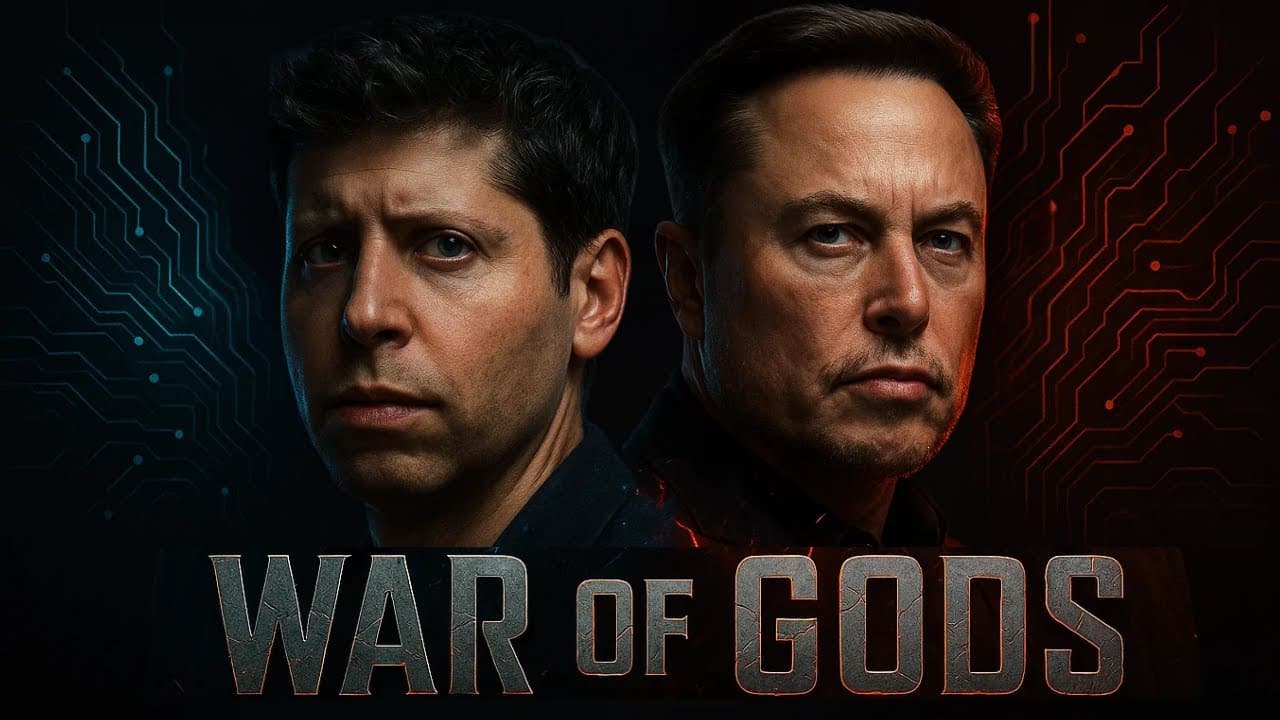
How OpenAI Surpassed Google in AI: Altman’s Strategy
TL;DR
OpenAI beat Google by turning research into rapid action, shipping public tools, and leveraging transformer breakthroughs. While Google feared risks and held back from launching a consumer AI, OpenAI built on existing research and pushed ChatGPT to the public, gaining a decisive early lead in practical AI deployment.
Transcript
Yeah, that's an exciting move. The year is 2016 and the world is shocked. This event wasn't unfolding at a rocket launch or in a sports stadium. It was happening on an ancient Chinese game named Go. Beating a professional player at Go is a long-standing challenge of artificial intelligence. 18-year-old South Korean player Lee Sadal conceded defeat ... Read More
Key Insights
- Go is far more complex than chess, with far more possible games than atoms in the universe. This complexity made human victory over Go with AI historically improbable.
- AlphaGo’s 2016 victory demonstrated a major leap in AI capability and reshaped how the industry viewed machine intelligence in complex tasks.
- Google DeepMind’s approach relied on research and safety, prioritizing trust and potential regulatory concerns over shipping a consumer AI product.
- Transformer architecture, introduced around 2017, solves long-range memory problems by processing all words in a sentence together, dramatically improving language understanding.
- The transformer breakthrough allowed AI to retain context and relationships within text, enabling more accurate and meaningful outputs across tasks.
- OpenAI’s Sam Altman read research papers carefully and chose action over caution, building an AI product rapidly on top of existing research.
- ChatGPT’s public release in November 2022 created a surge of interest and set a new standard for accessible conversational AI and user engagement.
- Google faced existential risk from a perfect AI that could disrupt search and revenue, leading to conservative moves rather than bold product launches
- More videos from this channel:
- More from this channel: Think School
Install to Summarize YouTube Videos and Get Transcripts
Explore YouTube Video Summarizer or Get YouTube Transcript Extractor
Questions & Answers
Q: A real search query question about the video (e.g. 'How to...', 'What is...', 'Why does...', 'When should...'). Question 1
What breakthrough enabled AI to understand language by reading all words at once instead of one by one, and why did this matter for later products? The transformer architecture introduced in 2017 processes all words in a sentence together, maintaining context and relationships across the text. This eliminates the memory loss of earlier models and allows for more coherent, context-aware outputs, which is foundational for advanced language models and products like conversational AI tools.
Q: Question 2
Why did Google hesitate to ship a consumer AI product despite vast funding and talent, and how did this contrast with OpenAI’s approach? Google prioritized trust, safety, and regulatory risk given its massive ad revenue and user base, fearing mistakes could lead to crisis for a $500 billion empire. OpenAI chose rapid experimentation, public testing, and practical deployment, which catalyzed a user-driven feedback loop and faster iteration.
Q: Question 3
What role did Sam Altman play in the AI race, according to the video, and how did his actions differ from Google’s strategy? Altman conducted thorough literature review on AI research but, crucially, acted quickly to implement and ship products. He built on transformer insights and launched ChatGPT to the public in November 2022, creating momentum while Google remained cautious.
Q: Question 4
How did the public release of ChatGPT influence the AI landscape, based on the transcript, and what implications did it have for competition with Google? The public release sparked massive interest in general AI tools, effectively creating an iPhone moment for AI and forcing competitors to respond rapidly. It shifted expectations toward consumer-accessible AI and pressured Google to accelerate its own productization.
Q: Question 5
What is the paradox in Google’s strategy after the transformer breakthrough and AlphaGo victory, as described in the video? Google had the resources and research but chose not to ship a transformative consumer AI product, risking losing leadership to OpenAI. The paradox is that extensive capability and fear of missteps can impede market leadership when rapid deployment could have preserved dominance.
Q: Question 6
What does the video imply about the importance of shipping versus research in AI development, and how should a company balance it? The video suggests shipping public, usable AI tools can outpace purely theoretical progress, especially when user feedback guides improvement. A balanced approach combines deep research with risk-managed deployment to capture real-world utility while addressing safety concerns.
Q: Question 7
How did transformer-based models change the way AI handles context and memory, according to the video, and why is that significant for AI tools? Transformer models read all words in parallel, enabling the system to link subjects, actions, and references across the entire input. This leads to better understanding, longer coherent outputs, and the ability to handle longer inputs, which is essential for sophisticated AI assistants.
Q: Question 8
What is the overarching narrative about the AI battle between Altman and Google as presented in the video, and what lessons does it offer about strategy and timing? The narrative frames OpenAI’s timely action and focus on public-facing products as decisive, while Google’s cautious approach is portrayed as a strategic disadvantage. The lesson emphasizes the value of action, rapid iteration, and user-focused products in maintaining leadership in fast-moving AI fields.
Summary & Key Takeaways
-
OpenAI capitalized on rapid execution and public deployment to gain an early lead in consumer AI. The team studied transformer research and turned it into a usable product despite OpenAI having less funding than Google. This shift from theory to practice defined the competitive edge.
-
Google hesitated to ship a disruptive AI product due to trust and risk concerns for a $500 billion empire. Their focus on research and caution prevented them from delivering a groundbreaking consumer tool like ChatGPT, allowing OpenAI to capture user attention and market momentum.
-
The breakthrough in transformer architecture enabled AI models to understand context by reading all words simultaneously, eliminating early memory limitations and enabling more coherent outputs. This technical leap underpins the shift from theoretical capabilities to scalable, user-facing products.
Read in Other Languages (beta)
Share This Summary 📚
Summarize YouTube Videos and Get Video Transcripts with 1-Click
Try YouTube Summary with ChatGPT & Claude or YouTube Transcript Generator
Explore More Summaries from Think School 📚






Summarize YouTube Videos and Get Video Transcripts with 1-Click
Try YouTube Summary with ChatGPT & Claude or YouTube Transcript Generator