How to avoid the middle income trap in India
TL;DR
The middle income trap threatens India if GDP growth relies on cheap labor and current demand never broadens. To prevent stagnation, India must expand sources of demand, invest in infrastructure, education, and productivity, and learn from successful economies that moved up the value chain. Diversifying growth reduces the risk of stagnation and poverty persistence.
Transcript
india has now surpassed Japan to become the world's fourth fourth largest economy in the world it is now worth more than $4 trillion japan has Hi everybody india just hit the $4 trillion GDP mark india is poised to become the world's fourth fourth fourth fourth largest economy in the world modi guarantee guarantee guarantee we've raced past the Uni... Read More
Key Insights
- The middle income trap is a real risk if growth stalls after initial income gains.
- A single focus on cheap labor can fail as wages rise and cheaper competitors appear.
- Sustained growth requires moving from assembly to design and innovation.
- Education alone is not enough without meaningful opportunities and jobs for graduates.
- Infrastructure and business environment reforms unlock higher value industries.
- Learning from Korea shows the importance of sequential development and investment in people.
- Malaysia’s experience warns that relying on cheap labor without advancing productivity leads to stagnation.
- Policy focus should be on expanding demand and reducing inequality to maintain momentum.
- More videos from this channel:
- More from this channel: Think School
Install to Summarize YouTube Videos and Get Transcripts
Explore YouTube Video Summarizer or Get YouTube Transcript Extractor
Questions & Answers
Q: What is the middle income trap and why does it matter for India?
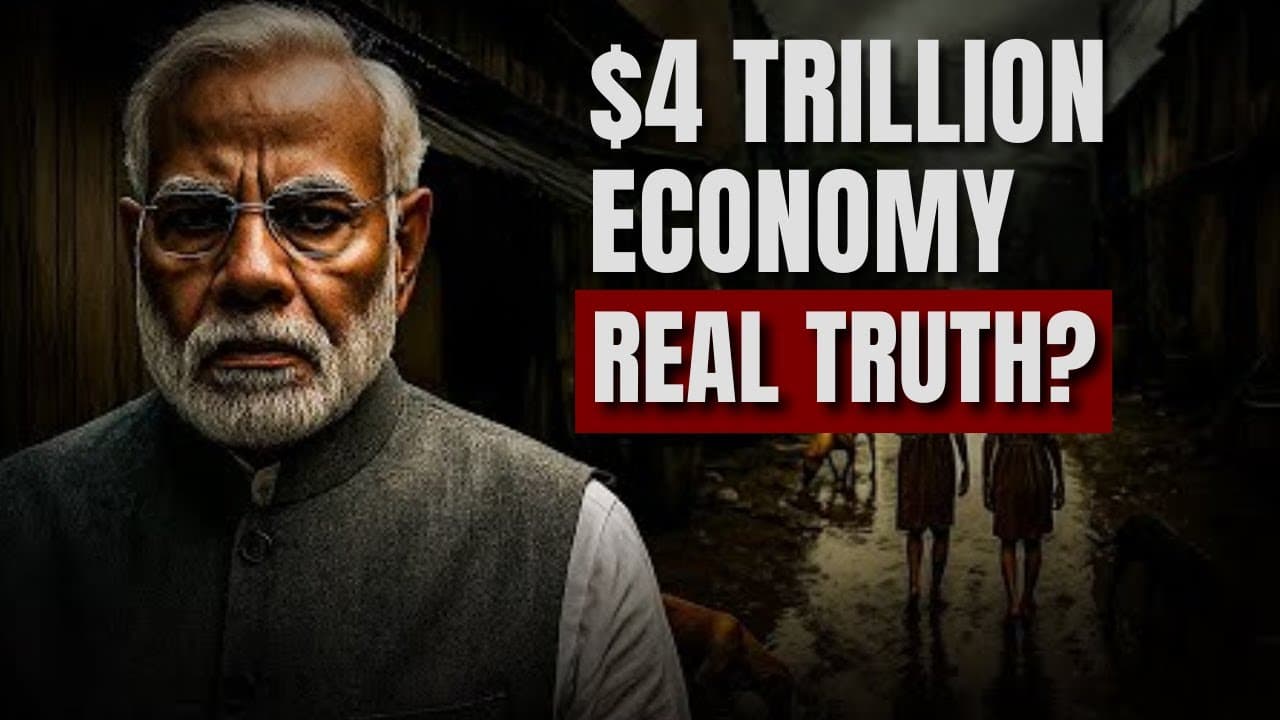
The middle income trap is a situation where a country reaches a middle level of income but cannot sustain growth to become high income. This matters for India because despite a $4 trillion GDP milestone, two Indias exist on the same street: one prospering and another still struggling with basic needs. Without broadening the sources of demand and moving up the value chain, India risks stagnation and persistent poverty for many citizens.
Q: Why does the video compare India with other economies like Malaysia and South Korea?
The video uses Malaysia and South Korea as cautionary and aspirational benchmarks. Malaysia grew rapidly on cheap labor but later faced stagnation as wages rose and innovation lagged, illustrating the trap of relying on low costs alone. South Korea, by contrast, shows a pathway from labor to design and innovation, suggesting how India could diversify to sustain growth.
Q: What are the three pillars Malaysia used to grow, and what happened afterwards?
Malaysia invested in infrastructure, education, and ease of doing business with tax breaks and free zones. This lifted income initially, but over time wages rose and Malaysia failed to move beyond assembly and cheap labor, leading to a stagnation risk as other countries offered cheaper production and innovation did not keep pace.
Q: What lesson does the video draw from South Korea’s development path?
South Korea’s path shows a generational shift strategy: the first generation focused on workers in factories, the second on design and advanced manufacturing, and the third on invention and innovation. This staged approach helped Korea climb from poverty to high income and escape the middle income trap by continuously upgrading capabilities and value creation.
Q: What role does education play in escaping the trap according to the video?
Education is essential to raise literacy and skills, but it must be coupled with meaningful opportunities. The video notes that Malaysia produced graduates with degrees but few job matches, which undermined growth. For India, education needs to translate into innovation, design, and higher value work to sustain momentum and reduce underemployment.
Q: How does the video describe the current Indian economy’s two Indias problem?
The video describes one India that celebrates the GDP milestone and another that struggles with basic needs like water, toilets, and affordable living. This dual reality highlights that GDP alone does not measure welfare; without inclusive growth and better distribution, a rising aggregate economy can coexist with widespread poverty.
Q: What does the World Bank’s analysis indicate about India’s future trajectory?
The World Bank’s perspective, as discussed in the video, warns that without increasing demand sources, infrastructure, and higher value industries, India risks stalling after initial growth. The implication is that policy should focus on avoiding the middle income trap by scaling up productivity, improving education quality, and fostering innovation rather than relying on low-cost manufacturing alone.
Q: What actions are suggested to fix the incomplete story of India’s economy?
To fix the incomplete story, the video recommends expanding infrastructure investment, upgrading education to align with industry needs, improving ease of doing business further, and creating policy environments that support high value exports and brands. The core idea is to shift from cheap labor to innovation, design, and scalable domestic demand to sustain long-term growth.
Summary & Key Takeaways
-
India faces a risk of becoming a middle income country with rising poverty if it does not diversify growth, despite hitting a $4 trillion GDP milestone. The video argues that one India flourishing financially and another living in poverty co exist and must be addressed through structural reform. The World Bank guided lesson highlights Malaysia and Korea as mirrors for reform and long term strategy.
-
The analysis compares Malaysia’s reliance on cheap labor and its later decline as wages rose, stressing the need to move up the value chain through innovation and education. South Korea is presented as a model of staged development with a focus on workers, then designers, then innovators to escape the trap.
-
Key recommendations include increasing infrastructure investment, improving education quality and relevance, and creating environments that support higher value industries and brands rather than low cost production alone.
Read in Other Languages (beta)
Share This Summary 📚
Summarize YouTube Videos and Get Video Transcripts with 1-Click
Try YouTube Summary with ChatGPT & Claude or YouTube Transcript Generator
Explore More Summaries from Think School 📚






Summarize YouTube Videos and Get Video Transcripts with 1-Click
Try YouTube Summary with ChatGPT & Claude or YouTube Transcript Generator