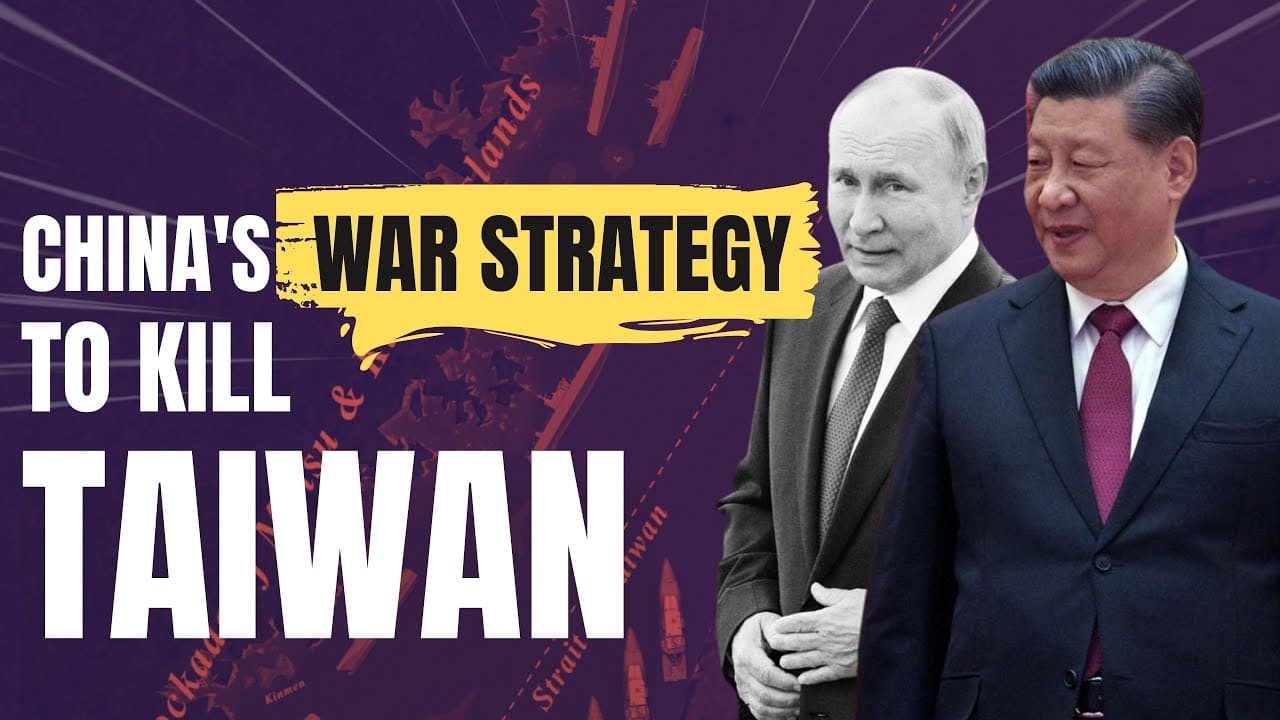
How Could China Attempt to Take Taiwan?
TL;DR
China could first isolate Taiwan’s nearby islands, then impose a wider air and maritime quarantine designed to cut communications, energy imports, trade, and allied access. If Taiwan resisted and American and Japanese forces intervened, competing blockades, missile strikes, economic sanctions, and attacks on military bases could escalate the conflict into a wider war.
Transcript
the chinese president xi jinping delivering a stern warning to president biden today as tensions escalate quickly over taiwan china is using its unprecedented military drills to prepare for a full-scale invasion of the self-governing island are you willing to get involved militarily to defend taiwan if it comes to that yes you are that's the commit... Read More
Key Insights
- China’s initial strategy could focus on intimidation rather than a direct invasion, because quickly forcing Taiwan to surrender would reduce military losses and limit exposure to sanctions or American intervention while China was already facing pressure from COVID and its real estate bubble.
- The Matsu and Kinmen islands are vulnerable pressure points because they lie only nine kilometers and six kilometers from mainland China, respectively. Surrounding these islands could isolate their coast guard units, military garrisons, and civilian populations while creating political pressure inside Taiwan.
- A quarantine strategy works by surrounding Taiwan and controlling its adjacent waters and airspace so ships and aircraft cannot enter or leave. China could then demand surrender while avoiding the immediate costs associated with launching a full amphibious assault against Taiwan itself.
- Taiwan’s military disadvantage is presented as substantial because China has ten times more ground forces, eight times more naval destroyers, and thirty times more submarines. The transcript also states that China possesses the world’s largest naval fleet, totaling 355 ships.
- Taiwan’s undersea cables are critical vulnerabilities because approximately 95 percent of its data and voice traffic travels through fiber-optic connections across the seabed. Cutting these cables could disrupt civilian communications as well as coordination within Taiwan’s armed forces during a blockade.
- Taiwan’s energy dependence could make a prolonged quarantine damaging because about 98 percent of its energy was imported as of 2020. Coal, crude oil, and petroleum products arrived from Australia, Qatar, Indonesia, and Russia, making maritime access essential to continued supply.
- Taiwan’s oil stockpile could provide time for resistance because it was reported as sufficient for 138 days. That reserve could allow Taiwan to delay surrender while waiting for American and Japanese forces to arrive and attempt to reopen access through the blockade.
- A direct clash could expand through missile strikes, attacks on military bases, economic sanctions, and competing efforts to choke energy and trade routes. The Strait of Malacca is identified as China’s critical chokepoint because more than 50 percent of its oil and trade shipments pass through it.
Install to Summarize YouTube Videos and Get Transcripts
Explore YouTube Video Summarizer or Get YouTube Transcript Extractor
Questions & Answers
Q: How could China begin an attempt to take Taiwan?
China could begin by avoiding an immediate attack on Taiwan’s main island and instead surrounding the nearby Matsu and Kinmen islands. Naval vessels, submarines, fishing boats, sand dredgers, and paramilitary ships could isolate these territories. Fighter aircraft could patrol the Taiwan Strait, while Beijing restricted flights and threatened to attack Taiwanese forces crossing the median line, creating pressure for surrender or negotiations.
Q: Why are the Matsu and Kinmen islands strategically vulnerable?
The Matsu and Kinmen islands are strategically vulnerable because they are extremely close to mainland China. Matsu is nine kilometers away, while Kinmen is six kilometers away. Their populations, including 13,500 people on Matsu and 140,000 on Kinmen, could become leverage. A Chinese blockade could isolate their coast guard and military garrisons while increasing pressure on Taiwan’s government from concerned families and citizens.
Q: What is China’s proposed quarantine strategy against Taiwan?
The proposed quarantine strategy would use China’s naval fleet to surround Taiwan and establish control over the waters and airspace around it. Ships and aircraft would be prevented from entering or leaving without Chinese approval. The purpose would be to separate Taiwan from allied assistance, stop trade and energy deliveries, disrupt communications, and compel surrender before a costly direct invasion became necessary.
Q: How could a blockade disrupt Taiwan’s communications?
A blockade could disrupt Taiwan’s communications by targeting the fiber-optic cables running across the seabed. The transcript states that approximately 95 percent of Taiwan’s data and voice traffic travels through these lines to other parts of the world. Cutting them could interrupt civilian connectivity and interfere with military communications, making it harder for Taiwan to coordinate its defense or communicate with supporting allies.
Q: Why are energy imports a major weakness for Taiwan?
Energy imports are a major weakness because about 98 percent of Taiwan’s energy was imported as of 2020. The supplies included coal, crude oil, and petroleum products shipped from Australia, Qatar, Indonesia, and Russia. If China controlled Taiwan’s surrounding waters and stopped incoming vessels, these deliveries would cease, gradually weakening Taiwan even though the island was described as relatively self-sufficient in food.
Q: How long could Taiwan withstand an energy blockade?
Taiwan could continue resisting for some time because its oil stockpile was reported as sufficient for 138 days. This reserve would not remove the effects of a wider blockade, including lost trade and communications, but it could provide a window for Taiwan to avoid immediate surrender. During that period, American and Japanese forces could approach and attempt to break China’s surrounding naval barrier.
Q: How could the United States and Japan respond to a blockade?
The United States could accelerate deliveries of F-16 fighter jets, long-range anti-ship missiles, tanks, smart mines, and attack helicopters. Japan could move army and navy units toward its southern islands and prepare for amphibious landing operations. If allied forces reached Taiwan, their surface warships and submarines could attempt to break the blockade while launching attacks from locations including Guam and Australia.
Q: Why could a Taiwan conflict expand into a wider war?
A Taiwan conflict could widen if Chinese, American, Japanese, and Taiwanese forces exchanged missile and air strikes, attacked military bases, and sank opposing fleets. The United States and its allies could also impose sanctions and restrict China’s access through the Strait of Malacca. Continued escalation could disrupt semiconductor production, electronics shipments, automobile manufacturing, technology stocks, textile industries, and other international supply chains.
Summary & Key Takeaways
-
China’s least destructive opening strategy would be to surround the Matsu and Kinmen islands using naval vessels, submarines, fishing boats, sand dredgers, and paramilitary ships. Fighter patrols and flight restrictions would reinforce the pressure, potentially forcing Taiwan into negotiations or surrender before American military assistance could arrive.
-
If intimidation failed, China could impose a broader quarantine around Taiwan by controlling surrounding airspace and waters. The strategy would exploit Taiwan’s smaller armed forces, dependence on imported energy, and reliance on undersea communication cables. Taiwan could resist while using its oil stockpile to buy time for allied forces to approach.
-
American and Japanese intervention could produce a double blockade, air and missile exchanges, attacks on regional bases, and economic pressure against China’s trade routes. China might seek another ceasefire and negotiations before choosing between withdrawal and wider warfare, while disruptions spread through semiconductor, electronics, automobile, textile, and consumer-goods industries.
Read in Other Languages (beta)
Share This Summary 📚
Summarize YouTube Videos and Get Video Transcripts with 1-Click
Try YouTube Summary with ChatGPT & Claude or YouTube Transcript Generator
Explore More Summaries from Think School 📚




Summarize YouTube Videos and Get Video Transcripts with 1-Click
Try YouTube Summary with ChatGPT & Claude or YouTube Transcript Generator