How did Veeba become a top sauce brand in India
TL;DR
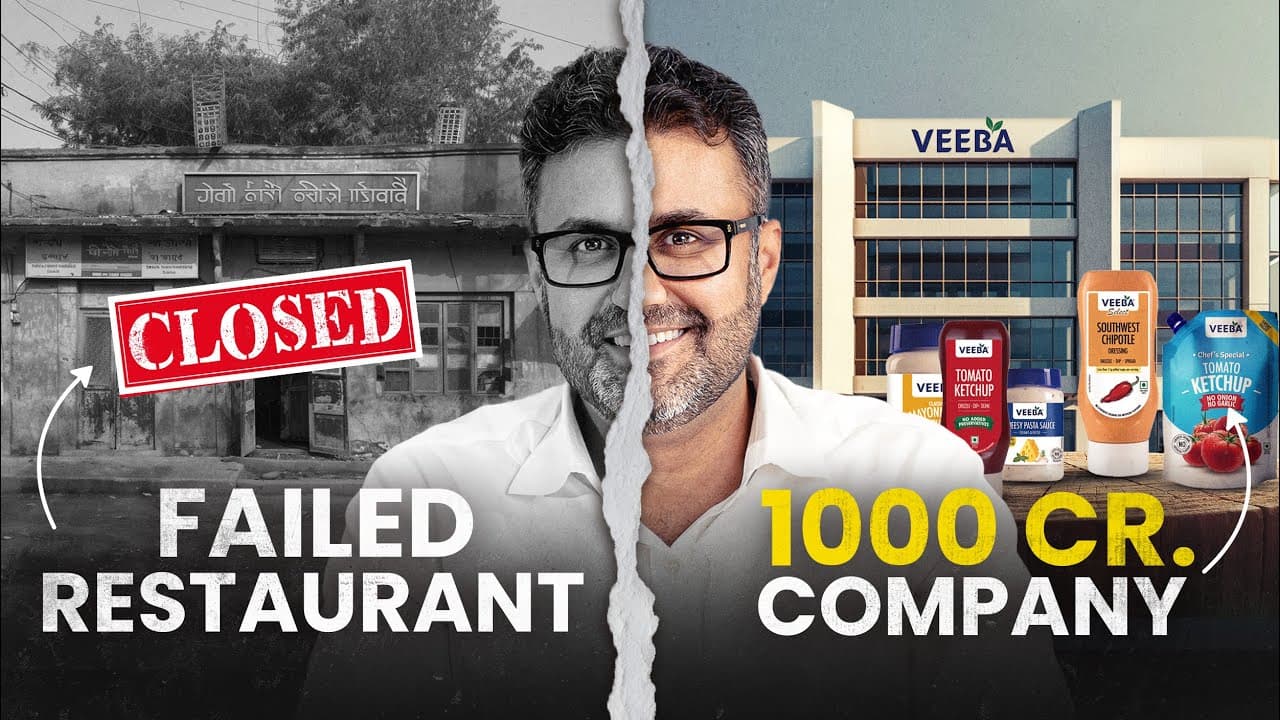
Viraj Bahl shifts from navy training to entrepreneurship, failing in a restaurant venture before building Veeba into a major sauce company. The interview covers lessons learned, distribution and manufacturing challenges, and strategies to scale from a single product to a nationwide pantry staple. It also highlights how Veeba competed with big players and what it takes to grow a food brand from scratch.
Transcript
so our first client was Domino's first client was Domino's yeah first how did you crack Domino's how did I crack dominoes nothing sexy be M from a failed restaurant business to now a 1,000 CR rup business vaj B who is the founder and MD of Viba there is ketchup on every burger that you eat which comes from Viba with 300 plus SK youth Viba has becom... Read More
Key Insights
- Veeba began as a response to a perceived gap in the market for Indian sauces and dips, driven by a creator with a background in operations and manufacturing.
- The key to Veeba’s growth is building a scalable model that can reach retailers and wholesalers through offline distribution channels.
- A critical lesson is that personal resilience and a willingness to learn from failures are essential when venturing into consumer food brands.
- Outsourcing and supply chain management are central to growing a food brand, balancing quality with cost efficiency.
- The founder emphasizes hands-on product development and continuous iteration to meet consumer taste preferences.
- Pricing strategy and market penetration are treated as ongoing challenges requiring market feedback and agile adjustments.
- Building a brand in a crowded market requires persistent storytelling and relationship-building with retailers and distributors.
- The business case study highlights the importance of long-term vision and the willingness to endure initial losses to achieve scale.
- More videos from this channel:
- More from this channel: Think School
Install to Summarize YouTube Videos and Get Transcripts
Explore YouTube Video Summarizer or Get YouTube Transcript Extractor
Questions & Answers
Q: How did Viraj transition from navy training to starting a sauce company
Viraj describes an early career path that included navy training and a period of education supported by a company, followed by work experience that led him to join and eventually lead a family business. After attempting to grow a restaurant chain and failing, he redirected his energy toward creating a sauce brand. He emphasizes learning from the restaurant setback and recognizing a market opportunity for sauces and dips, which inspired the shift toward starting Veeba.
Q: What was the initial venture before Veeba and why did it fail
The initial venture was a chain of Indian fast food restaurants with a product focus on a butter chicken pocket and accompanying sides. Despite a tasty offering and a strong product concept, the venture failed due to structural and strategic missteps in scaling the business, resulting in a conclusion that running a restaurant chain is a naked form of failure when the business model does not stay financially viable.
Q: How did the founder view competition from major brands
The founder notes Veeba’s growth occurred despite competition from large, established brands. The narrative highlights the challenge of entering a market dominated by giants and the need to differentiate through product quality, distribution strategy, and a commitment to building a scalable business model that can compete on availability and value.
Q: What strategies contributed to Veeba’s growth to a large revenue milestone
Strategic emphasis was placed on building a distribution network that reaches retailers and wholesalers, navigating manufacturing and outsourcing, and maintaining product quality through hands-on development. The approach included leveraging field learnings to refine pricing and market penetration while maintaining a focus on the consumer experience and expanding product categories gradually.
Q: What lessons did the founder emphasize from the initial failures
Key lessons include the importance of resilience, learning from failure, and staying committed to a long-term vision. The founder stresses not giving up after a setback, using the experience to sharpen strategies for market entry, distribution, and product development, and recognizing that sustainable growth requires both adaptability and disciplined execution.
Q: How important is product development in Veeba’s story
Product development is portrayed as central to Veeba’s success, with emphasis on continuous iteration to meet consumer taste preferences and to differentiate in a crowded market. The founder’s background as a product person helps explain why Veeba prioritizes quality, shelf stability, and scalable formulations suitable for mass distribution.
Q: What role does distribution play in building a food brand
Distribution is depicted as a critical pillar for scale, enabling Veeba to move from a niche product to nationwide availability. Building relationships with retailers and wholesalers, combined with efficient supply chain management, is presented as essential for achieving broad market reach and consistent product availability.
Q: What is the core message for aspiring food entrepreneurs
The core message is to pursue a clear market opportunity with a viable product, learn from early failures, and build a scalable distribution and manufacturing model. Persistence, practical learning, and a focus on delivering value to the consumer are highlighted as essential drivers for turning a small venture into a major brand.
Summary & Key Takeaways
-
Veeba’s founder Viraj Bahl narrates a transition from service to entrepreneurship, detailing early career moves and the pivotal decision to start a sauce company after a failed restaurant venture.
-
The discussion emphasizes practical paths to scale, including building distribution networks and outsourcing challenges, with emphasis on authentic, hands-on product development.
-
The episode reveals how Veeba navigated competition from established brands, and the mindset required to persist through initial setbacks and pursue growth to a multinational scale.
Read in Other Languages (beta)
Share This Summary 📚
Summarize YouTube Videos and Get Video Transcripts with 1-Click
Try YouTube Summary with ChatGPT & Claude or YouTube Transcript Generator
Explore More Summaries from Think School 📚






Summarize YouTube Videos and Get Video Transcripts with 1-Click
Try YouTube Summary with ChatGPT & Claude or YouTube Transcript Generator