How to Prepare for an AI Driven Future of Work
TL;DR
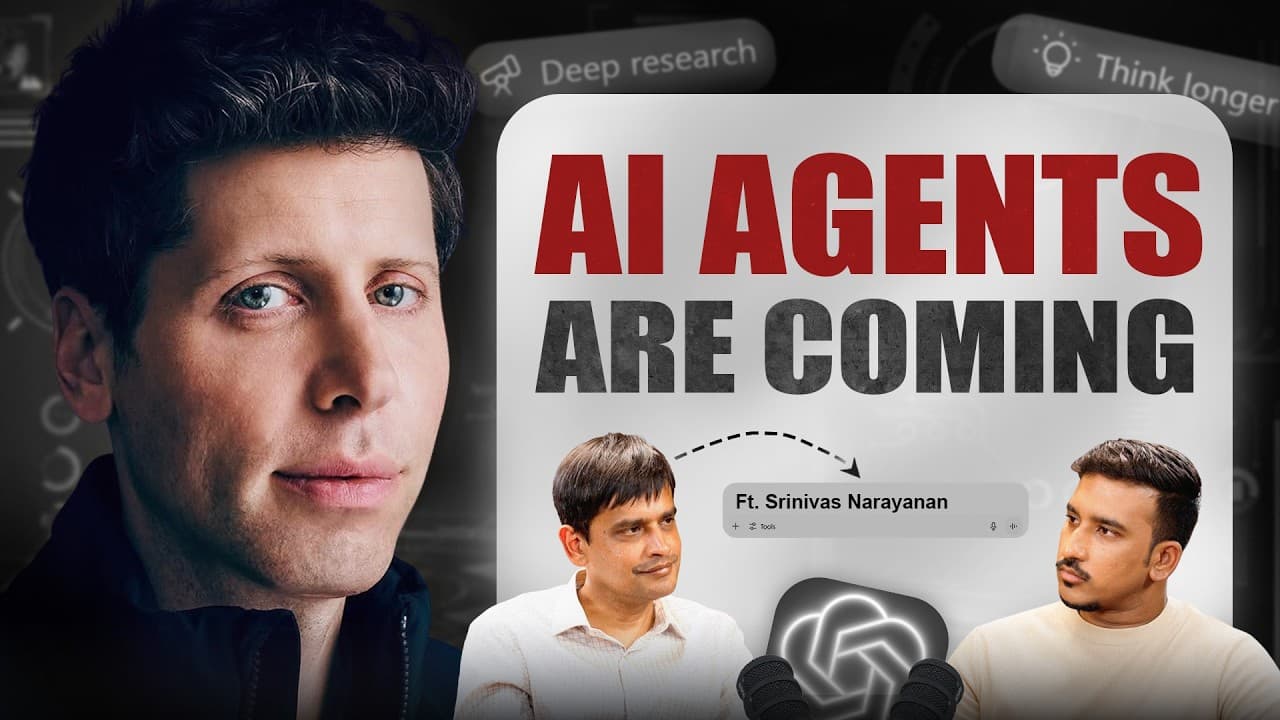
AI will redefine how we work by acting as reasoning assistants and scaling capabilities. OpenAI leadership emphasizes scaling and agentic AI, while engineers focus on safety and practical product design. This episode outlines what jobs may shift and what skills will stay relevant.
Transcript
So what's going to be the future of software engineers? Are they at threat? Uh Shimos, you've been working with Sam Alman for 2 years now. My question to you is what kind of leader is Sam Alman? Sam, welcoming the founder and CEO of Open AI. We do all of this because we believe the AI is going to be a technological and societal revolution. This is ... Read More
Key Insights
- AI agents are a core next step beyond chatbots, enabling more complex, multi-step tasks and reasoning over longer timelines.
- The key to OpenAI’s progress is a belief in scaling as a path to intelligence, supplemented by strong unique leadership and a high-caliber team.
- First principles thinking helps leaders like Sam Altman connect research directions to practical outcomes and risk management.
- Agentic AI requires robust safety and governance frameworks to align AI behavior with human values and goals.
- The pace of AI improvement is rapid, with new capabilities emerging every few months and driving shifts in how work is organized.
- Foundational models remain central, even as there is interest in smaller models and open weights, because large-scale pretraining provides broad capabilities.
- Product design at OpenAI combines user needs with engineering rigor to build tools like ChatGPT that solve real problems for teams.
- Leadership culture focuses on mission, incentives, and recruiting top talent to sustain long-term progress toward AGI.
- More videos from this channel:
- More from this channel: Think School
Install to Summarize YouTube Videos and Get Transcripts
Explore YouTube Video Summarizer or Get YouTube Transcript Extractor
Questions & Answers
Q: What is agentic AI and why is it a next step beyond chatbots?
Agentic AI refers to AI systems that can act with independence over longer timelines to achieve user goals, not just respond to prompts. It goes beyond chatbots by integrating reasoning, planning, and action within workflows, enabling more complex tasks to be automated and coordinated. This shift can transform how teams operate by taking on multi-step processes that previously required human oversight.
Q: How does OpenAI view scaling as a path to intelligence?
OpenAI believes that scaling—more data, more compute, and larger models—can drive significant gains in capability, sometimes even without new algorithms. This approach is paired with careful safety and governance to ensure that the benefits are realized while risks are managed. The idea is that scale unlocks emergent abilities that improve performance across tasks.
Q: What leadership traits does Sam Altman bring to OpenAI according to the interview?
Sam Altman is portrayed as highly visionary and ambitious, with a strong belief in scaling as a driver of progress. He is described as assembling a high-caliber team, inspiring a shared mission to develop AGI for humanity, and applying first principles thinking to connect research trends with practical outcomes and risk-aware strategies.
Q: Why is first principles thinking important for AI leadership?
First principles thinking helps leaders distill complex problems into fundamental truths, allowing them to reason from the ground up rather than relying on conventional wisdom. This approach enables spotting novel connections, evaluating risks, and formulating clear theses about the future of AI, which can guide experimental priorities and resource allocation.
Q: What does the interview say about the pace of AI advancement?
The discussion emphasizes a rapid pace of progress, with new AI systems and capabilities appearing at frequent intervals, often within months. This pace necessitates ongoing evaluation of safety, alignment, and practical deployment, as well as adaptation of product strategy to leverage emergent abilities responsibly.
Q: How might AI agents change job relevance over the next decade?
As AI agents handle more complex tasks and coordinate across tools and teams, some routine or data-heavy roles may decline while roles focusing on design, governance, and integration of AI into workflows could grow. The emphasis is on leveraging AI to augment human capabilities rather than replace them wholesale.
Q: What role do safety and governance play in scaling AI at OpenAI?
Safety and governance are treated as integral to scaling, ensuring that increased capabilities do not outpace our ability to manage risks. This includes testing at scale, developing policies for responsible use, and building systems that can be audited and controlled to prevent misuse while enabling productive deployment.
Q: What is the long term mission of OpenAI as described in the podcast?
OpenAI aims to build AGI that benefits all of humanity, pursuing ambitious research with a mission-driven culture. The interview frames this as a collective effort involving talented engineers, thoughtful leadership, and rigorous safety practices, all directed at ensuring AI advancements improve lives while mitigating potential harms.
Summary & Key Takeaways
-
A high level discussion frames how AI agents could shape work processes, emphasizing leadership vision and product strategy. The conversation presents a future where traditional roles evolve as AI becomes a more capable partner in problem solving and decision making.
-
Engineering culture at OpenAI is highlighted, with emphasis on assembling top talent and applying first principles thinking to pursue ambitious goals while balancing safety and scalability.
-
The episode surveys the next five years, describing the pace of AI development, how agents differ from chatbots, and the ongoing importance of foundational models and data scale in building useful tools.
Read in Other Languages (beta)
Share This Summary 📚
Summarize YouTube Videos and Get Video Transcripts with 1-Click
Try YouTube Summary with ChatGPT & Claude or YouTube Transcript Generator
Explore More Summaries from Think School 📚






Summarize YouTube Videos and Get Video Transcripts with 1-Click
Try YouTube Summary with ChatGPT & Claude or YouTube Transcript Generator