How Emirates stays profitable while rivals go bankrupt
TL;DR
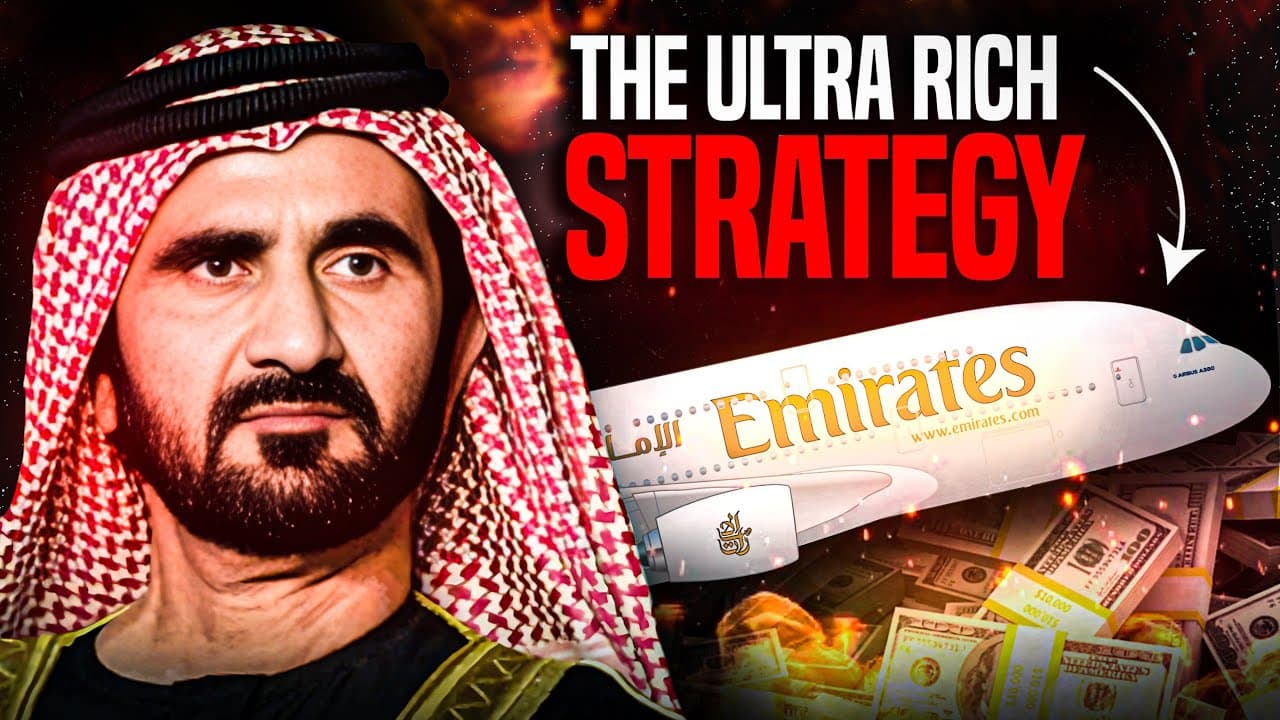
Emirates remains profitable due to intelligent cost management and strategic choices. They started with a wet lease, avoiding large upfront investments, and later expanded by identifying high demand routes. The airline also limits labor cost impact and avoids unions, which helps maintain stable operations even as fuel costs threaten peers.
Transcript
Emirates the Long Haul carrier known for its luxury Services has set new Abu Dhabi was built on a sandbed so it's never had a proper Harbor but that didn't matter much when there was nothing but a few dates to ship out and a few tins to ship in Emirates Remains the world's largest operator of the Airbus A380 the Emirates Airbus A380 can see over 60... Read More
Key Insights
- Emirates started with wet leasing to launch quickly without heavy upfront capital.
- Wet leasing provided three main benefits: rapid start, ability to test routes, and reduced initial investment.
- Emirates reached profitability within nine months of commencing operations due to disciplined execution.
- Labor cost as a percentage of revenue is low at Emirates, contributing to margin stability.
- Compared to European airlines, Emirates sees far fewer labor strikes, aided by non recognition of unions.
- Dubai’s strategic location enables Emirates to leverage hub and cargo advantages for growth.
- Emirates avoids government capital injections beyond an initial $10 million, ensuring financial discipline.
- The global airline industry is sensitive to oil price shifts, but Emirates mitigates this through strategy and operational choices.
- More videos from this channel:
- More from this channel: Think School
Install to Summarize YouTube Videos and Get Transcripts
Explore YouTube Video Summarizer or Get YouTube Transcript Extractor
Questions & Answers
Q: How did Emirates start its operations with minimal upfront investment?
Emirates started by entering a wet lease agreement with Pakistan International Airlines, using two aircraft and providing crew, maintenance, and insurance from the lessor. This allowed Emirates to begin operations within five months and test routes before committing to own aircraft. The approach reduced initial capital needs while enabling rapid market entry and service quality from day one.
Q: What role did wet leasing play in Emirates early strategy?
Wet leasing played a critical role by letting Emirates launch quickly without buying aircraft. It provided a ready fleet with crew and maintenance, while Emirates only had to cover fuel costs, airport fees, taxes, and other operating expenses. This arrangement enabled fast market entry, flexible testing of demand, and later, informed expansion into owned aircraft.
Q: Why is labor cost a key factor in Emirates profitability?
Labor cost as a percentage of operating revenue is notably lower for Emirates compared with peers, contributing to stronger margins. This lower cost base, combined with a lack of union-driven disruptions, helps Emirates maintain smoother operations and reliability, which translates into better profitability even when fuel prices are volatile.
Q: How does Dubai’s policy environment support Emirates?
Dubai’s environment supports Emirates by not recognizing trade unions, reducing potential strikes, and by hosting a diverse, multinational crew, which complicates collective action. Fixed term contracts and penalties for unauthorized strikes reinforce labor discipline, enabling stable operations and predictable financial performance despite industry volatility.
Q: What strategic advantage does Dubai provide for Emirates’ growth?
Dubai’s location makes it an optimal transit hub, being within an eight-hour flight of 60 percent of the world’s population. This strategic positioning supports route connectivity, refueling hubs, and cargo opportunities, enabling Emirates to connect Europe, India, Africa, and Asia efficiently and drive higher utilization of aircraft and networks.
Q: What evidence shows Emirates became profitable quickly after launch?
Emirates became profitable within nine months of starting operations and generated average revenue and profit figures prior to 2020, indicating strong early performance. This rapid profitability is tied to the leveraged use of testing routes, controlled costs, and the strategy of growing into profitable corridors rather than spreading resources thinly.
Q: How does Emirates compare to other carriers during industry volatility?
Compared to European carriers facing frequent labor strikes, Emirates experiences far fewer disruptions due to non recognition of unions and diversified staff. This reduces grounded operations and revenue losses from strikes, helping Emirates maintain steadier service levels and financial performance during market instability.
Q: What lessons can business leaders learn from Emirates’ approach?
Leaders can learn to reduce upfront risk by testing demand before heavy capital expenditures, maintain cost discipline, and utilize strategic hub positioning to unlock growth. Avoiding frequent disruption risks and leveraging a stable workforce model can protect profits amid external shocks such as fuel price volatility and global economic shifts.
Summary & Key Takeaways
-
Emirates built profitability by combining low upfront risk with careful route testing and selective expansion, enabling rapid profitability within months of starting operations.
-
The airline sustains margins by minimizing labor costs relative to revenue and by avoiding union-related disruptions common in European carriers.
-
Dubai’s role as a mid point hub and strict governance around capital injections supported a high quality, low risk growth model for Emirates.
Read in Other Languages (beta)
Share This Summary 📚
Summarize YouTube Videos and Get Video Transcripts with 1-Click
Try YouTube Summary with ChatGPT & Claude or YouTube Transcript Generator
Explore More Summaries from Think School 📚






Summarize YouTube Videos and Get Video Transcripts with 1-Click
Try YouTube Summary with ChatGPT & Claude or YouTube Transcript Generator