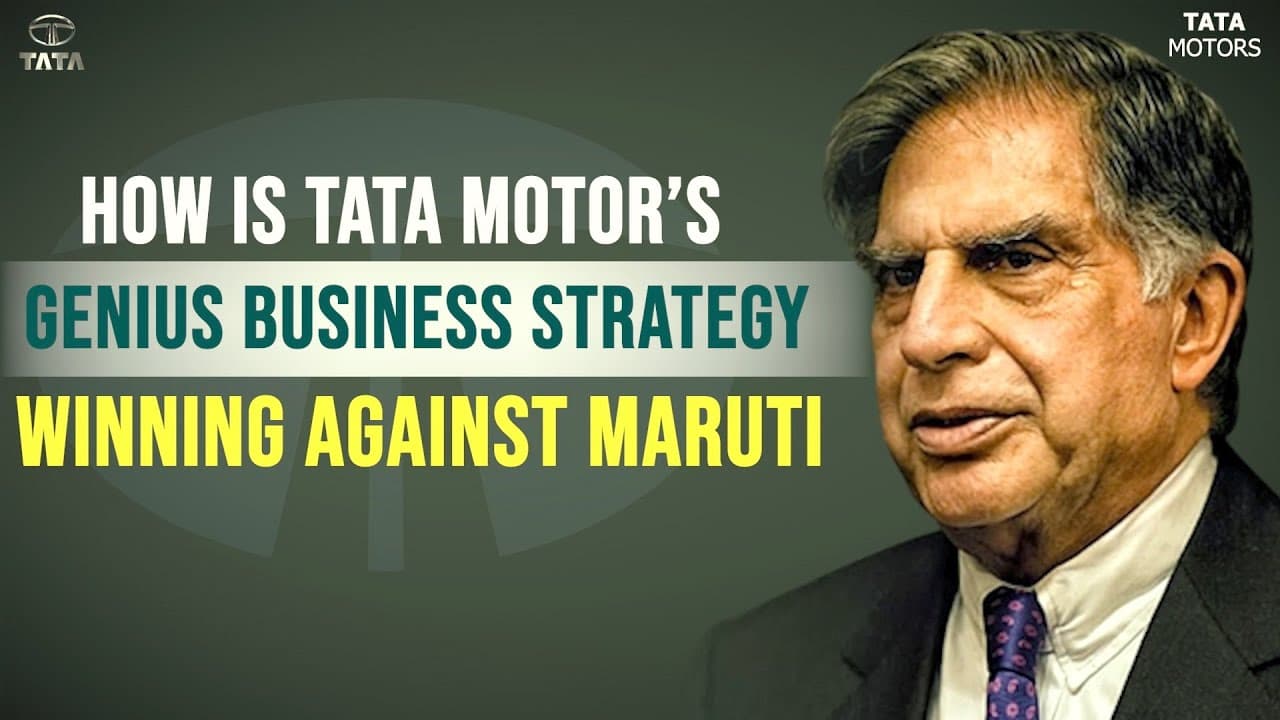
How did Tata Motors outrun Hyundai and Suzuki in India?
TL;DR
Tata Motors unlocked scale and efficiency through a two platform strategy and aggressive EV pivot, backed by group support. The result is lower costs, higher margins per car, and rapid market share growth from a history of losses to leadership in EVs and overall sales.
Transcript
tataa Motors reported highest ever annual sales at 3.7 lakh units which is a 67% increase from the last fiscal chair person of tataa suns n Chandra sharan highlighted how the demand in the overall passenger EV Market has risen the demand for our vehicles in each of our businesses remain strong we expect the performance to progressively improve thro... Read More
Key Insights
- Tata Motors shifted from six platforms to two main platforms, Alpha and Omega, dramatically increasing carryover parts from initial to later models and cutting costs and wastage.
- The platform sharing approach enables higher volumes per tool, shorter development times, and lower risk if a model underperforms, since losses are amortized across a broader product family.
- EV strategy used a pragmatic approach by using an existing factory space to wire and fit battery packs, significantly reducing upfront investment and speeding time to market.
- Group support accelerates EV infrastructure, with Tata Power and other group entities building charging networks and connected platforms to support EV adoption and vehicle financing.
- Tata Motors achieved record profits per car by improving efficiency and margins, surpassing peers in profitability per vehicle during the period described.
- The narrative emphasizes risk management in the auto industry, noting high fixed costs, geopolitics, and market sensitivity to price and demand in India.
- The author highlights the importance of manufacturing and fixed-cost discipline to maintain margins without pricing cars out of reach for customers.
- The case study frames Tata Motors as leveraging architecture discipline, cost control, and ecosystem synergies to achieve rapid market leadership.
- More videos from this channel:
- More from this channel: Think School
Install to Summarize YouTube Videos and Get Transcripts
Explore YouTube Video Summarizer or Get YouTube Transcript Extractor
Questions & Answers
Q: How does Tata Motors use platform sharing to reduce costs and increase profits?
Tata Motors reduced its platform count from six to two main platforms, Alpha for smaller cars and Omega for larger ones, to maximize common carryover parts across multiple models. This strategy lowers design, tooling, and supplier costs, increases volumes per tool, and slows wastage. By sharing parts among several models, the company can amortize fixed costs over a larger output, improving margins, reducing cash burn, and enabling more aggressive pricing while maintaining quality and performance.
Q: What role did the EV strategy play in Tata Motors’ rise in India?
The EV strategy played a crucial role by enabling rapid entry into a high-growth segment with minimal upfront capital. Tata leveraged existing spaces to retrofit vehicles into EVs, accelerating test marketing and acceptance. The company also benefited from group support, including charging infrastructure development and financing solutions, which helped scale EV sales quickly and strengthen the overall automotive ecosystem around Tata products.
Q: How did group companies support Tata Motors’ EV expansion?
Group companies supported EV expansion by providing complementary capabilities: Tata Power developed charging networks, Tata LXE and others advanced connected vehicle platforms, and Tata Capital offered financing options. This integrated ecosystem reduced friction for customers, increased vehicle adoption, and integrated services such as charging, connectivity, and finance into a seamless ownership experience.
Q: Why is the risk of model failure lower with a platform-based strategy?
A platform-based strategy lowers risk because a single platform supports multiple models, so if one model underperforms, the loss is cushioned by the profits or stability of other models built on the same platform. This reduces sunk costs in bespoke architectures, spreads fixed costs across a broader product family, and allows more flexible production planning with less wasted capacity.
Q: How did Tata’s approach affect the efficiency of manufacturing and suppliers?
Efficiency improved as fewer platforms reduced the variety of parts and supplier bases, leading to fewer defective parts per million and lower warranty costs. The consolidation also shortened product development cycles, improved commonality of parts such as seats and steering components, and lowered overall procurement and logistics expenses due to higher volumes of shared components.
Q: What was the significance of moving into EVs with Nexon EV and related strategy?
Entering EVs with Nexon EV allowed Tata to claim early market leadership in a growing segment while leveraging the existing platform and space optimization approaches. The strategy enabled rapid scale, test-market adaptation, and the ability to service demand with a proven product, reinforcing the company’s reputation for innovation while expanding margins through higher-value offerings.
Q: How does the Tata case illustrate the impact of cost discipline on market leadership?
The case shows that disciplined cost management, especially through platform simplification and shared components, can transform a business model from loss-making to highly profitable. By reducing fixed costs, optimizing supply chains, and balancing high volumes with high-margin products, Tata achieved a sustainable competitive edge, enabling faster leadership turnover in a competitive market.
Q: What lessons can other automakers learn from Tata Motors’ strategy?
Other automakers can learn the value of platform consolidation, early adoption of scalable EV strategies, and leveraging ecosystem partnerships for infrastructure, financing, and connectivity. The Tata case demonstrates that disciplined manufacturing, cost control, and strategic use of group resources can accelerate growth, improve margins, and reduce risk during industry transitions toward electrification and new mobility models.
Summary & Key Takeaways
-
Tata Motors transformed its cost structure by simplifying platforms from six to two, enabling reuse of carryover parts and reducing waste, which lowered manufacturing costs and boosted margins. The move also consolidated supplier base and improved efficiency across extended product lines.
-
The company aggressively leveraged its EV push by repurposing existing spaces and accelerating battery and charging infrastructure with Tata group support, allowing faster market entry and scaling in EV sales while maintaining competitive total cost of ownership.
-
Overall, Tata Motors combined platform sharing, EV acceleration, and group ecosystem partnerships to achieve faster, more profitable growth, turning around a long period of losses into leading market performance in India.
Read in Other Languages (beta)
Share This Summary 📚
Summarize YouTube Videos and Get Video Transcripts with 1-Click
Try YouTube Summary with ChatGPT & Claude or YouTube Transcript Generator
Explore More Summaries from Think School 📚






Summarize YouTube Videos and Get Video Transcripts with 1-Click
Try YouTube Summary with ChatGPT & Claude or YouTube Transcript Generator