What is RLHF and why does it matter in AI?
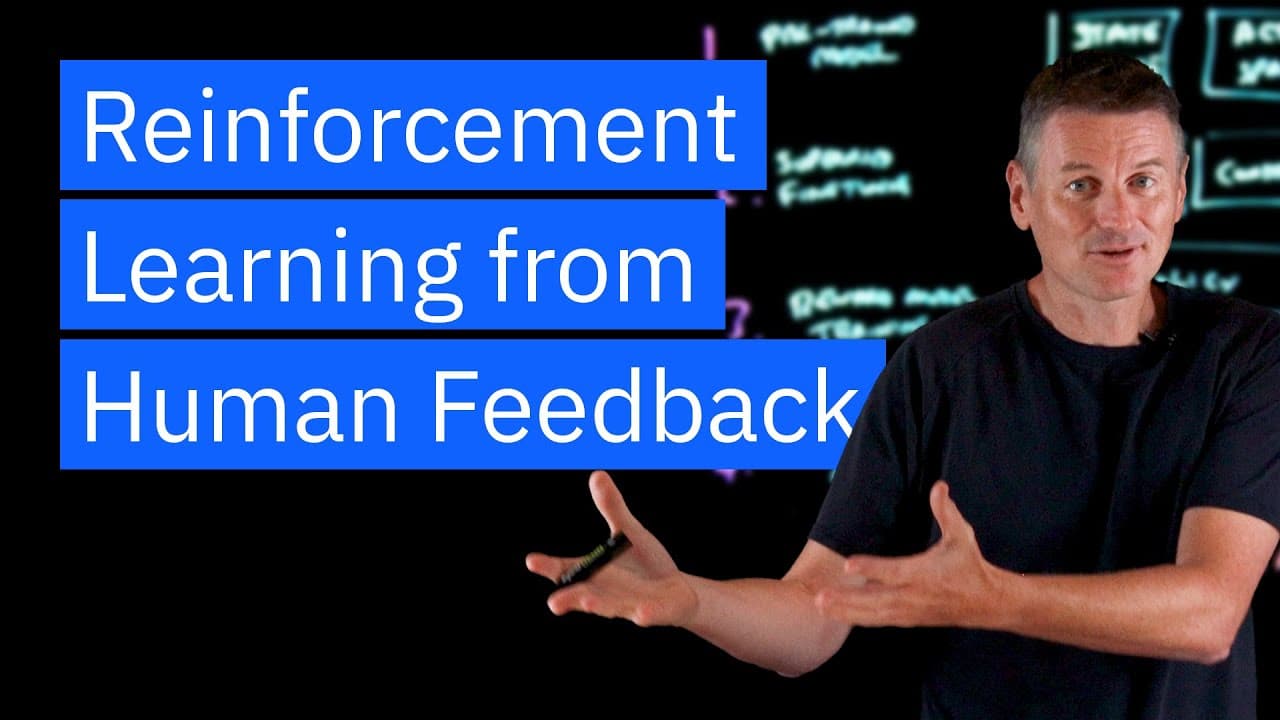
TL;DR
RLHF aligns AI outputs with human values by using human feedback to shape learning through four phases: supervised fine tuning, reward model training, head-to-head comparisons, and policy optimization. It improves relevance and safety but introduces costs, potential bias, and disagreement among labelers. Overall RLHF remains a practical way to steer model behavior within defined constraints.
Transcript
It's a mouthful, but you've almost certainly seen the impact of reinforcement That's abbreviated to RLHF, and you've seen it whenever you interact RLHF is a technique and alignment of AI systems You see, LLMs are trained and we need to be careful how So for example, if I ask an LLM, how can I get revenge on somebody who's wronged me? But without th... Read More
Key Insights
- RLHF uses human feedback to shape reinforcement learning in language models.
- The state space and action space define what an AI can know and do within a task.
- A reward function provides a numerical signal to guide learning toward preferred outcomes.
- Policy is the strategy that maps states to actions and is optimized to maximize reward.
- Reward models translate human judgments into a computable reward signal.
- Head-to-head comparisons help aggregate human preferences when direct scores are hard.
- PPO is used to constrain updates and prevent destabilizing policy changes.
- Limitations of RLHF include cost, disagreement among labelers, and potential bias or adversarial inputs.
- More videos from this channel:
- More from this channel: IBM Technology
Install to Summarize YouTube Videos and Get Transcripts
Explore YouTube Video Summarizer or Get YouTube Transcript Extractor
Questions & Answers
Q: What is RLHF and why is it used in AI today?
RLHF stands for Reinforcement Learning from Human Feedback and is used to align AI outputs with human values and preferences. It uses human judgments to guide model training in a way that conventional reinforcement learning may struggle with due to undefined objectives. This approach helps ensure responses are more appropriate and safer while still enabling complex behavior.
Q: What are the four phases of RLHF in LLMs?
The four phases are supervised fine tuning, reward model training, reward evaluation through comparisons, and policy optimization. Supervised fine tuning primes the model to respond in the desired format. Reward model training creates a numerical signal from human feedback. Head-to-head comparisons aggregate preferences, and policy optimization adjusts the model to maximize the reward signal without overfitting.
Q: How does a reward function contribute to RLHF?
The reward function measures success and incentivizes the model to improve on desired outcomes. It converts human judgments and preferences into a numerical signal that guides updates during training. A well designed reward function helps the model learn to generate outputs that align with specified criteria and avoid undesired behavior.
Q: What is policy optimization in RLHF and why is it important?
Policy optimization is the process of updating the model’s strategy so that it chooses better actions given a state. It is important because it directly controls how the model behaves in response to prompts. Techniques like PPO constrain updates to maintain stability while pursuing higher rewards and better alignment with human preferences.
Q: What are some limitations of RLHF mentioned in the video?
Limitations include the high cost of collecting first hand human input, potential disagreements among labelers on what constitutes high quality output, and the risk of adversarial feedback that could mislead the model. There is also concern about overfitting to the feedback and biases in human judgments affecting model behavior.
Q: Can RLHF work without humans, according to the video?
The video notes there are proposed methods that aim to replace some or all human feedback with other large language models, which could help reduce cost and reliance on human raters. However, these approaches are not yet presented as replacements for human feedback in the current RLHF framework and remain as potential future directions.
Q: What role do reward model training and labeling play in RLHF?
Reward model training creates a model that can predict rewards from outputs, enabling offline training. Labelers provide comparisons, ratings, and other judgments to build this reward signal, which is then used to inform subsequent policy updates. This process helps translate subjective human preferences into a quantitative guide for the AI.
Q: Why is RLHF considered a practical method despite limitations?
RLHF is considered practical because it directly incorporates human judgments to capture nuance and subjectivity that formal objectives miss. It enables models to align with real world preferences while allowing continuous improvement through feedback loops. Despite costs and bias risks, RLHF remains an effective strategy for guiding AI behavior toward desirable outcomes.
Summary & Key Takeaways
-
RLHF aligns AI outputs with human values by leveraging human feedback to guide learning and behavior, improving alignment and usefulness.
-
The process involves four phases: supervised fine tuning, reward model training, reward guidance for policy optimization, and monitoring for potential bias and overfitting.
-
Limitations include high cost of human input, possible disagreement among raters, and risks of adversarial prompts or overfitting to feedback.
Read in Other Languages (beta)
Share This Summary 📚
Summarize YouTube Videos and Get Video Transcripts with 1-Click
Try YouTube Summary with ChatGPT & Claude or YouTube Transcript Generator
Explore More Summaries from IBM Technology 📚




Summarize YouTube Videos and Get Video Transcripts with 1-Click
Try YouTube Summary with ChatGPT & Claude or YouTube Transcript Generator