How to choose AI agent knowledge methods?
TL;DR
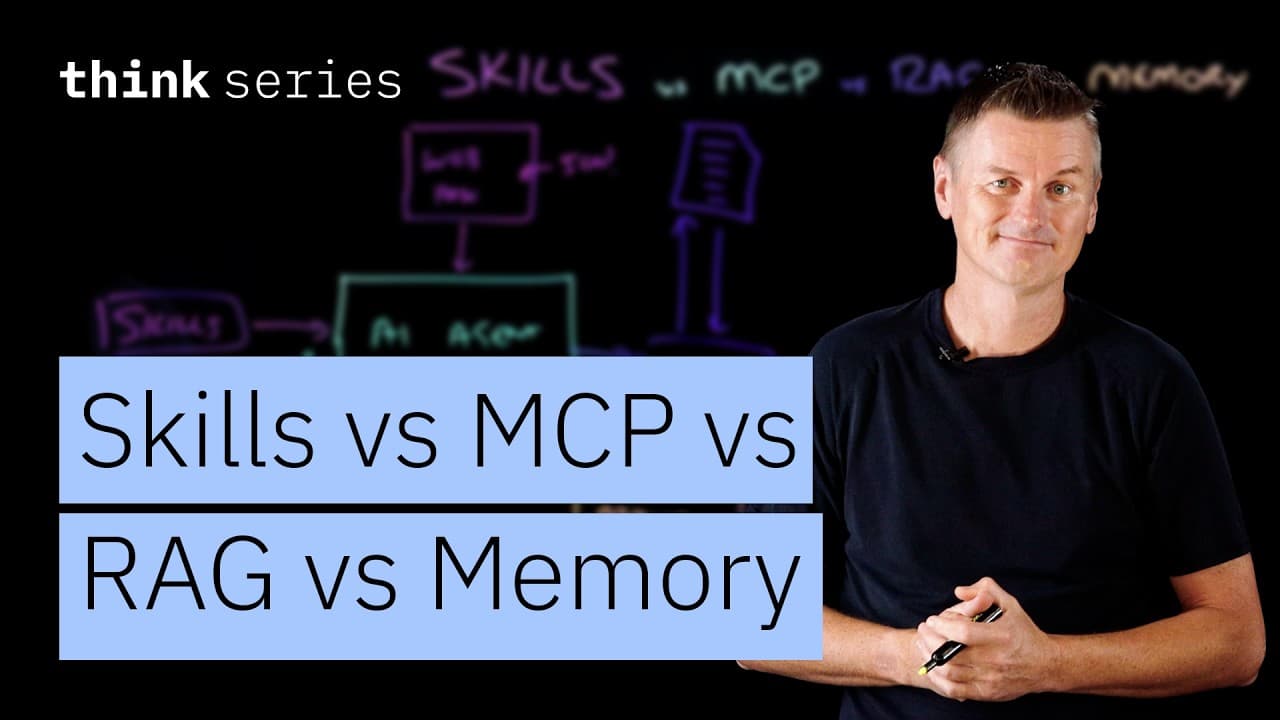
Skills give agents repeatable procedures with measurable steps, MCP connects the agent to external systems so it can read live data, RAG pulls in relevant documents only when needed, and memory stores past experiences to inform future choices. Use each method in the right context to avoid dead ends and improve task resolution.
Transcript
There are different ways to give an AI agent the knowledge it needs to complete a task beyond the knowledge that it just has in its training data. So let's look at four of them, skills, MCP, RAG and memory and define which methods are best in different situations. So let us consider that we've got some kind of web app here and we look at this webpa... Read More
Key Insights
- Skills provide a repeatable procedure for tasks, including steps and when to escalate
- MCP, or model context protocol, lets the agent reach external backends and read live data
- RAG retrieves relevant documents on demand through a semantic search
- Memory stores experience from past tasks to inform future actions
- RAG uses vector databases and human-curated documents, whereas memory grows from the agent’s own history
- A skill can include judgments about when to stop and escalate to humans
- MCP acts as a bridge between the agent and external systems
- Using knowledge written down as RAG and knowledge gained from experience as memory can complement each other
- More videos from this channel:
- More from this channel: IBM Technology
Install to Summarize YouTube Videos and Get Transcripts
Explore YouTube Video Summarizer or Get YouTube Transcript Extractor
Questions & Answers
Q: How should I choose between skills and MCP for a task
Choose skills when you need a clear procedural guide the agent can follow with defined steps and decision points. Skills provide a structured run book and can include the conditions under which the agent should escalate. If the task requires reading live data from external systems, MCP is used to connect to those systems so the agent can query metrics and logs in real time.
Q: What role does MCP play in accessing a web service
MCP serves as a protocol layer that connects the agent to an external system behind an MCP server. The agent does not need to know how to query the backend directly; instead, MCP exposes the necessary interfaces. This enables the agent to read error rates and access logs or metrics that are essential to diagnose issues like a 500 error.
Q: How does RAG differ from memory in practice
RAG retrieves information from a vector database based on documents prepared by people, using semantic search to fetch relevant chunks when the agent asks. Memory, on the other hand, is built from the agent’s own past experiences and can be written back to improve future performance. RAG brings external knowledge, memory retains experiential learning.
Q: What is the benefit of using memory for AI agents
Memory allows the agent to remember past incident patterns and successful fixes. This experience helps avoid repeating dead ends and can reveal the real cause of issues that were not documented in runbooks. Memory also enables the agent to adapt and improve its responses over time by learning from prior outcomes.
Q: Can all four techniques be used together
Yes, the four techniques complement each other. A practical approach combines skills for procedures, MCP to access necessary external data, RAG to pull relevant documents when needed, and memory to leverage past experience. This combination helps the agent resolve tasks efficiently while learning from outcomes.
Q: What is the key rule of thumb for using these methods
If knowledge is documented, use RAG to retrieve it; if knowledge comes from experience, use memory; if you need a repeatable procedure, use a skill; if the task requires looking up something in the real world, use MCP. This rule helps tailor the right tool to the task.
Q: Why is progressive disclosure important with skills
Progressive disclosure ensures the agent only pulls in a skill when the task actually calls for it, preventing information overload and misapplication. It also helps the agent decide when to stop exploring on its own and escalate to human help. This keeps the resolution process efficient and reliable.
Q: What would you do first to fix a 500 internal server error using these methods
First, define a triage skill that outlines steps such as checking error rates and recent deployments. Use MCP to access the dashboards for real-time metrics. If needed, pull in relevant runbooks via RAG to guide diagnosis, and rely on memory to recall prior similar incidents and the fixes that worked. This combination provides a structured and informed approach.
Summary & Key Takeaways
-
A guide to four core AI agent knowledge methods and their best use cases. It explains when to apply skills, MCP, RAG, and memory to resolve a web page error and similar tasks. The goal is to clarify how these approaches complement each other for practical agent performance.
-
The summary emphasizes progressive disclosure for skills, the role of MCP in accessing external systems, the on demand nature of RAG, and the experiential value of memory for learning from past incidents.
-
The content highlights a practical framework for combining the four techniques to create capable AI agents that can diagnose issues, fetch data, and remember past outcomes for future efficiency.
Read in Other Languages (beta)
Share This Summary 📚
Summarize YouTube Videos and Get Video Transcripts with 1-Click
Try YouTube Summary with ChatGPT & Claude or YouTube Transcript Generator
Explore More Summaries from IBM Technology 📚
Summarize YouTube Videos and Get Video Transcripts with 1-Click
Try YouTube Summary with ChatGPT & Claude or YouTube Transcript Generator