How to Choose the Right Agentic AI Framework
TL;DR
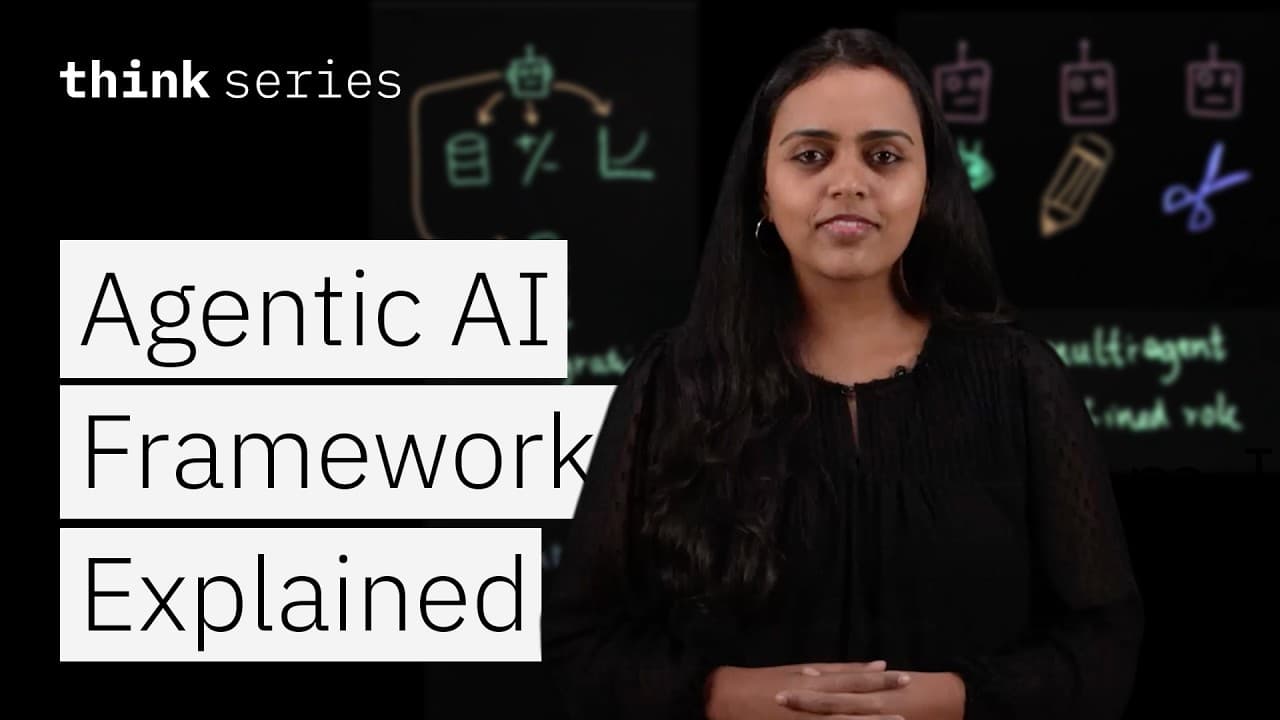
Choose an agentic AI framework according to the system you are building, rather than searching for one universally best option. Predictable pipelines suit workflow tools, open-ended goals suit autonomous agents, specialized teamwork suits role-based systems, real-world deployments require production orchestration, and early idea validation benefits from visual prototyping tools.
Transcript
Hi, let me guess. The world around you is abuzz with agentic AI systems and their massive potential. So you decide to go off and build an agentic system. You look for the best available framework out there. And now, all of a sudden, you have 17 GitHub tabs open, five medium blocks bookmarked, and you are still clueless on how to proceed. Yes... Read More
Key Insights
- An agentic AI framework is a toolkit for building systems that plan, act, iterate, and coordinate tasks. It supplies reusable building blocks such as predefined architectures, integrations, monitoring tools, task-management features, and communication protocols.
- Linear workflows are agentic systems in which tasks proceed through a predictable sequence. They are appropriate when reliability and control matter more than flexible collaboration, as illustrated by a support agent that searches a knowledge base, drafts a response, and creates a ticket.
- LangChain is suited to workflows requiring several ordered steps, while LlamaIndex is suited to applications focused heavily on data retrieval and indexing. LangGraph can support more complex workflow arrangements when a basic sequence is not sufficient.
- Autonomous agentic systems work by receiving a goal and determining how to accomplish it. They often use several communicating agents, such as planner, coder, and reviewer agents, making frameworks such as AutoGen, Baby AGI, and CrewAI relevant to open-ended problems.
- Role-based agentic systems are multi-agent arrangements with explicit responsibilities and boundaries. A content workflow can assign research, writing, and editing to separate agents that communicate while remaining confined to their designated roles.
- CrewAI is presented as a strong fit for role-based systems, while AutoGen can support the same pattern when additional structure is imposed. Specialized frameworks can also address narrow domains, with ChatDev identified for software-development tasks.
- Production orchestration systems are designed for AI applications operating inside real-world environments. They require deep connections to APIs, databases, business workflows, documentation, and automation, with Agent Framework and LangGraph identified as suitable options.
- Rapid-prototyping tools are intended to validate whether an idea can work before establishing a complete production architecture. LangFlow and Flowise provide graphical interfaces where users can place components on a canvas, connect models and workflows, and test ideas quickly.
- More videos from this channel:
- More from this channel: IBM Technology
Install to Summarize YouTube Videos and Get Transcripts
Explore YouTube Video Summarizer or Get YouTube Transcript Extractor
Questions & Answers
Q: How do you choose the right agentic AI framework?
Choose the framework by first identifying the type of system you intend to build. Use a workflow approach for predictable sequential tasks, autonomous agents for exploratory and open-ended goals, role-based systems for bounded teamwork, production orchestration for real-world integrations, and rapid-prototyping tools when the immediate goal is testing whether an idea works.
Q: What is an agentic AI framework?
An agentic AI framework is a toolkit that provides building blocks for systems capable of planning, acting, iterating, and coordinating work. It can include predefined architectures, integration and monitoring tools, task-management capabilities, and communication protocols. These features simplify the development and management of systems in which agents retrieve data, perform calculations, generate reports, or collaborate.
Q: When should you use a linear agent workflow?
Use a linear workflow when tasks must follow a predictable sequence and reliability or control is important. A customer-support agent provides an example: it receives a question, searches a knowledge base, prepares a response, returns that response, and may create a support ticket. This pattern does not require several agents to collaborate dynamically.
Q: Which frameworks are suited to linear agent workflows?
LangChain is suited to applications in which multiple steps must occur in a particular sequence. LlamaIndex is especially suitable for applications that rely heavily on data retrieval and indexing. LangGraph, which is also associated with LangChain, can be used when the workflow requires a more complex setup than a straightforward sequence of steps.
Q: How do autonomous multi-agent systems work?
Autonomous multi-agent systems receive a goal and determine how to achieve it, often through collaboration among several agents. An AI coding assistant might use a planner to design a solution, a coder to implement it, and a reviewer to assess the code, recommend changes, and assist with debugging. AutoGen, Baby AGI, and CrewAI are suggested options.
Q: What is the difference between autonomous and role-based agent systems?
Both autonomous and role-based systems can involve multiple agents communicating toward a shared goal. The distinguishing feature of a role-based system is that every agent has clearly defined responsibilities and constraints. A researcher gathers source material, a writer creates an article, and an editor revises it, with each agent staying inside the boundaries of its assigned role.
Q: What frameworks can support production AI orchestration?
Agent Framework and LangGraph are presented as suitable choices for production orchestration. Agent Framework combines Semantic Kernel and AutoGen and can support orchestration as well as autonomous workflows. LangGraph is appropriate for structured, multilayered applications. These systems are intended for deployments requiring connections to APIs, databases, documentation, automation scripts, and established business workflows.
Q: How can agentic AI ideas be prototyped quickly?
Agentic AI ideas can be tested quickly with graphical tools such as LangFlow and Flowise. These tools provide interfaces where components can be placed on a canvas and connected into model-driven workflows. The resulting prototype helps determine whether an idea is workable before developers invest in a more complete architecture or move the system into production.
Summary & Key Takeaways
-
Agentic AI frameworks provide building blocks for systems that plan, act, iterate, retrieve information, perform calculations, coordinate tasks, and communicate with external services. Their predefined architectures, integrations, monitoring tools, task-management capabilities, and communication protocols reduce the difficulty of building and managing systems involving one or more agents.
-
Linear workflows execute predictable steps in a defined sequence, while autonomous systems let agents determine how to pursue an open-ended goal. Role-based systems also use multiple collaborating agents, but each agent operates within explicit responsibilities, such as researching, writing, or editing content without taking over another agent's role.
-
Production orchestration connects AI agents with APIs, databases, automation scripts, documentation, and business workflows. Rapid-prototyping tools instead provide graphical canvases for assembling and testing ideas quickly. The appropriate framework therefore depends on whether the intended system is a pipeline, an autonomous collaboration, a specialized team, or a production application.
Read in Other Languages (beta)
Share This Summary 📚
Summarize YouTube Videos and Get Video Transcripts with 1-Click
Try YouTube Summary with ChatGPT & Claude or YouTube Transcript Generator
Explore More Summaries from IBM Technology 📚

Summarize YouTube Videos and Get Video Transcripts with 1-Click
Try YouTube Summary with ChatGPT & Claude or YouTube Transcript Generator