How to Foster AI Ethics and Trust in Organizations
TL;DR
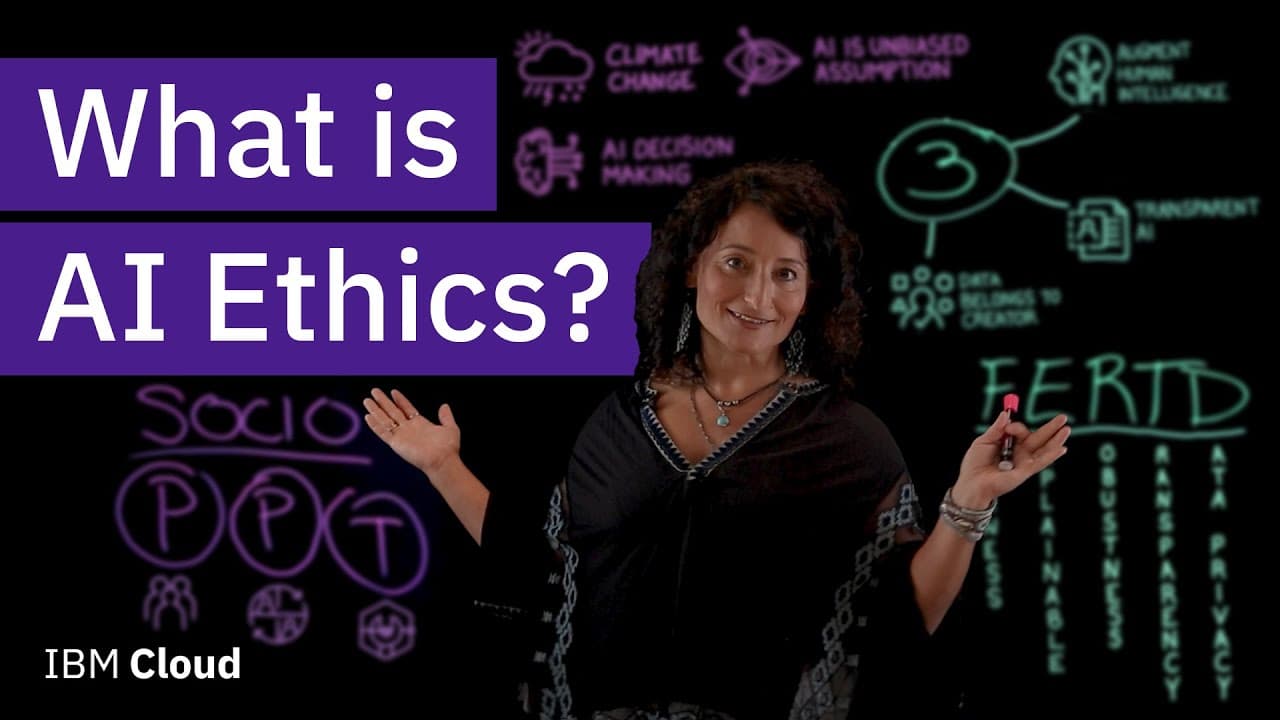
AI ethics rests on five pillars to build trust: fairness toward underrepresented groups, explainability with data lineage and provenance, robustness to avoid disadvantaging users, transparency with metadata and usage, and a governance mindset within organizational culture. The speaker emphasizes that AI should augment humans and that trust hinges on people, culture, and tooling alongside technical safeguards.
Transcript
I want to start off with talking to you about Three things: the first, and it may be, you Climate change absolutely keeps me up at night. The second thing that keeps me up at night is that people may have no idea that an artificial intelligence is making a decision that directly impacts their lives - what percentage interest job that you applied fo... Read More
Key Insights
- AI now makes decisions that directly affect people’s lives, such as job outcomes for applicants or resource access for students.
- Trust is central to AI adoption, and poor results reduce confidence in AI systems.
- The five pillars of AI ethics are fairness, explainability with data lineage, robustness, transparency with metadata, and governance aspects.
- AI should be used to augment human effort rather than replace human judgment.
- Ethics in AI requires consideration of culture, data science teams, and organizational diversity to improve outcomes.
- Having diverse teams improves the wisdom and fairness of AI systems, reflecting broader societal values.
- Tooling and processes must support fairness, accountability, and traceability in AI deployments.
- Ethical AI relies on clear data provenance and end-user understanding of how datasets influence results
- More videos from this channel:
- More from this channel: IBM Technology
Install to Summarize YouTube Videos and Get Transcripts
Explore YouTube Video Summarizer or Get YouTube Transcript Extractor
Questions & Answers
Q: How can organizations start implementing AI ethics in practice
Organizations can start by defining five pillars to guide AI projects: fairness toward all groups, explainability including data lineage and provenance, robustness to avoid biased or harmful results, transparency through metadata and clear usage notices, and governance to oversee ethical considerations. In practice, this means auditing datasets, documenting model decisions, involving diverse teams, and embedding ethical reviews in project workflows. This approach helps build trust with end users and reduces risks associated with biased or opaque AI outcomes.
Q: Why is trust highlighted as a central issue in AI adoption
Trust is highlighted because AI decisions directly affect people’s lives, such as job applications or access to services. Without trust, organizations risk rejection of AI solutions and lingering skepticism about outcomes. Building trust involves making AI processes explainable, ensuring fairness, and providing transparency about data sources and decision criteria. A trusted AI system is more likely to be adopted responsibly and used as intended.
Q: What does explainability mean in the AI ethics context
Explainability in this context means being able to tell end users what data and expertise informed a decision, including the data lineage and provenance behind the model. It requires clear, accessible explanations of how inputs translate into outputs and the assumptions involved. Explainability helps users understand, contest, or appeal decisions and strengthens accountability within the organization.
Q: How does robustness factor into AI ethics
Robustness refers to ensuring AI systems do not disadvantage people or produce harmful or unreliable results under varied conditions. This involves testing across scenarios, validating assumptions, and implementing safeguards that prevent errant behavior. A robust AI system maintains performance and fairness even when data or contexts change.
Q: What role does transparency play in trustworthy AI
Transparency involves making the use of AI explicit and accessible, including providing metadata and information about how the model operates and what data it uses. This openness enables stakeholders to assess suitability, manage expectations, and hold the system accountable. Transparent practices reduce secrecy and misinformation around AI deployments.
Q: How should organizational culture influence AI ethics
Organizational culture shapes how AI ethics are implemented, as it determines whether diverse voices are included in design and governance, and whether ethical considerations are prioritized alongside performance. A socio-technological approach recognizes people, processes, and technology as interdependent. Inclusive cultures support fair, responsible AI outcomes.
Q: Why is diversity important for AI teams
Diversity in AI teams improves the likelihood that products reflect a wide range of perspectives and reduce blind spots. The more diverse a group, the more robust their collective judgment becomes, which can lead to fairer algorithms and better alignment with real-world use cases. Diversity thus supports the wisdom required for trustworthy AI.
Q: What should organizations do to begin auditing AI ethics
Organizations should start by mapping datasets for bias and provenance, documenting model decisions, and creating clear governance processes to review ethical concerns. Establishing objective criteria for fairness, transparency, and accountability, plus ongoing monitoring and user feedback loops, helps ensure responsible AI use and fosters consumer and employee trust.
Summary & Key Takeaways
-
AI ethics centers on trust by applying five pillars and integrating human factors with technology. The talk stresses that AI should augment people, not replace judgment, and that data lineage and transparency are essential for trustworthy outcomes. Organizational culture and diverse teams are critical for fair AI.
-
The video notes that poor upfront research and biased datasets can cause unforeseen AI consequences, highlighting the need for principled trust and transparent practices when adopting AI technologies. It also frames AI as a socio-technological challenge requiring cross-functional alignment.
-
Finally, the speaker urges attention to fairness, explainability, robustness, transparency, and responsible governance to ensure AI decisions respect people and uphold ethical standards across the organization.
Read in Other Languages (beta)
Share This Summary 📚
Summarize YouTube Videos and Get Video Transcripts with 1-Click
Try YouTube Summary with ChatGPT & Claude or YouTube Transcript Generator
Explore More Summaries from IBM Technology 📚






Summarize YouTube Videos and Get Video Transcripts with 1-Click
Try YouTube Summary with ChatGPT & Claude or YouTube Transcript Generator