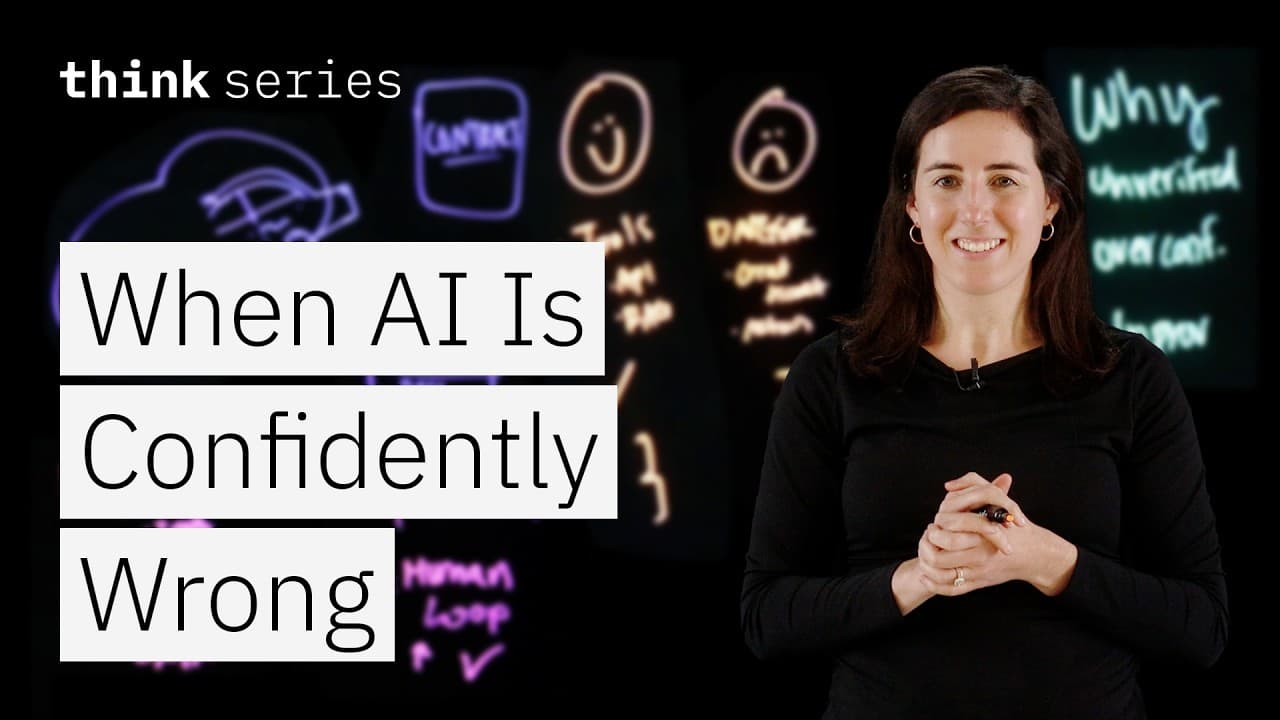
How to reduce AI hallucinations with grounding and tools
TL;DR
Grounding AI agents in sources and using tool-based reasoning reduces hallucinations. The design choices, scope, and human in the loop are critical to prevent confident but wrong actions. Tools, live data, and clear boundaries lower risk but can increase errors if not managed.
Transcript
There are stories of drivers following their GPSs so faithfully that they ended up in a lake. The GPS directed them down a boat launch and because they trusted the system more than their instincts, in they went. Now we laugh at that story because it seems so ridiculous. Who would follow directions that blindly? But something similar happens with AI... Read More
Key Insights
- Grounding the agent in data is the fastest way to reduce hallucinations, by giving it a reliable map it can trust instead of guessing.
- Tool-based reasoning means the agent should use actual tools like calculators, APIs, and data connectors to verify information before responding.
- Connectivity to sources of truth such as SharePoint, CRM systems, and contract repositories is essential to ground outputs in reality.
- Explicitly defining what the agent can and cannot do, where data comes from, and which workflows require sign off reduces scope creep and errors.
- Adding a human to the loop provides judgment, context, and accountability that automated systems alone cannot replicate.
- Agents can hallucinate less when they verify information with tools, but multi-step reasoning can introduce more opportunities for errors if not managed.
- Higher model capability can increase confidence and the risk of wrong answers if data grounding is weak or context is incomplete.
- The shift from predicting to verifying is the core design principle that moves AI toward reliable performance rather than plausible but incorrect outputs.
- More videos from this channel:
- More from this channel: IBM Technology
Install to Summarize YouTube Videos and Get Transcripts
Explore YouTube Video Summarizer or Get YouTube Transcript Extractor
Questions & Answers
Q: How can grounding reduce AI hallucinations in practical terms
Grounding reduces hallucinations by connecting the AI to real data sources such as contract repositories, CRMs, and APIs, allowing it to verify facts before answering. This approach replaces speculation with checks against sources of truth, like a GPS using live traffic instead of a static map, dramatically improving reliability.
Q: Why is tool-based reasoning preferable to pure text prediction
Tool-based reasoning forces the AI to operate through actual tools, such as calculators or data queries, rather than guessing based on memory. This verification step ensures calculations and data retrieval come from real computations and data, lowering the chance of presenting made up results as facts.
Q: What role does data provenance play in reducing hallucinations
Data provenance provides a clear, auditable trail of where information originates, enabling the agent to cite sources and rely on known, vetted data. This grounding helps prevent confident but false conclusions by ensuring that outputs are aligned with verified records and established data channels.
Q: How does scope definition affect agent reliability
Defining the agent’s scope sets boundaries on what it can access and what actions it can perform. When lanes are explicit, the agent operates within a safe domain, reducing the likelihood of generating wrong answers or taking unsafe actions outside its competence.
Q: Why is human oversight important in AI workflows
Human oversight acts as a final checkpoint for critical decisions, catching errors the agent might miss and providing context and accountability. The video compares this to cruise control that still requires a driver for on-ramps and unexpected situations, ensuring safe and responsible outcomes.
Q: Can more capable models increase hallucinations
Yes, more capable models can produce more confident outputs even when data is missing or ambiguous. If not grounded properly, their enhanced fluency and tendency to fill gaps can lead to plausible but incorrect information, underscoring the need for grounding and checks.
Q: What is meant by ‘predicting versus verifying’ in AI design
Predicting refers to generating an answer based on learned patterns, while verifying involves checking that answer against live data and tools. The video argues that shifting toward verification, with live data and tools, is the key design choice to reduce hallucinations and improve reliability.
Q: How should organizations design AI systems to prevent lake-driving hallucinations
Organizations should ground the AI in sources of truth, enforce tool-based reasoning, define strict operational scope, and include a human-in-the-loop for critical decisions. This combination creates a reliable workflow where the agent proposes, a human reviews, and final approvals are obtained before action.
Summary & Key Takeaways
-
The video explains that hallucinations occur when AI systems generate plausible yet unverified information, and that grounding the agent with reliable data sources can dramatically reduce this issue.
-
It emphasizes tool-based reasoning and access to live data or APIs so the agent can verify facts instead of guessing, akin to using a calculator or querying a live system.
-
It argues for tight scope, explicit data provenance, and human oversight to prevent dangerous actions and ensure accountability, comparing it to cruise control with a human driver in critical situations.
Read in Other Languages (beta)
Share This Summary 📚
Summarize YouTube Videos and Get Video Transcripts with 1-Click
Try YouTube Summary with ChatGPT & Claude or YouTube Transcript Generator
Explore More Summaries from IBM Technology 📚

Summarize YouTube Videos and Get Video Transcripts with 1-Click
Try YouTube Summary with ChatGPT & Claude or YouTube Transcript Generator