How does NLP turn speech into structured data
TL;DR
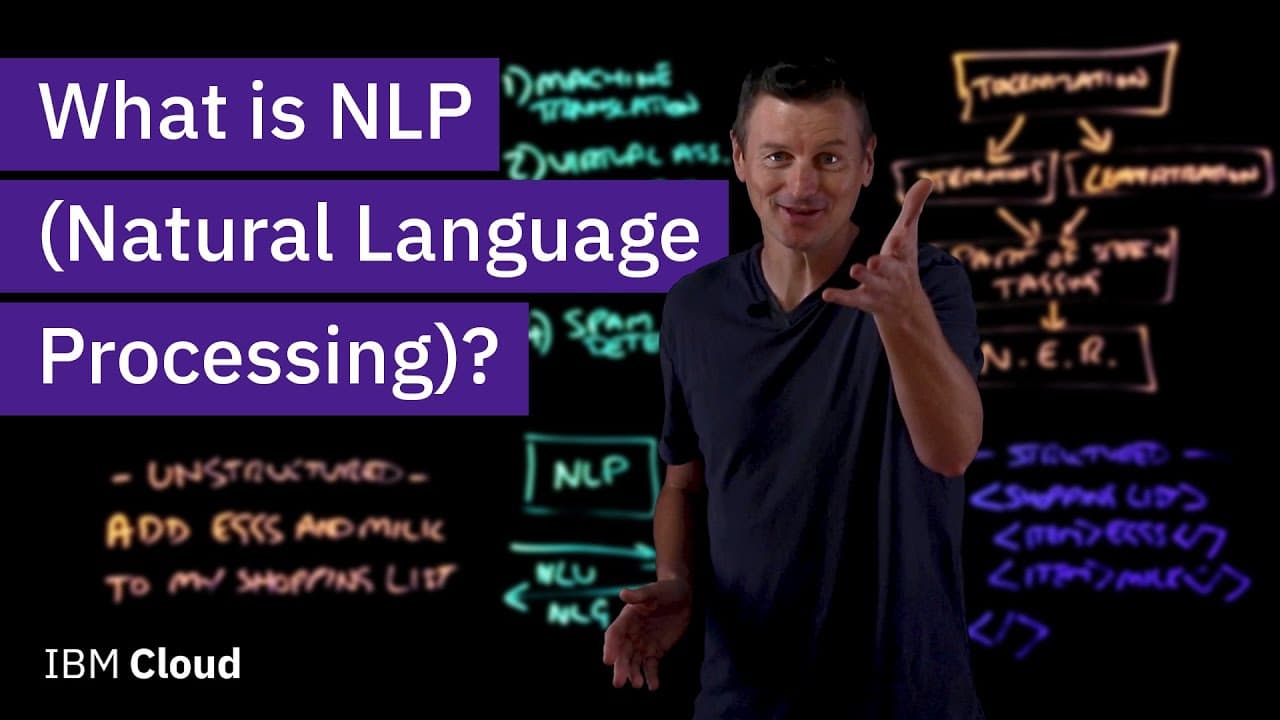
NLP takes unstructured human language and converts it into a structured form that computers can understand. It uses a toolbox of techniques like tokenization, stemming, lemmatization, POS tagging, and named entity recognition to enable applications such as translation, virtual assistants, sentiment analysis, and spam detection. This transformation enables AI systems to process language and take actions.
Transcript
What is natural language processing? Well, you're doing it right now, you're listening to the words and the sentences that I'm forming and you are forming some sort of comprehension from it. And when we ask a computer to do that that is NLP, or natural language processing. My name is Martin Keen, I'm a Master Inventor at IBM, and I've utilized ... Read More
Key Insights
- NLP starts with unstructured text such as spoken language or written content and creates a structured representation that a computer can understand.
- The core tasks in NLP include tokenization, which breaks text into tokens, and lemmatization, which derives the base form of a word from its inflected form.
- Stemming reduces words to a root form, but lemmatization uses dictionary meaning to find the true root, affecting accuracy for certain words.
- Part of speech tagging identifies how a word functions in a sentence, helping to disambiguate meaning based on context.
- Named entity recognition detects entities like states or person names, aiding in understanding referenced concepts in text.
- NLP is not a single algorithm but a bag of tools that work together to translate between unstructured and structured data.
- Use cases of NLP include machine translation, virtual assistants and chatbots, sentiment analysis, and spam detection.
- The process of turning unstructured to structured data is essential for downstream AI applications to reason and act on language.
- More videos from this channel:
- More from this channel: IBM Technology
Install to Summarize YouTube Videos and Get Transcripts
Explore YouTube Video Summarizer or Get YouTube Transcript Extractor
Questions & Answers
Q: How does NLP begin with unstructured data and convert it into something a computer can process?
NLP begins with unstructured text such as spoken language or written sentences and then applies a sequence of processing steps to produce structured data. This involves tokenization to split the input into manageable pieces, followed by further steps like stemming or lemmatization, POS tagging, and named entity recognition. The resulting structured data can then be used by AI systems to understand meaning, extract entities, and perform actions.
Q: What is tokenization and why is it important in NLP?
Tokenization is the process of breaking text into smaller units called tokens, such as words. It is the first practical step in NLP because working with individual tokens allows subsequent tools to analyze and manipulate language piece by piece. By treating each token as a basic unit, the system can apply rules for normalization, counting, and semantic interpretation essential for further processing.
Q: Why are stemming and lemmatization both used in NLP, and how do they differ?
Stemming and lemmatization are used to reduce words to a common base form to improve analysis. Stemming removes prefixes and suffixes to reach a root form, which can be crude and may produce non words. Lemmatization uses a dictionary and linguistic rules to return the true lemma, preserving meaningful base forms. Choosing between them affects accuracy for different words and tasks.
Q: How does part of speech tagging help NLP understand sentences?
Part of speech tagging assigns grammatical roles to each token in a sentence, such as noun, verb, or adjective. This context helps disambiguate meaning, for example distinguishing make as a verb in They will make dinner from make as a noun in a make of laptop. Proper tagging improves accuracy for downstream interpretation and task execution.
Q: What is named entity recognition and what does it identify?
Named entity recognition looks for specific real world objects in text and identifies them as entities. Examples include recognizing that Arizona is a U S state or that Ralph is a person’s name. This helps extract structured facts from unstructured text, enabling more precise data understanding and processing.
Q: What are common NLP use cases mentioned in the video, and what problem does each solve?
The video highlights machine translation to preserve meaning across languages, virtual assistants and chatbots to execute commands from user input, sentiment analysis to detect positive or negative tones and sarcasm, and spam detection to distinguish legitimate messages from spam by examining content cues. Each use case relies on turning text into actionable, structured data.
Q: Why is NLP described as a bag of tools rather than a single algorithm?
NLP is described as a bag of tools because language tasks vary greatly and different problems require different techniques. Tokenization, stemming, lemmatization, POS tagging, and NER each address a distinct aspect of language. By combining these tools, NLP can handle a range of tasks from translation to sentiment detection, rather than relying on one universal method.
Q: How does NLP support machine translation and why is understanding context crucial?
In machine translation, NLP must understand context rather than translating word by word. This means considering sentence structure, semantics, and overall meaning to avoid errors like misinterpreting phrases after translation cycles. The process relies on structured representations and context-aware analysis to produce accurate translations that retain the original intent.
Summary & Key Takeaways
-
NLP converts unstructured input into a structured representation that a computer can process and analyze.
-
NLP relies on a toolkit of techniques rather than a single algorithm, allowing flexible handling of different language tasks.
-
NLP enables practical AI applications such as translation, virtual assistants, sentiment analysis, and spam detection by turning text into computable data.
Read in Other Languages (beta)
Share This Summary 📚
Summarize YouTube Videos and Get Video Transcripts with 1-Click
Try YouTube Summary with ChatGPT & Claude or YouTube Transcript Generator
Explore More Summaries from IBM Technology 📚

Summarize YouTube Videos and Get Video Transcripts with 1-Click
Try YouTube Summary with ChatGPT & Claude or YouTube Transcript Generator