How AI and Data Science Tables Shape Pipelines
TL;DR
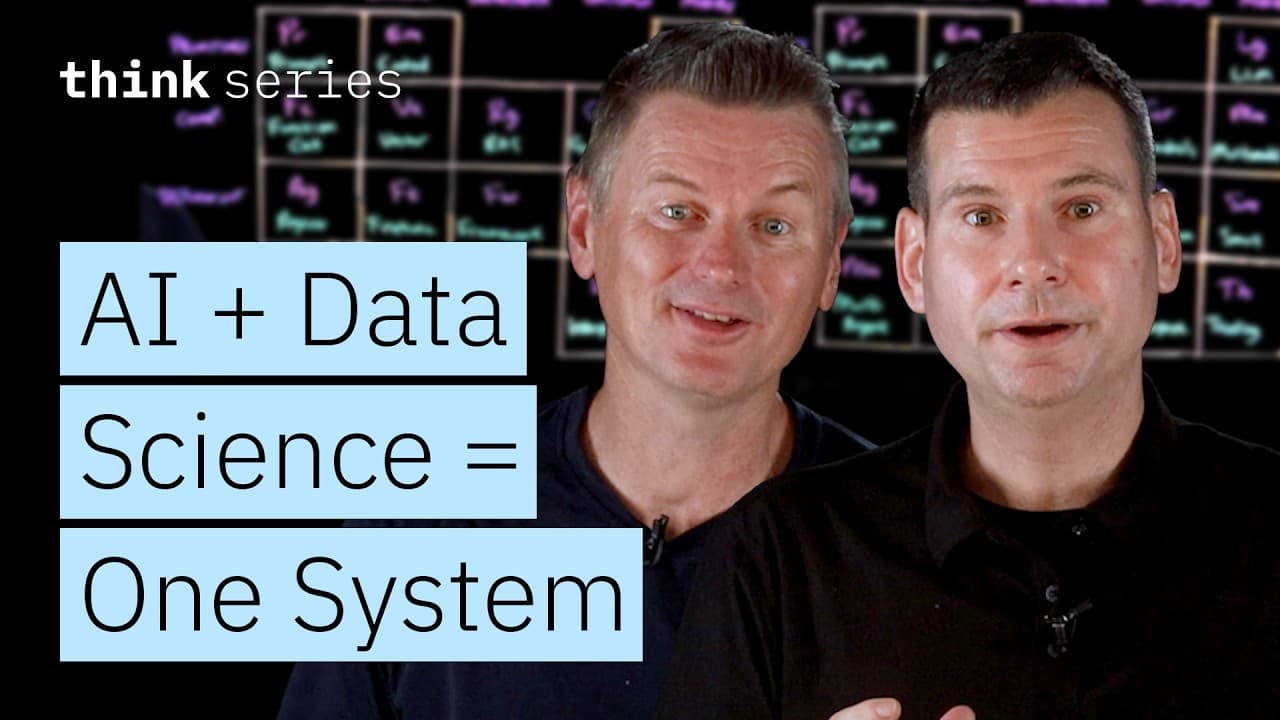
The video explains how data science and AI rely on parallel, interconnected periodic tables to organize data work and model development. It shows a practical document Q&A scenario where data preparation, embeddings, retrieval, and guardrails come together to ground answers. Both tables guide workflows from raw data to validated insights.
Transcript
Data science has been around for decades. And today AI is having its moment. But everything happening in AI, it all sits on top of all the work that data science had been doing the whole time. Right. So an AI embedding, well, what is that? I mean, it's just a series of numbers until the data behind it has been cleaned or a large language model is o... Read More
Key Insights
- The data science table uses rows to track data maturity from raw to governed insights, and columns to separate acquisition, preparation, modeling, generation, and evaluation.
- The AI table groups elements into reactive, retrieval, orchestration, and validation, with rows for primitives, composition, deployment, and emerging techniques.
- Embeddings convert text into numerical vectors, enabling semantic search and similarity, which is stored in a vector database for retrieval.
- RAG, or retrieval augmented generation, coordinates embeddings, vector storage, and prompt grounding to fetch relevant chunks before prompting the model.
- Data governance, including permissions and audit trails, is a dedicated element to prevent leakage of restricted information and ensure trusted outputs.
- The pipeline uses ETL and data cleansing to prepare documents, making the data queryable and suitable for embedding and grounding.
- Synthetic data and drift monitoring extend the pipeline by generating new training examples and adapting models to distribution changes.
- Guardrails and red teaming act as final filters to verify grounding and compliance, reducing hallucinations and policy violations.
- More videos from this channel:
- More from this channel: IBM Technology
Install to Summarize YouTube Videos and Get Transcripts
Explore YouTube Video Summarizer or Get YouTube Transcript Extractor
Questions & Answers
Q: What is the main purpose of combining data science and AI periodic tables in the video?
The video demonstrates that data science and AI are interdependent and can be organized into periodic tables to make complex pipelines easier to understand. By aligning stages from data acquisition to governance with AI elements like embeddings, RAG, and guardrails, teams can design end to end workflows that ground model outputs in verifiable data and processes. This structured view helps identify where data preparation, modeling, and validation interact, reducing confusion and improving governance.
Q: How is the data science table structured in the explanation?
The data science table is structured with rows representing data maturity levels from raw data to validated insights and governance, and columns labeled acquisition, preparation, modeling, generation, and evaluation. This layout mirrors common data lifecycle stages and helps users map activities such as extraction, cleansing, and data governance to the corresponding modeling and evaluation tasks. The framework emphasizes progression and quality control across the entire data workflow.
Q: What are the four top groups in the AI table, and what do they cover?
The AI table groups are reactive, retrieval, orchestration, and validation, covering how AI components respond to input, how they store and retrieve information, how different modules coordinate operations, and how system honesty and safety are maintained. These groups map to practical capabilities like embeddings, vector databases, RAG, and guardrails, showing how AI systems process data from input to a trusted output within a production environment.
Q: What role do embeddings play in the AI pipeline described?
Embeddings convert text into numerical vectors to enable semantic search and similarity retrieval. They are used to store information in a vector database and are retrieved during runtime to fetch relevant document chunks for grounding. This step is crucial for reducing hallucinations by ensuring that model responses are anchored to actual, relevant data retrieved from trusted sources.
Q: How does RAG contribute to the document Q and A use case?
RAG, or retrieval augmented generation, coordinates embedding, vector storage, and retrieval to bring the most relevant document chunks into the prompt. It ensures that the model uses grounded information when forming answers, reducing the likelihood of hallucinations. The retrieved chunks are then integrated into prompts to guide the language model toward factual, source-supported responses.
Q: What is the purpose of the guardrails in the AI workflow?
Guardrails act as the final filter on the output to ensure claims align with cited sources and to redact any sensitive information like PII. They help maintain compliance and trust by validating that the answer only includes information that is permissible and accurate, preventing leakage of restricted data and ensuring the response adheres to governance policies.
Q: How does the video describe handling data drift and synthetic data?
The video explains monitoring for data drift to detect shifts in query distributions or embeddings. When drift is detected, synthetic data is generated to cover failing patterns, and this synthetic data is used to fine tune embeddings and improve the model. This creates a feedback loop that helps the system stay aligned with real world usage over time.
Q: What is the sequence from ETL to governance in the data pipeline example?
The sequence starts with ETL to pull data from various sources, followed by data ingest and cleansing to remove noise. Then data is structured and encoded into metadata, prepared for downstream processing. This data is then used to generate embeddings and support RAG with groundings, and finally wrapped with governance to ensure auditable, compliant outputs.
Summary & Key Takeaways
-
The data science table organizes data by maturity from raw data to governance, with columns for acquisition, preparation, modeling, generation, and evaluation guiding the workflow.
-
The AI table emphasizes primitives, composition, deployment, and emerging ideas, showing how prompts, embeddings, and LLMs connect to production systems through frameworks and guards.
-
When combined, the tables enable a grounded document Q&A process that uses ETL, data cleansing, embeddings, RAG, and guardrails to produce trustworthy, auditable answers.
Read in Other Languages (beta)
Share This Summary 📚
Summarize YouTube Videos and Get Video Transcripts with 1-Click
Try YouTube Summary with ChatGPT & Claude or YouTube Transcript Generator
Explore More Summaries from IBM Technology 📚


Summarize YouTube Videos and Get Video Transcripts with 1-Click
Try YouTube Summary with ChatGPT & Claude or YouTube Transcript Generator