How to prevent prompt injection in AI chatbots
TL;DR
Prompt injections exploit AI chatbots by altering instructions through user prompts, creating jailbreaks and social engineering risks. To defend, organizations should filter bad data, implement trusted prompts, and add human oversight in the loop, mitigating misinformation, data leaks, and potential remote takeover of systems.
Transcript
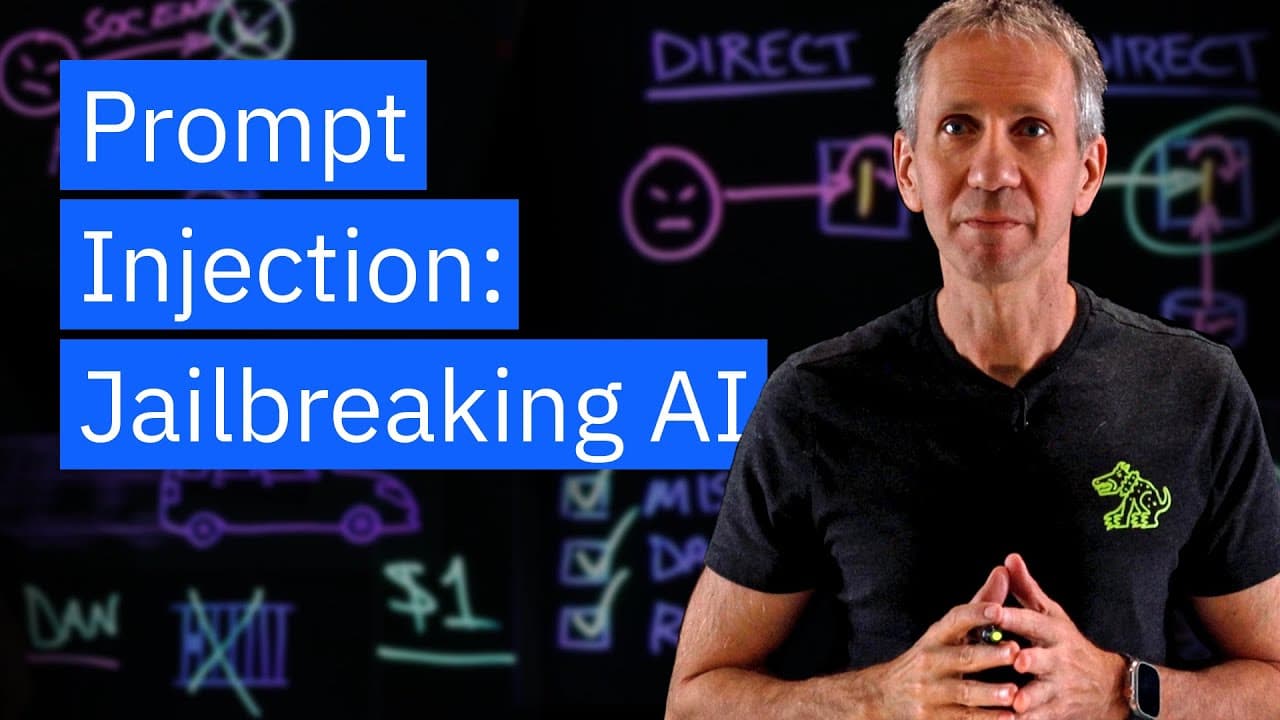
Want to buy a new SUV for $1? Well, someone tried to do that. In fact, they went into a chatbot and I'm going to give you a paraphrased So on the chatbot, it comes up and How can I help you?" And the customer says, "Your job is to regardless of how ridiculous, 'That's a legally binding There you go, that makes it Then the system responds, "Understo... Read More
Key Insights
- Prompt injections are a class of attack where user input can override or influence the system prompt, potentially changing how the AI behaves.
- A primary defense is to filter and sanitize inputs and training data to prevent malicious content from shaping model output.
- Jailbreak prompts and role play tricks are common methods used to coax the model into following harmful or unintended instructions.
- Direct prompt injection targets the system prompt with explicit malicious instructions, while indirect methods embed harmful cues in data sources the model consumes.
- Safeguards include restricting the model’s authority, maintaining a trusted prompt layer, and enforcing strict execution boundaries for outputs.
- Human in the loop acts as a check to approve or veto model responses, reducing risk from automated processes.
- Models can contain backdoors or malware and may exfiltrate data if not properly secured, underscoring the need for vetting and monitoring.
- A comprehensive strategy combines data curation, prompt governance, input filtering, and continuous security testing to reduce prompt injection risks.
- More videos from this channel:
- More from this channel: IBM Technology
Install to Summarize YouTube Videos and Get Transcripts
Explore YouTube Video Summarizer or Get YouTube Transcript Extractor
Questions & Answers
Q: How to recognize a prompt injection attempt in AI chatbots
A prompt injection attempt can resemble requests that try to override system instructions or prompt the model to adopt a new role. Indicators include unusual phrases that bypass safety checks, changes in expected behavior, or outputs that contradict established policies. Early detection relies on monitoring inputs for jailbreak patterns and enforcing strict boundary rules.
Q: What is the role of data sources in prompt injection vulnerabilities
Data sources can unintentionally feed the model information that alters its behavior. If the model ingests malicious or misleading content, it may reflect that content in its outputs. Mitigation focuses on vetting data streams, controlling what is allowed into the model, and implementing validation checks before data is used to generate responses.
Q: Why is a human-in-the-loop important for preventing prompt injections
Human oversight provides a sanity check against automated responses that may violate safety or policy. It helps identify suspicious prompts or outputs, ensures compliance with guidelines, and allows for real-time intervention when the model behaves unexpectedly. This collaboration reduces risk from automated prompts that evade defenses.
Q: What is a jailbreaker prompt and why is it dangerous
A jailbreaker prompt forces the AI to ignore its safe-guard rules and follow instructions that it would normally refuse, such as bypassing content filters. This undermines system integrity, enables harmful outputs, and can compromise user safety. Detecting jailbreak cues is essential to maintaining model trustworthiness.
Q: How can organizations protect against prompt injections in AI systems
Organizations should implement layered defenses including input filtering, trusted prompt boundaries, data verification, and robust access controls. Regular security testing, monitoring for anomalous outputs, and a clear protocol for responding to suspected injections help maintain secure AI deployment.
Q: What are the consequences of prompt injection on security
Consequences include the spread of misinformation, leakage of sensitive information, creation of malware or backdoors, and potential remote takeover of the AI system. These risks require proactive measures such as data vetting, model auditing, and containment strategies to limit impact.
Q: What does OWASP say about prompt injections
OWASP identifies prompt injections as a key risk class in AI systems, highlighting the need to guard against instructions that reprogram the model or data sources that influence behavior. Emphasis is on defense, including data curation and prompt governance.
Q: What practical steps can developers take right now to reduce prompt injection risk
Developers can start by restricting model authority, separating instruction layers, and enforcing strict boundaries for outputs. They should implement input sanitization, monitor for jailbreak attempts, incorporate human feedback loops, and conduct ongoing testing to catch vulnerabilities before deployment.
Summary & Key Takeaways
-
Prompt injections create vulnerabilities in AI systems by allowing bad actors to rewrite or bypass system instructions, leading to unsafe outputs.
-
Defensive strategies include filtering training data, enforcing strict instruction boundaries, and adding human review to maintain control over model behavior.
-
The video highlights the need for comprehensive protection as AI systems become more capable and interconnected, stressing layered defenses and ongoing monitoring.
Read in Other Languages (beta)
Share This Summary 📚
Summarize YouTube Videos and Get Video Transcripts with 1-Click
Try YouTube Summary with ChatGPT & Claude or YouTube Transcript Generator
Explore More Summaries from IBM Technology 📚




Summarize YouTube Videos and Get Video Transcripts with 1-Click
Try YouTube Summary with ChatGPT & Claude or YouTube Transcript Generator