How Do Humanities Ground AI for Responsible Use?
TL;DR
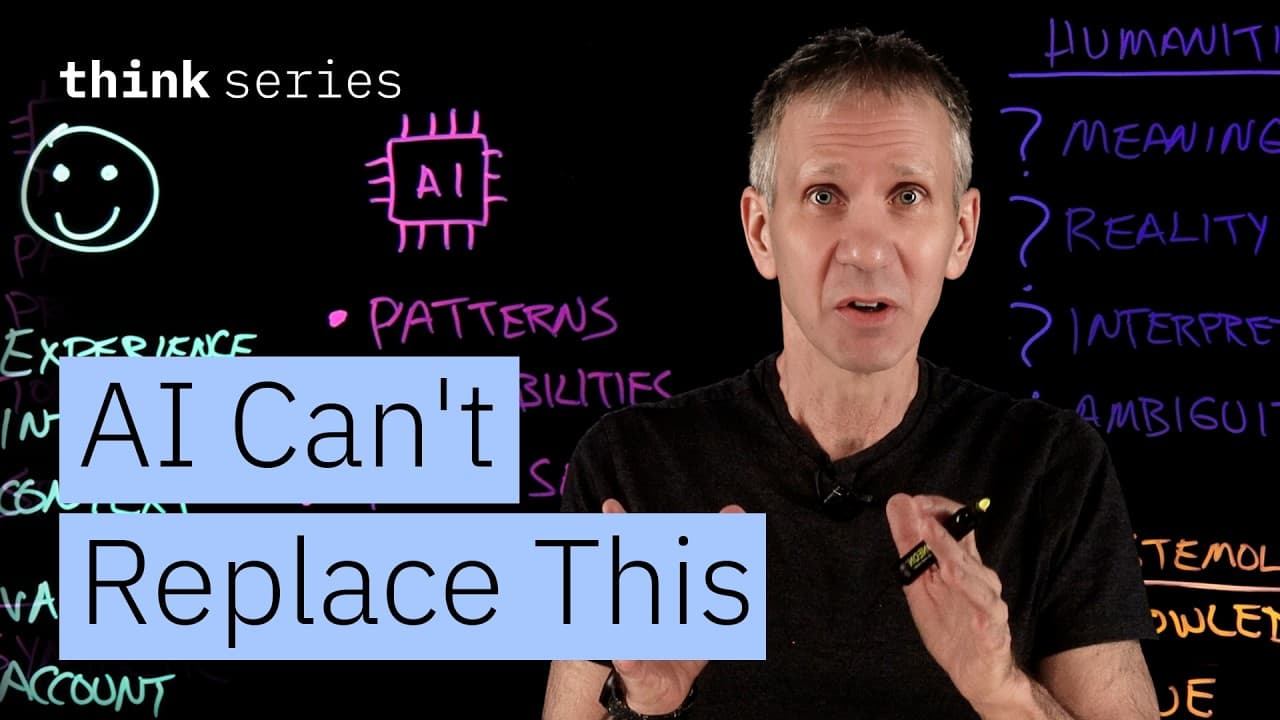
The humanities provide grounding for judging AI outputs and guiding ethical use. They teach interpretation, meaning, and accountability, which algorithms alone cannot supply, ensuring questions, values, and consequences are considered before action. By examining language, context, and social impact, humans retain oversight in an AI driven world.
Transcript
AI can generate answers, but who decides the question? In the current AI era, we're rapidly improving machines that can summarize documents, answer questions, do research, write code, even compose music. These systems are becoming incredibly capable at producing outputs that look like understanding. But there's a critical gap emerging. We're buildi... Read More
Key Insights
- AI is fundamentally syntactic, predicting the next token rather than understanding truth or lived experience.
- The humanities teach meaning, language relation to reality, and interpretation across contexts to ground AI outputs.
- Epistemology helps us assess knowledge, evidence, and certainty in AI results.
- Not everything on the Internet is true, so human judgment remains essential.
- Outputs require interpretation by humans, not just automated generation.
- Ethics, political theory, and sociology reveal who benefits and potential harms of AI systems.
- Prompt framing, constraints, and context drastically influence AI quality and alignment.
- Human interpretive skills increase in importance as AI becomes more capable and pervasive.
- More videos from this channel:
- More from this channel: IBM Technology
Install to Summarize YouTube Videos and Get Transcripts
Explore YouTube Video Summarizer or Get YouTube Transcript Extractor
Questions & Answers
Q: What is the core reason the humanities are important in an AI era
The humanities are important because they provide grounding in meaning, interpretation, and context that explain what counts as good or ethical in human terms. They help evaluate knowledge, assess evidence, and understand the consequences of AI actions, ensuring that algorithmic outputs align with human values rather than just statistical correctness.
Q: How does AI differ from human understanding according to the video
AI operates on probabilistic pattern prediction and syntax, not lived experience or semantic meaning. It can generate plausible outputs without grounding them in reality or intent, which means human judgment is needed to assess relevance, truth, and potential misalignment in AI responses.
Q: What role does epistemology play in evaluating AI outputs
Epistemology questions what counts as knowledge, how we know something is true, and how we distinguish belief from knowledge. In AI, this helps identify what evidence supports outputs, how certain claims are, and where hallucinations or errors might occur, guiding careful interpretation and verification by humans.
Q: Why is interpretation emphasized as a human responsibility in AI usage
Because AI outputs are probabilistic and context sensitive, multiple readings can be valid and the original intent may be inaccessible. Humans must interpret results, assess ambiguity, and decide how to act, ensuring that AI assistance informs decisions rather than dictating them.
Q: What does the video say about the relationship between AI and meaning
The video argues that AI can manipulate symbols and generate language without grounding meaning in lived reality. Meaning arises from human interpretation, context, and intent, which are provided by humanities disciplines and are necessary to evaluate AI outputs and their societal impact.
Q: How can prompt framing affect AI results
Prompt framing, including constraints and context, shapes the outputs you receive. Small changes in how a prompt is written or what boundaries are set can lead to significantly different results, highlighting the need for precise communication and clear intent when using AI systems.
Q: What questions should we ask to assess AI's impact on society
We should ask who benefits, what data biases exist, what possible harms could occur, and what plausible outputs could mislead. These questions require ethical, political, and sociological perspectives to ensure AI aligns with broad human values and minimizes negative consequences.
Q: What practical skills from humanities can enhance AI interaction
Skills from rhetoric, philosophy of language, and hermeneutics improve prompt writing, context definition, and interpretation of outputs. These disciplines provide frameworks for understanding ambiguity, bias, and omission, enabling users to frame problems clearly and interpret AI results more accurately.
Summary & Key Takeaways
-
The video argues that AI excels at pattern prediction, not genuine understanding, and requires human interpretation to determine meaning and value. It emphasizes that meaning and context come from humanities disciplines such as literature, history, and philosophy, which ground responsible use of AI.
-
Ethics and social theory are essential in evaluating who benefits from AI systems, what data biases exist, and what harms might arise. These questions cannot be answered by STEM alone and demand humanities informed perspectives.
-
Prompt framing and communication play a crucial role in shaping AI outputs. Clear intent, context, and constraints turn from mere syntax into operational competence, bridging user goals with responsible algorithmic action.
Read in Other Languages (beta)
Share This Summary 📚
Summarize YouTube Videos and Get Video Transcripts with 1-Click
Try YouTube Summary with ChatGPT & Claude or YouTube Transcript Generator
Explore More Summaries from IBM Technology 📚




Summarize YouTube Videos and Get Video Transcripts with 1-Click
Try YouTube Summary with ChatGPT & Claude or YouTube Transcript Generator