How Do Vision Language Models Read Images and Text
TL;DR
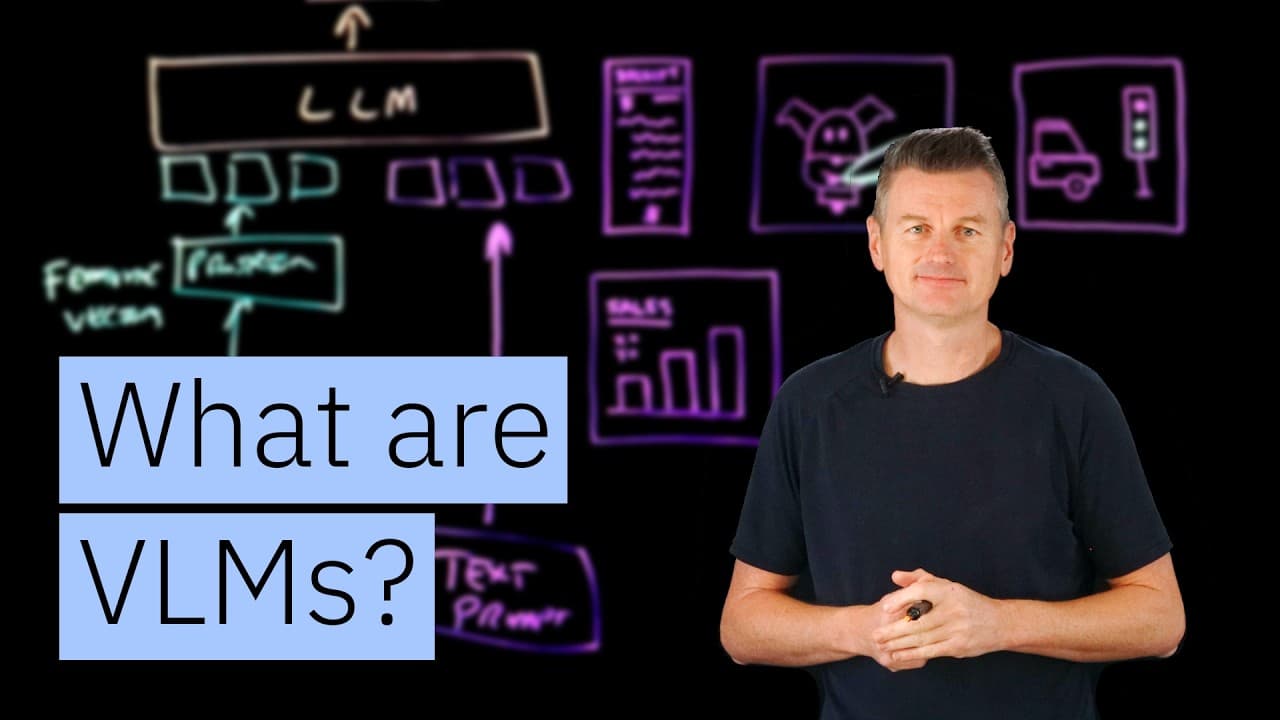
Vision language models merge image and text inputs into a shared token space using a vision encoder to produce image feature vectors, a projector to create image tokens, and a large language model to process both modalities. They excel at VQA, image captioning, and graph analysis but face tokenization, hallucination, and bias challenges that require careful data handling and optimization.
Transcript
Large language models have a problem. We know that they can process a text document, like a PDF maybe, and then they can respond to queries about it. And they do this by encoding both the document and any prompt we provide as tokens, and then putting that into the LLM, where it's processed through attention mechanisms, and then generates a text-bas... Read More
Key Insights
- Vision language models are multimodal systems that integrate text and images into a shared representation space for unified processing and response generation.
- A vision encoder converts images into high dimensional feature vectors, which are then translated into image tokens by a projector so the LLM can process them alongside text tokens.
- The architecture relies on attention mechanisms to relate text and image tokens, enabling tasks such as visual question answering, image captioning, and graph data interpretation.
- VLMs do not see images like humans; they learn statistical associations, which can lead to incorrect inferences and must be mitigated with training data and validation.
- Tokenization bottlenecks arise because images lack natural token structures, increasing memory use and slowing inference compared to text-only processing.
- Hallucinations in VLMs mirror those in LLMs and stem from overreliance on statistical cues rather than true visual understanding.
- Bias in training data can propagate cultural and contextual errors, so careful data curation and bias mitigation are essential for robust performance.
- Despite challenges, vision language models extend LLMs by enabling image understanding and context-aware reasoning alongside text for more capable AI systems.
- More videos from this channel:
- More from this channel: IBM Technology
Install to Summarize YouTube Videos and Get Transcripts
Explore YouTube Video Summarizer or Get YouTube Transcript Extractor
Questions & Answers
Q: How do vision language models convert images into a form an LLM can understand?
Vision language models start with a vision encoder that processes images into high dimensional feature vectors, which capture patterns, edges and spatial relationships. A projector then maps these vectors into image tokens that align with text tokens. The LLM processes both types of tokens together using attention, allowing multimodal reasoning and generation.
Q: What tasks can vision language models perform beyond simple image description?
Beyond captioning, vision language models can perform visual question answering, where a model analyzes a photo or graphic and answers questions about it. They can also interpret graphs from PDFs, extract data, summarize content, and reason about multimodal information, integrating visual context with textual prompts to produce coherent responses.
Q: Why is tokenization a bottleneck for image processing in VLMs?
Tokenization is a bottleneck because images do not have natural subword tokens like text. The encoded visual data yields many tokens, which increases memory usage and slows inference. Although strategies like perceiver resampling help, processing image tokens remains more computationally intensive than text alone.
Q: How do VLMs handle graphs and charts in documents?
VLMs extract data from graphs and charts by analyzing the visual content and interpreting the embedded data. They can perform graph analysis to understand trends and relationships, then respond with text that summarizes findings or answers questions about the data, combining this with textual understanding for a unified output.
Q: What are common challenges related to bias in vision language models?
Bias in VLMs often reflects biases in training data scraped from the web. Models can misinterpret cultural artifacts or contexts if the data is Western-centric or unbalanced. Mitigating these biases requires careful data curation, diverse datasets, and ongoing evaluation to reduce skew in model outputs.
Q: How does a VLM differ from a traditional LLM when processing input?
A VLM extends a traditional LLM by adding an image input path. It uses a vision encoder to convert images into feature vectors, a projector to make image tokens, and then fuses these with text tokens in the LLM. This enables the model to reason about both textual and visual information simultaneously.
Q: What is the role of attention mechanisms in VLMs?
Attention mechanisms in VLMs measure relationships between all tokens, whether from text or image, to determine contextual relevance and dependencies. This allows the model to align visual features with words, enabling accurate answering, captioning, and reasoning across modalities.
Q: What safety or reliability issues do VLMs face?
VLMs face reliability concerns such as hallucinations where the model outputs plausible but incorrect information. This stems from learned statistical associations rather than actual understanding of the image. Mitigation involves data validation, careful prompting, and monitoring outputs for factual accuracy.
Summary & Key Takeaways
-
Vision language models fuse visual and textual data to enable coherent reasoning across modalities, combining perception and language understanding in a single system.
-
They rely on a vision encoder to extract image features, a projector to convert features into tokens, and a text-based LLM to reason about all tokens jointly, yielding captions, answers, or analyses.
-
Challenges include tokenization bottlenecks, potential hallucinations, and biases from training data, necessitating careful design, data curation, and model tuning for robust multimodal performance.
Read in Other Languages (beta)
Share This Summary 📚
Summarize YouTube Videos and Get Video Transcripts with 1-Click
Try YouTube Summary with ChatGPT & Claude or YouTube Transcript Generator
Explore More Summaries from IBM Technology 📚
Summarize YouTube Videos and Get Video Transcripts with 1-Click
Try YouTube Summary with ChatGPT & Claude or YouTube Transcript Generator