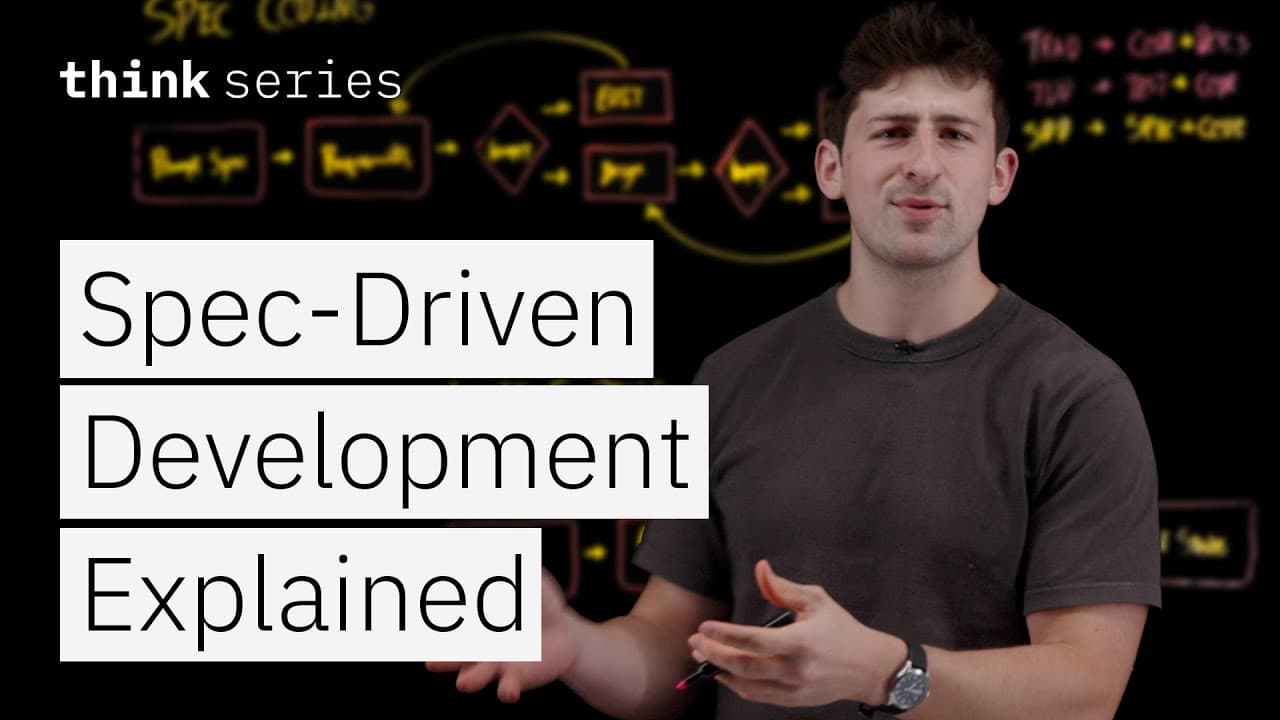
What is spec-driven development in AI assisted coding?
TL;DR
Spec-driven development uses a requirements based contract to drive design, tests, and implementation with an AI agent, unlike vibe coding which starts from prompts. It adds SDLC phases like design, testing, and deployment to AI generated software, improving predictability and aligning output with stated requirements.
Transcript
Right now, the way apps are getting built is completely changing because before, writing and reviewing code was the hardest part. But now it's knowing how to effectively convey what you want to build with an LLM. And then, my friends, is what's known as spec-driven development. Thank you very much. Nah, I'm just kidding. Because the thing is, spect... Read More
Key Insights
- Spec-driven development starts from a requirements specification that becomes the contract for implementation.
- Vibe coding relies on evolving prompts rather than upfront specifications.
- The approach incorporates SDLC stages such as design, tests, and deployment.
- A design document and to-dos are generated from the requirements before coding.
- Tests can be generated from the specification to validate behavior.
- Implementation proceeds only after the requirements are approved.
- Behavior-driven and test-driven elements are combined in spec coding.
- Using specifications reduces ambiguity in AI generated code.
- More videos from this channel:
- More from this channel: IBM Technology
Install to Summarize YouTube Videos and Get Transcripts
Explore YouTube Video Summarizer or Get YouTube Transcript Extractor
Questions & Answers
Q: What is the core idea of spec-driven development for AI coding?
The core idea of spec-driven development is to use a requirements specification as a contract that guides design, testing, and implementation by an AI agent. This shifts focus from guessing the best solution to delivering code that matches predefined behavior and constraints, reducing ambiguity and improving alignment with the intended outcome. The process emphasizes planning before coding, with the requirements driving all downstream work.
Q: How does spec-driven development differ from vibe coding?
Spec-driven development differs from vibe coding by starting with a formal requirements specification rather than an initial prompt for a specific implementation. This specification acts as a contract that dictates design decisions, tests, and deployment considerations. By contrast, vibe coding relies on iterative prompt edits after initial code generation, which can lead to variable outcomes and less predictable results.
Q: What SDLC components are added by spec-driven development?
Spec-driven development adds key SDLC components to AI generated software, including a formal design document, a structured requirements set, and explicit verification steps. It ensures that features are planned, designed, tested, and validated before implementation proceeds, aligning AI outputs with concrete design and quality expectations and enabling maintainability.
Q: What starts the spec-driven workflow in practice?
The workflow begins with a requirements specification that defines the system behavior and constraints. This serves as a contract that the AI agent uses to generate a design, create to-dos, and plan tests. If the requirements are approved, the model then implements the solution according to the agreed plan, ensuring traceability from requirements to code.
Q: How are tests created in spec-driven development?
Tests are generated from the requirements specification to validate the intended behavior. By deriving test cases from the contract, the AI agent can verify that the implementation adheres to defined inputs, outputs, and edge cases. This reduces rework and helps catch discrepancies between expected and actual functionality early in the cycle.
Q: When is implementation started in this approach?
Implementation begins after the requirements specification is approved and the design document is created. This sequence ensures that development happens from a clear, agreed plan rather than ad hoc prompt edits. It improves predictability and allows for traceability from the original requirements to the final code and tests.
Q: What is the benefit of combining behavior and test driven elements?
Combining behavior and test driven elements provides a robust feedback loop where the intended behavior is defined upfront and tested continuously. This alignment keeps the AI agent focused on delivering the specified functionality, reduces ambiguity in code generation, and supports reliable software delivery by validating behavior against predefined criteria throughout development.
Q: What claim about AI generated software is supported by spec-driven development?
Spec-driven development claims that using a requirements based contract to drive design, tests, and implementation can improve predictability and alignment in AI generated software. By enforcing a predefined behavior contract, it reduces the risk of unexpected or inconsistent outputs, ensuring that the final product adheres to the specified capabilities and quality standards.
Summary & Key Takeaways
-
Spec-driven development starts from a requirements specification that becomes the contract for implementation, guiding the entire project lifecycle.
-
The approach contrasts with vibe coding, which begins with an evolving prompt and code generation.
-
It incorporates traditional software engineering lifecycle components to AI generated software, including design, verification, and deployment.
Read in Other Languages (beta)
Share This Summary 📚
Summarize YouTube Videos and Get Video Transcripts with 1-Click
Try YouTube Summary with ChatGPT & Claude or YouTube Transcript Generator
Explore More Summaries from IBM Technology 📚


Summarize YouTube Videos and Get Video Transcripts with 1-Click
Try YouTube Summary with ChatGPT & Claude or YouTube Transcript Generator