When to Use MCP or Skills for AI Agents
TL;DR
Use MCP when an AI agent needs controlled, permissioned access to real-time external data, and use skills when the model needs reusable instructions, scripts, examples, or domain-specific procedures. Both approaches improve the model’s context, and they can be combined when an agent must retrieve information from a service and process it consistently according to a team’s rules.
Transcript
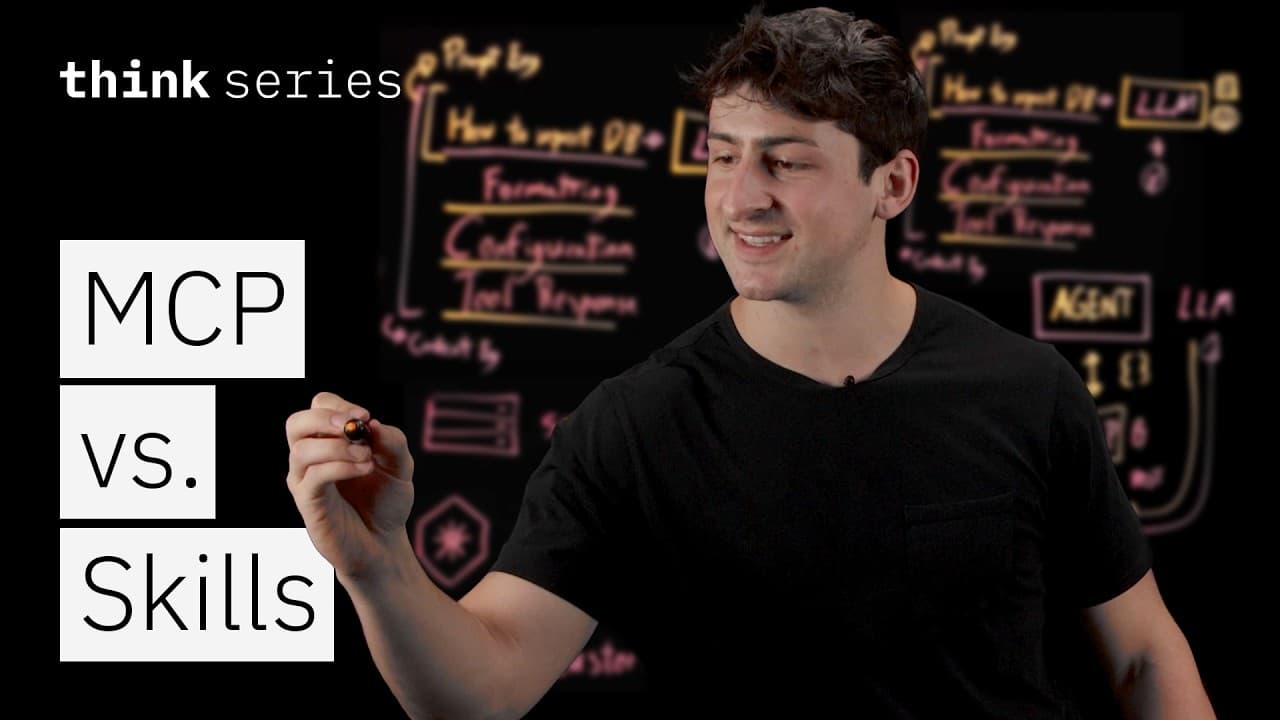
If you're looking to add capabilities to an LLM, look no further than MCP servers and skills. Because while an LLM is very general purpose and it knows a lot of things, well, I want to show you how these two concepts can help you to add custom and unique data to your LLM, whether it's for all types of use cases, right? This could be for coding assi... Read More
Key Insights
- Context engineering is the practice of supplying an LLM with the information needed to produce the desired answer, including formatting requirements, team-specific configurations, and responses from tools. It extends beyond assigning a role or task through prompt engineering alone.
- MCP is a standardized layer between an LLM and external data sources. It abstracts service APIs into an LLM-ready format, supports authentication and scoped permissions, and enables an agent to request information or actions without receiving raw API documentation and credentials.
- An MCP server works by receiving a structured JSON request from an LLM and translating it into operations such as GET or POST requests against a connected service. The server is added to an IDE or AI application and exposes defined tools and resources.
- Skills are reusable packages that teach an LLM how to perform a specific task consistently. A skill can contain a prompt, identifying metadata, scripts, examples, and other resources needed for activities such as code debugging, spreadsheet cleanup, or compliance checks.
- Selective loading is a central feature of skills. A skill can be added to the LLM’s context window only when its capability is relevant, so a code-debugging skill, for example, is loaded when the user asks about code errors.
- MCP is best suited to real-time, tightly permissioned data access. Suitable questions include which virtual machines are currently running, what state a cluster is in, or what information is stored about a customer in a connected CRM.
- Skills are best suited to lightweight, repeatable procedures and domain knowledge. They can specify an exact output format or workflow, reducing variation when a team wants an LLM to process similar requests in the same way repeatedly.
- MCP and skills can be combined because they solve different context problems. MCP can retrieve external records or call services, while a skill can direct the model to analyze, verify, or format the resulting information according to a defined process.
- More videos from this channel:
- More from this channel: IBM Technology
Install to Summarize YouTube Videos and Get Transcripts
Explore YouTube Video Summarizer or Get YouTube Transcript Extractor
Questions & Answers
Q: What is the difference between MCP and AI skills?
MCP connects an LLM or agent to external data sources and services through a standardized, permissioned interface. It addresses how the model retrieves information or performs service operations. Skills package domain knowledge, prompts, scripts, examples, and resources that teach the model how to complete a repeatable task. MCP supplies access, while skills supply procedures and expected behavior.
Q: When should an AI agent use an MCP server?
An AI agent should use an MCP server when it needs real-time information or service access in a controlled, tightly permissioned way. Examples include checking currently running virtual machines, inspecting cluster state, retrieving customer information from a CRM, or accessing a database. MCP is appropriate when authentication, scoped tokens, and clearly defined tools or resources are important.
Q: When should an LLM use a skill instead of MCP?
An LLM should use a skill when it needs a reusable custom capability rather than a full external-service integration. Skills are suitable for tasks such as debugging code, cleaning spreadsheet documents, applying compliance checks, formatting customer records, or analyzing information through a defined process. They are lightweight and can include prompts, scripts, examples, and supporting resources.
Q: How does an MCP server connect an LLM to a service?
An MCP server is added to an IDE or AI application and exposes service capabilities in a format the LLM can use. The model provides a structured JSON request for the information or action it needs. The MCP server then translates that request into an operation, such as a GET or POST request, and communicates with the connected service.
Q: What information can an AI skill contain?
An AI skill can contain a Markdown file with metadata and instructions. Its metadata identifies the skill’s name and describes when it should be used, while the main content provides the prompt passed to the LLM. The skill folder can also include scripts, examples, resources, and additional context that support the task the skill is designed to perform.
Q: How do skills make an LLM more consistent?
Skills make an LLM more consistent by packaging the same instructions, formatting rules, scripts, and examples for repeated use. For instance, a sales team can define a standard CRM record format that always includes specified customer details. Although LLM outputs are non-deterministic, loading a defined procedure each time gives the model a repeatable method and expected structure.
Q: What is context engineering for an AI agent?
Context engineering is the process of giving an AI model all the information it needs to produce the intended answer or action. That context can include desired formatting, a team’s database configuration, domain-specific instructions, and information returned by tools. Prompt engineering assigns a role or task, while context engineering also assembles the supporting information required to complete it correctly.
Q: Can an AI agent use MCP and skills together?
An AI agent can use MCP and skills together because they address complementary needs. MCP can retrieve customer records, system status, or other external data through controlled service access. A skill can then tell the model how to analyze, verify, or format that information according to a repeatable process. Combining them provides both external connectivity and domain-specific operating instructions.
Summary & Key Takeaways
-
MCP standardizes communication between an AI model and external data sources. An MCP server presents service capabilities in an LLM-ready format, handles authentication and scoped access, receives structured requests from the model, and translates those requests into operations against services such as a CRM, database, virtual machine environment, or cluster.
-
Skills package reusable instructions into a folder containing a Markdown file with metadata, including a name, usage description, and prompt. The folder can also contain scripts, examples, and supporting resources. A relevant skill can be loaded into the model’s context only when its particular capability is needed.
-
The choice depends on the required context. MCP is appropriate for controlled access to current external information, while skills are appropriate for teaching repeatable processes such as debugging code, cleaning spreadsheets, formatting CRM records, or performing compliance checks. An agent can use both to retrieve data and handle it consistently.
Read in Other Languages (beta)
Share This Summary 📚
Summarize YouTube Videos and Get Video Transcripts with 1-Click
Try YouTube Summary with ChatGPT & Claude or YouTube Transcript Generator
Explore More Summaries from IBM Technology 📚
Summarize YouTube Videos and Get Video Transcripts with 1-Click
Try YouTube Summary with ChatGPT & Claude or YouTube Transcript Generator