How do MCP and RAG connect AI to data sources?
TL;DR
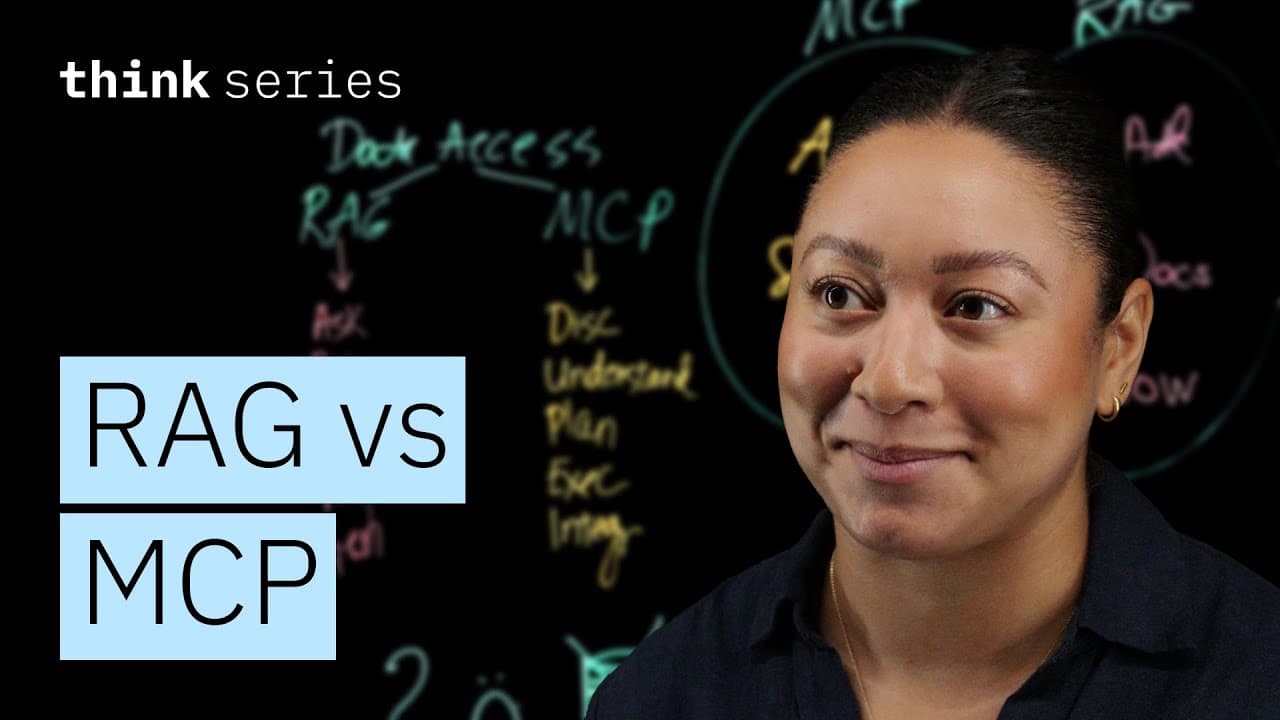
MCP connects AI to external tools and live systems to perform actions, while RAG retrieves information from data sources to ground responses. RAG adds context from static or semi-structured data, and MCP executes workflows and calls tools to inspire real tasks. Together they make AI both informed and capable.
Transcript
Imagine you're short on time and need to use an AI agent to help you answer some questions quickly and accurately. You grab your mobile device, type in the first question, and nuhhh! The agent replies, "Sorry! I don't know enough to answer your question." Aren't AI agents supposed to know everything on the internet? You've probably heard someone sa... Read More
Key Insights
- RAG is defined as adding information from external sources to a model’s context so outputs are grounded in up to date data.
- The key to RAG is retrieval and augmentation, which brings relevant documents or data into the prompt before generation.
- RAG provides source passages with answers, enabling verification and trust in model outputs.
- MCP is defined as a protocol that lets an agent connect to external systems to gather data or perform actions.
- MCP focuses on tool awareness and execution, planning which tools to call and in what order to fulfill a user request.
- MCP operates through five steps: discover, understand, plan, execute, and integrate to manage tool use and results.
- RAG and MCP share goals of reducing hallucinations and grounding responses in real data, but they differ in whether they retrieve knowledge or perform actions.
- The combined use of MCP and RAG can enhance AI projects by leveraging data retrieval for grounding and tool orchestration for action.
- More videos from this channel:
- More from this channel: IBM Technology
Install to Summarize YouTube Videos and Get Transcripts
Explore YouTube Video Summarizer or Get YouTube Transcript Extractor
Questions & Answers
Q: What is MCP and how does it differ from RAG in purpose and data use?
MCP, or Model Context Protocol, is a framework that enables AI agents to connect to external systems and execute actions or workflows. It focuses on doing and interacting with tools, APIs, and live data. In contrast, RAG, or Retrieval Augmented Generation, centers on retrieving and augmenting the model’s context with external information to ground its answers. While MCP drives action and integration, RAG drives knowledge retrieval and verification. Together they cover both knowing and doing, with security and governance considerations guiding their integration.
Q: How does RAG handle data retrieval and why is source attribution important?
RAG retrieves information from external knowledge bases or documents and then augments prompts before generation. This process helps ensure the model’s outputs are grounded in up-to-date, authoritative information. Source attribution is important because it allows users to verify claims and check the provenance of the information used in the generated answer. It also supports auditing and governance by providing a clear trail from question to cited data.
Q: What are the five steps of RAG and what happens in each?
The five steps of RAG are: ask, where the user submits a question; retrieval, where relevant data is pulled from a knowledge base; return, which sends the data back to the integration layer; augmentation, where the model prompt is enhanced with retrieved content; and generation, where the model produces a grounded answer using the augmented prompt. Each step builds toward a trustworthy answer grounded in verified data.
Q: What are the five steps of MCP and what happens in each?
The five steps of MCP are: discover, where the model discovers available tools and APIs; understand, where it reads each tool’s input and output schemas; plan, where it decides which tools to call and in what order; execute, where structured calls are sent through the MCP runtime to perform actions; and integrate, where results are used to refine reasoning or finalize an action. This workflow enables live data access and task execution.
Q: Can MCP and RAG be used together, and why would you do that?
Yes, MCP and RAG can be used together to leverage the strengths of both approaches. RAG can provide grounded knowledge to the model by retrieving relevant data, while MCP can perform actions by calling tools and updating systems. Using both enables an AI to answer questions with verified information and then take actionable steps based on that information, such as updating records or triggering workflows.
Q: What is the main difference in end goals between RAG and MCP?
RAG aims to know more by grounding model outputs in external data and providing source-backed answers. MCP aims to do more by connecting the model to tools and systems to drive actions and workflows. The two patterns complement each other, with RAG supplying knowledge and MCP delivering execution and automation.
Q: How does grounding reduce hallucinations in AI responses?
Grounding reduces hallucinations by anchoring responses to verifiable external data or live system results rather than relying solely on the model’s internal memorized patterns. RAG achieves grounding through retrieved passages and citations, while MCP grounds actions by requiring tool outputs and structured calls, making the final answer or action more trustworthy.
Q: What should teams consider when architecting RAG and MCP for governance and security?
Teams should consider data provenance, access control, and tool/API security when architecting RAG and MCP. RAG requires secure data sources and reliable retrieval mechanisms with clear citations. MCP requires secure runtimes, validated tool schemas, and controlled orchestration of actions to prevent unintended operations. Balancing accessibility with controls is key.
Summary & Key Takeaways
-
RAG and MCP are two distinct patterns for grounding AI: RAG focuses on retrieving and anchoring data to improve accuracy, while MCP enables action through tool integration and workflow execution.
-
RAG handles static or semi-structured knowledge bases with source attribution, whereas MCP orchestrates live tool calls and system interactions to complete tasks.
-
The video compares purpose, data flow, and process steps for RAG and MCP, and notes that they can be used together to enhance AI capabilities while addressing security and governance needs.
Read in Other Languages (beta)
Share This Summary 📚
Summarize YouTube Videos and Get Video Transcripts with 1-Click
Try YouTube Summary with ChatGPT & Claude or YouTube Transcript Generator
Explore More Summaries from IBM Technology 📚
Summarize YouTube Videos and Get Video Transcripts with 1-Click
Try YouTube Summary with ChatGPT & Claude or YouTube Transcript Generator