How Do AI Agents Solve Real-World Problems?
TL;DR
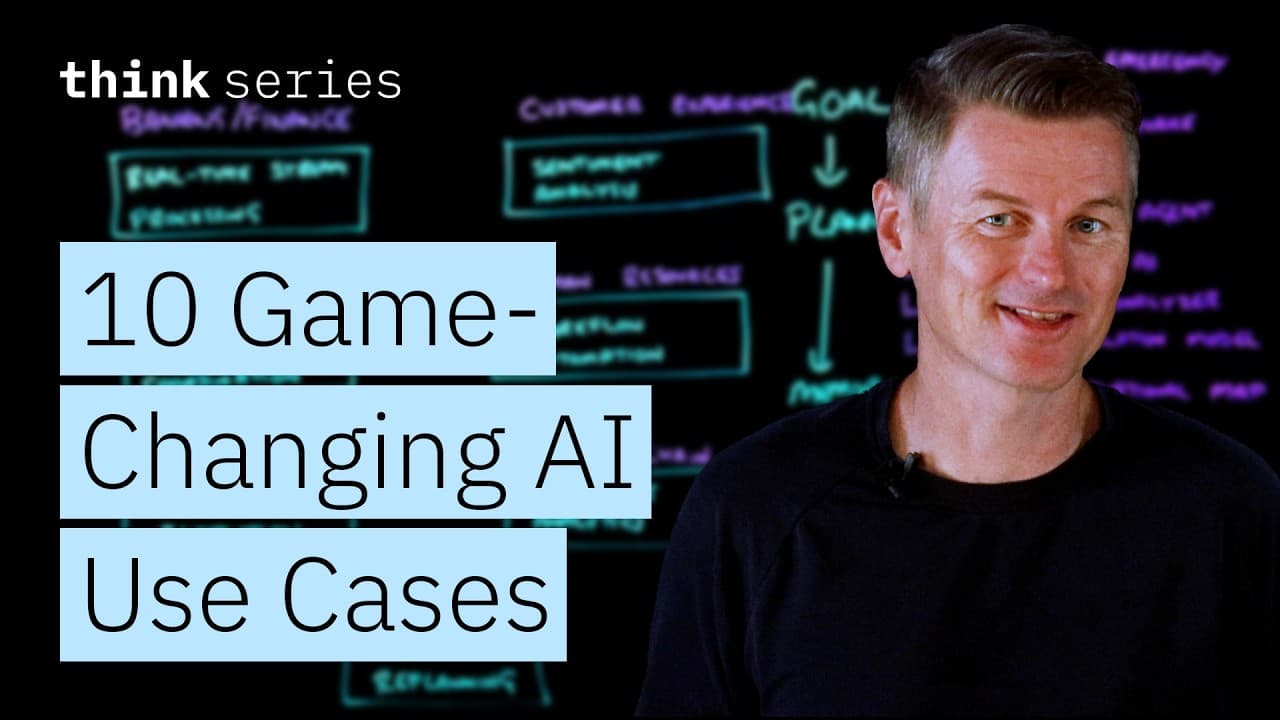
AI agents achieve complex goals by combining a goal, planner, memory, executor, and action component in an iterative feedback loop. They can monitor farms through IoT devices, create current and well-supported content with retrieval augmented generation, coordinate disaster response through specialist agents, and automate decisions across finance, healthcare, human resources, IT operations, supply chains, customer service, and transportation.
Transcript
AI agents can reason and act autonomously to achieve goals, and unlike a chatbot that only responds one prompt at a time, AI agents maintain state and can break down complex tasks into subtasks, execute them in a sequence, or all at once in parallel, and then adjust their plan based on intermediate results to ultimately execute actions towards a de... Read More
Key Insights
- AI agents are autonomous systems that maintain state, divide complex objectives into subtasks, execute work sequentially or in parallel, and revise their plans based on intermediate results until they can take actions supporting a defined goal.
- The core AI agent framework is a cycle of goal, planner, memory, executor, and action. External tools provide current information, memory supplies historical context, the executor develops an action plan, and connected systems carry out the selected action.
- Agricultural AI agents are systems that combine current weather conditions, soil readings, past actions, and irrigation history to decide how crops should be managed. They can then operate irrigation through IoT controllers and adjust future decisions using crop growth outcomes.
- Retrieval augmented generation is a method that gives a content agent access to fresh, task-specific information instead of relying only on an LLM's training data. Documents are divided into chunks, embedded in a vector database, and retrieved as relevant sections are written.
- Content creation agents are able to plan an article, search for statistics and research, populate an outline, adapt the tone to a specified audience, and critique their own drafts. When evidence or style is insufficient, they can search again or revise the writing.
- Multi-agent disaster response is a parallel workflow in which specialist agents analyze sources such as satellite images, social media posts, damage simulations, emergency transcripts, and sensor data. Their findings update a shared situational map used to recommend and coordinate emergency actions.
- Industry-specific AI agents apply distinct capabilities to different goals. Examples include stream processing for financial fraud detection, sentiment analysis for customer interactions, specialist coordination in healthcare, workflow automation in human resources, and automated remediation in IT operations.
- Dynamic replanning is the ability to revise actions continuously as conditions change. Transportation agents demonstrate it by recalculating optimal routes, while supply chain agents use predictive analytics to forecast demand based on market conditions and agricultural agents react to updated sensor data.
- More videos from this channel:
- More from this channel: IBM Technology
Install to Summarize YouTube Videos and Get Transcripts
Explore YouTube Video Summarizer or Get YouTube Transcript Extractor
Questions & Answers
Q: How do AI agents differ from ordinary chatbots?
AI agents differ from chatbots because they do more than respond to one prompt at a time. They maintain state, break complex goals into smaller tasks, execute those tasks sequentially or in parallel, and revise their plans using intermediate results. They can also connect to tools and external systems, allowing them to perform actions that advance a defined goal.
Q: What components make up the core AI agent framework?
The core framework consists of a goal, planner, memory, executor, and action component. The goal defines the desired outcome. The planner uses an LLM and external tools to organize the work. Memory stores past actions and relevant context. The executor creates an action plan, and the action component interacts with connected systems to carry it out.
Q: How can AI agents improve agriculture with IoT?
Agricultural AI agents can pursue goals such as maximizing crop yield while reducing waste. They use APIs to obtain current weather conditions and soil readings, combine that information with stored context such as the date of the last irrigation, and determine an appropriate response. An IoT controller can then perform the action, such as running irrigation for a selected period.
Q: How does retrieval augmented generation support content creation?
Retrieval augmented generation gives a content agent access to current, task-specific sources. The agent searches for relevant articles, statistics, case studies, and research papers, divides the documents into chunks, and embeds those chunks in a vector database. While drafting, it retrieves information related to the current section instead of depending only on the LLM's older training data.
Q: How can an AI agent refine a blog post automatically?
A content agent can first create an outline, retrieve relevant facts, draft each section, and adjust the language for its intended audience. It can then critique the draft by checking whether claims are supported and whether the tone matches the brief. If it detects missing evidence or unsuitable wording, it can conduct another search or revise the text before completing the post.
Q: How do multiple AI agents coordinate disaster response?
A coordinator agent can assign parallel tasks to specialist agents during a major earthquake or wildfire. One agent may inspect satellite imagery for collapsed buildings, another may scan social media for distress messages, and another may forecast damage. Their findings update a shared situational map, which supports recommendations such as dispatching vehicles, routing ambulances, and sending evacuation alerts.
Q: What are practical AI agent use cases across industries?
Practical applications include monitoring farms and controlling irrigation, creating content with retrieval augmented generation, and coordinating disaster response through specialist agents. Other examples include detecting financial fraud, analyzing customer sentiment, coordinating healthcare tasks, onboarding employees, diagnosing and repairing IT problems, forecasting supply chain demand, and recalculating transportation routes as conditions change.
Q: Why are feedback loops important for AI agents?
Feedback loops allow an AI agent to update its planning, execution, and actions when new information or results become available. An agricultural agent can evaluate crop growth outcomes and improve resource decisions, while a writing agent can identify weak evidence and retrieve better sources. This iterative process helps the agent adapt its behavior while continuing to work toward its defined goal.
Summary & Key Takeaways
-
AI agents differ from prompt-by-prompt chatbots because they maintain state, divide complex goals into subtasks, execute tasks sequentially or in parallel, and revise plans using intermediate results. Their common operating framework combines a defined goal with planning, memory, execution, action, and feedback that supports iterative improvement.
-
Agricultural agents combine weather data, soil readings, irrigation history, and IoT controllers to improve crop yield while reducing waste. Content creation agents use retrieval augmented generation to search current sources, store document chunks in a vector database, retrieve relevant facts, draft for a target audience, and refine unsupported sections.
-
Disaster response demonstrates multi-agent coordination, with specialist agents analyzing satellite imagery, social media, and damage forecasts in parallel. Additional applications include fraud detection, sentiment-aware customer service, healthcare coordination, employee onboarding, automated IT remediation, demand forecasting, and transportation route planning. Each application follows the same fundamental agent framework.
Read in Other Languages (beta)
Share This Summary 📚
Summarize YouTube Videos and Get Video Transcripts with 1-Click
Try YouTube Summary with ChatGPT & Claude or YouTube Transcript Generator
Explore More Summaries from IBM Technology 📚
Summarize YouTube Videos and Get Video Transcripts with 1-Click
Try YouTube Summary with ChatGPT & Claude or YouTube Transcript Generator