How to design decision agents with DMN and ML
TL;DR
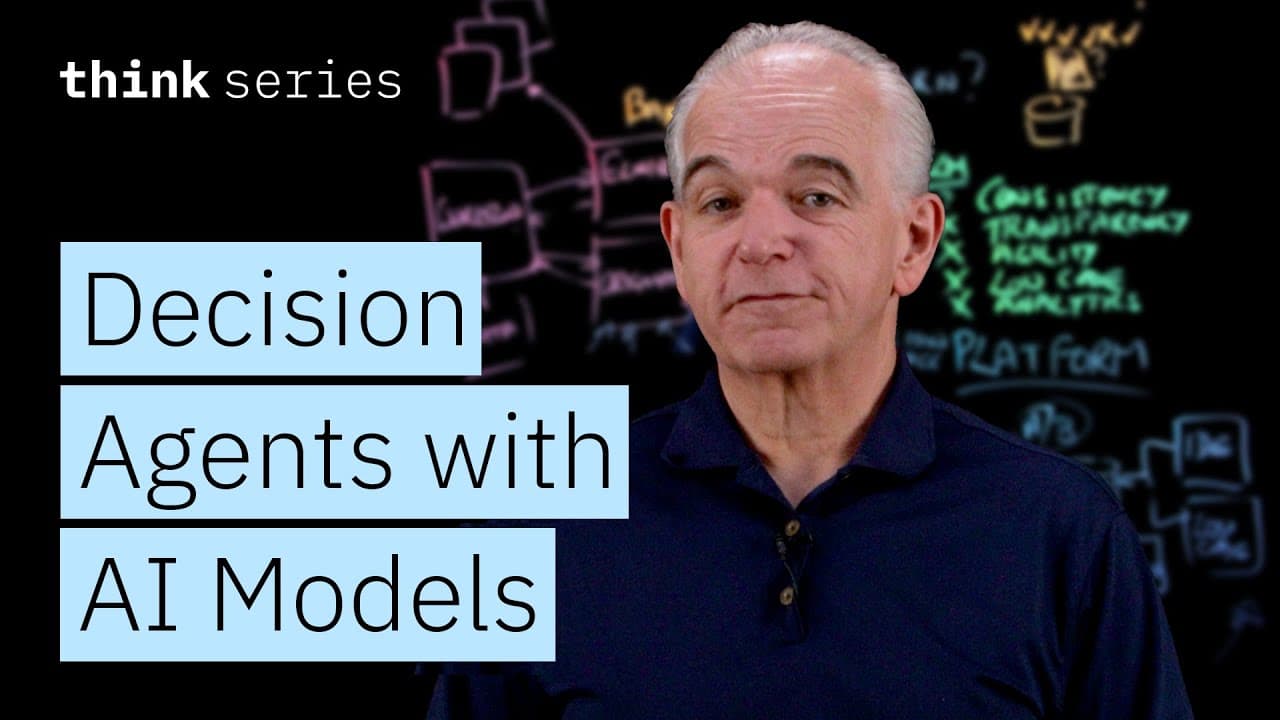
Decision agents use DMN to visually model how a loan origination decision should work, combining decision shapes, inputs, and knowledge sources with rules and ML where appropriate. The DMN approach emphasizes a reusable, explainable structure for decisions, enabling transparency and scalability across complex banking scenarios like loan origination for boats.
Transcript
If you're using agentic AI to build large autonomous systems, you're going to need to build decision agents. These are agents in your agentic framework that literally make decisions. And it turns out the large language models are not very good at making decisions. They're not consistent. They're not transparent. And so you need to use a differe... Read More
Key Insights
- DMN uses three core shapes and two lines to map most decision logic, providing a compact, scalable visual language for decision agents.
- Decisions are represented as rectangles, input data as ovals, and dependencies as solid arrows, creating a graph that shows how information flows to an output.
- Knowledge sources act as authorities that justify decisions, linking policy or risk guidance to the decision model for traceability.
- Subdecisions decompose complex questions into smaller decisions, enabling reusable components across multiple diagrams and decisions.
- Input data can be reused across diagrams, and you can reference the same data in different parts of the model to maintain consistency.
- Business knowledge models represent reusable calculations or functions, such as calculating payments or income, that can be shared across decisions.
- Decision tables are commonly used to encode the logic inside each decision, translating inputs into a clear yes/no or multi-output result.
- Diagrams in DMN are views into a network of decisions, not just static pictures, allowing large models to remain navigable and explainable.
- More videos from this channel:
- More from this channel: IBM Technology
Install to Summarize YouTube Videos and Get Transcripts
Explore YouTube Video Summarizer or Get YouTube Transcript Extractor
Questions & Answers
Q: How does DMN help in building transparent AI decision agents
DMN provides a visual blueprint that describes exactly how a decision should work, using a small set of shapes to represent decisions, inputs, and knowledge authorities. This structure makes the reasoning behind each decision traceable, allowing stakeholders to inspect dependencies and outputs, supporting governance and auditability in autonomous systems.
Q: What are the core shapes used in DMN diagrams
The core shapes are rectangles for decisions, ovals for input data, and solid arrows for dependencies. Additional shapes include knowledge sources to capture authorities and groups to organize related components. These shapes collectively model the decision logic, inputs, and the relationships that drive the final output in a decision agent.
Q: Why are decision tables important in DMN
Decision tables encode the logic inside each decision in a tabular form, mapping conditions to outcomes. This explicit representation makes it easier to validate, test, and modify decision rules, and it supports consistent behavior across subdecisions and higher level decisions, aiding transparency and maintainability.
Q: How can decision models be reused across diagrams
Diagrams in DMN can reference the same decision components or data objects, enabling reuse of decisions like credit tier or risk checks across multiple origination or marketing diagrams. By treating decisions as objects, they can be shared, updated in one place, and propagate consistently to all diagrams that rely on them.
Q: What role do knowledge sources play in DMN
Knowledge sources represent authorities such as policies or risk guidelines that justify how a decision should be made. They connect to decisions through authority requirements, helping teams track why certain logic or inputs are used, which improves traceability and compliance in decision making.
Q: How does a DMN model handle input data
Input data in DMN is depicted as ovals and is linked to decisions via dependency arrows. These inputs can be simple fields or complex objects, like a vehicle description or customer data, and they drive the evaluation of subdecisions and the final origination decision.
Q: What is an origination decision in the example
In the boat loan example, the origination decision determines whether to lend money and under what terms. It is decomposed into subdecisions like vehicle type, loan-to-value, and creditworthiness, each providing essential inputs. The decision aggregates these factors to decide if lending should occur.
Q: How do you use DMN to scale decisions in banking
DMN scales decisions by decomposing complex problems into subdecisions, reusing core concepts across diagrams, and connecting decisions to knowledge sources and inputs. This creates a modular, auditable decision network that can handle large, evolving origination processes while preserving transparency and consistency across multiple scenarios.
Summary & Key Takeaways
-
A visual blueprint called a decision model using three shapes and two lines guides how a decision agent should work, showing inputs, dependencies, and outputs.
-
The DMN approach includes knowledge sources and business knowledge models to capture authorities and reusable logic, improving explainability and reuse across diagrams.
-
The example loan origination decision demonstrates decomposing a decision into subdecisions and linking inputs to outputs through a dependency network and decision tables.
Read in Other Languages (beta)
Share This Summary 📚
Summarize YouTube Videos and Get Video Transcripts with 1-Click
Try YouTube Summary with ChatGPT & Claude or YouTube Transcript Generator
Explore More Summaries from IBM Technology 📚



Summarize YouTube Videos and Get Video Transcripts with 1-Click
Try YouTube Summary with ChatGPT & Claude or YouTube Transcript Generator