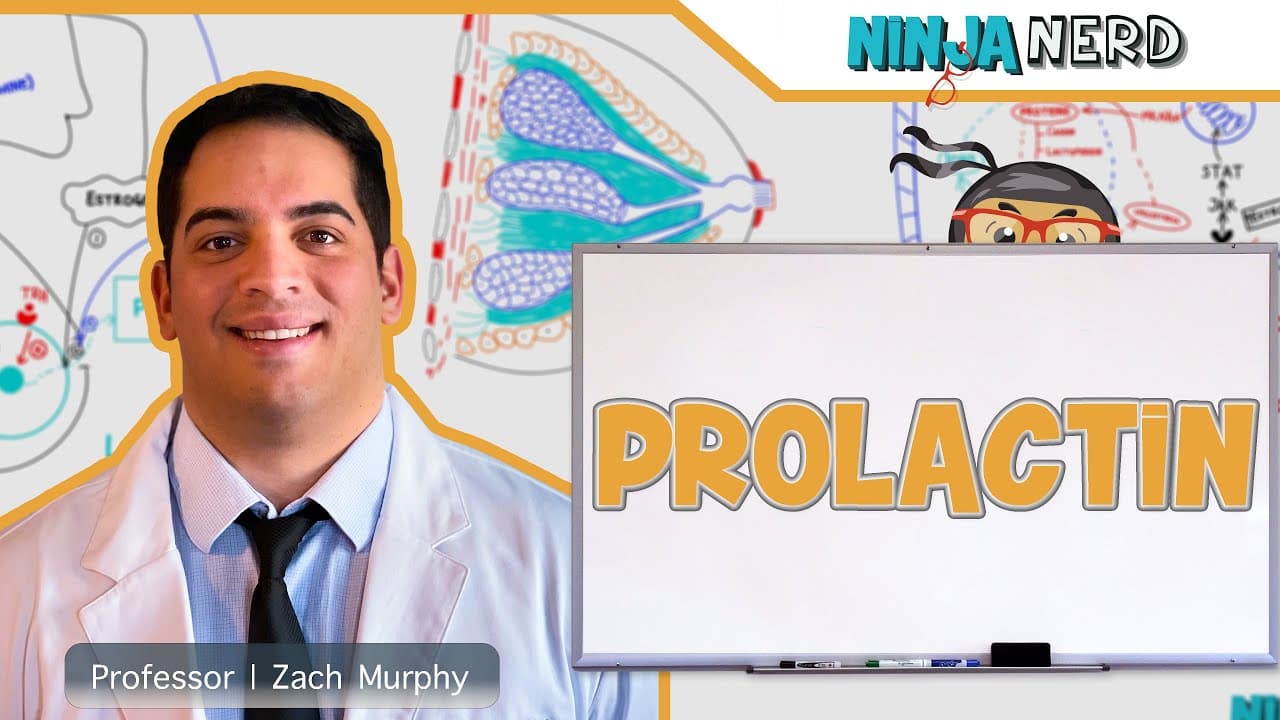
How does prolactin promote lactation and milk production?
TL;DR
Prolactin stimulates alveolar cells in the mammary gland to produce milk by activating transcription and translation of milk components. It is tonically inhibited by dopamine, while stimulatory inputs include thyrotropin releasing hormone, estrogen, and nipple stimulation through breastfeeding. These signals coordinate lactation with pregnancy, postpartum changes, and potential disorders.
Transcript
all right Ninja nerds so what we're going to do in this video is we're going to talk about prolactin okay so if you guys remember from the hypothalamic pituitary axis video we discussed what were the stimuli and what were some of the inhibiting factors for prolactin we're going to get into a little bit more detail on that and look at its effect on ... Read More
Key Insights
- Prolactin promotes lactation by acting on mammary alveolar cells to produce milk.
- Dopamine from the hypothalamus tonically inhibits prolactin release.
- TRH stimulates prolactin release via the hypothalamic-pituitary axis.
- Estrogen increases prolactin production and reduces dopamine inhibition.
- Nipple stimulation during breastfeeding boosts prolactin signaling.
- Prolactin interacts with oxytocin to coordinate the lactation reflex.
- Hyperprolactinemia can cause galactorrhea and infertility symptoms.
- Dopamine agonists are used to treat high prolactin levels by reducing secretion.
- More videos from this channel:
- More from this channel: Ninja Nerd
Install to Summarize YouTube Videos and Get Transcripts
Explore YouTube Video Summarizer or Get YouTube Transcript Extractor
Questions & Answers
Q: What triggers prolactin release from the anterior pituitary?
Prolactin release is triggered by stimulatory signals from thyrotropin releasing hormone, estrogen, and nipple stimulation that can occur during pregnancy and postpartum periods. These signals reduce dopamine inhibition or provide direct stimulation to lactotrope cells, leading to transcription and translation of prolactin. This mechanism ensures milk production aligns with developmental and reproductive status.
Q: How does dopamine affect prolactin and why is it important?
Dopamine acts as prolactin inhibiting hormone, tonically suppressing prolactin release from lactotrope cells in the anterior pituitary. This inhibitory control is crucial to prevent unnecessary lactation. When inhibition is lifted by stimulatory inputs such as TRH or estrogen or by breastfeeding feedback, prolactin levels rise to promote milk production in response to infant demand and hormonal context.
Q: What role does estrogen play in prolactin regulation?
Estrogen has a dual role in prolactin regulation: it directly stimulates prolactin production and also inhibits arcuate nucleus neurons that release dopamine, reducing inhibitory tone. This combined effect increases prolactin availability, which is particularly important during pregnancy and postpartum periods to prepare and sustain lactation in response to infant feeding cues.
Q: How does nipple stimulation influence prolactin levels?
Nipple stimulation during breastfeeding provides a mechanical signal that increases prolactin production by enhancing thyrotropin releasing hormone activity and reducing inhibitory dopamine influence. This feedback loop elevates prolactin, boosting milk synthesis while oxytocin coordinates milk ejection, ensuring effective lactation in response to infant suckling.
Q: What is the relationship between prolactin and milk production at the cellular level?
Prolactin circulates in the bloodstream and binds to receptors on alveolar cells in the mammary gland. This activates receptor-associated kinases leading to activation of STAT transcription factors, increasing mRNA for milk proteins and other factors, which are translated by ribosomes to synthesize milk components and facilitate secretion into the gland lumen.
Q: What clinical conditions are linked to prolactin regulation?
Clinical relevance includes hyperprolactinemia, which can be caused by pituitary adenomas or certain medications like antipsychotics. Symptoms include galactorrhea and infertility due to disruption of the normal reproductive hormonal axis. Management may involve dopamine agonists such as bromocriptine or cabergoline to suppress excessive prolactin secretion and restore hormonal balance.
Q: How does TRH influence prolactin compared to other releasing hormones?
TRH from the paraventricular nucleus acts as a releasing hormone that stimulates lactotrope cells to produce prolactin, contrasting with dopamine which inhibits release. The presence of TRH creates an additional pathway to raise prolactin levels when pregnancy, postpartum changes, or breastfeeding demands milk production, integrating thyroid axis signals with lactation needs.
Q: Why is prolactin important for the lactation process beyond milk synthesis?
Prolactin not only promotes milk protein production in alveolar cells but also supports the lactation reflex by coordinating with oxytocin for milk ejection. Its regulation ensures that milk production aligns with infant demand and hormonal status, preventing unnecessary lactation while enabling successful reproduction and energy transfer through breastfeeding.
Summary & Key Takeaways
-
Prolactin acts on alveolar cells in the mammary gland to promote milk production, driven by signaling pathways that increase milk protein synthesis and secretion.
-
Dopamine from the hypothalamus provides tonic inhibition, while TRH and estrogen provide stimulatory inputs, and breastfeeding provides a mechanical stimulus that enhances prolactin release.
-
The clinical relevance includes conditions like hyperprolactinemia and its treatments, linking prolactin regulation to reproductive health and lactation dynamics.
Read in Other Languages (beta)
Share This Summary 📚
Summarize YouTube Videos and Get Video Transcripts with 1-Click
Try YouTube Summary with ChatGPT & Claude or YouTube Transcript Generator
Explore More Summaries from Ninja Nerd 📚




Summarize YouTube Videos and Get Video Transcripts with 1-Click
Try YouTube Summary with ChatGPT & Claude or YouTube Transcript Generator