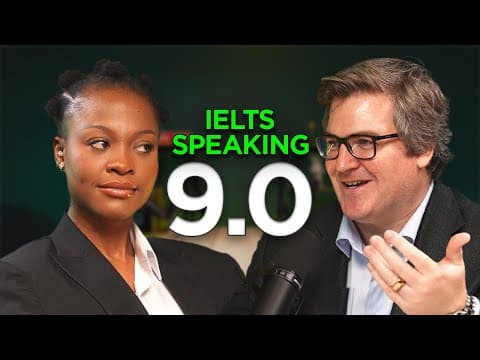
How to raise IELTS Speaking score with four simple tips

TL;DR
The key is to fix four simple areas, not chase complex ideas. By improving fluency, reducing errors, using appropriate vocabulary, and slowing pronunciation, Priyanka moved from band six to eight in two weeks. The method emphasizes natural speaking and clarity over trying to sound overly sophisticated.
Transcript
Priyanka failed her speaking test four times in a row and she was about to give up on her dream of moving to Canada forever but after I gave her these four simple tips she jumped from a band six to a band eight in just two weeks so the other day I got this email Chris my test is in two weeks and I'm going to fail again I failed my speaking four tim... Read More
Key Insights
- Priyanka improved from band six to eight in two weeks.
- Fluency issues were addressed by reducing filler sounds like ums and ers.
- Zero error sentences contribute to higher grammar scores.
- Complex ideas are not necessary for a high score, accuracy matters more.
- Vocabulary should be viewed as a toolkit rather than a hurdle for complexity.
- Pronunciation improves when the speaker slows down and is relaxed.
- Simplified but accurate grammar can outperform complex but error-prone structures.
- The method emphasizes speaking naturally to reflect real language use.
- More videos from this channel:
- More from this channel: IELTS Advantage
Install to Summarize YouTube Videos and Get Transcripts
Explore YouTube Video Summarizer or Get YouTube Transcript Extractor
Questions & Answers
Q: How do the four simple tips improve an IELTS speaking score?
The four tips focus on fluency, grammar accuracy, vocabulary usage, and pronunciation. By reducing filler sounds and pauses, using a simpler but accurate range of tenses and structures, relying on a practical vocabulary toolkit instead of trying to use fancy words, and slowing down for clearer pronunciation, a candidate can achieve higher scores. The method shows that simplicity and consistency often outperform complexity under test conditions.
Q: What is the core misconception about vocabulary in the video?
The video argues that more complex vocabulary is not automatically better and can reduce scores if misused. Instead, candidates should rely on a sufficient set of useful words as tools to discuss various topics. This toolkit approach helps learners express ideas clearly and accurately, avoiding mistakes that come with overreaching vocabulary.
Q: Why does the speaker suggest not focusing on complex ideas in the test?
Because the IELTS speaking criteria do not mark idea complexity, but rather fluency, accuracy, and coherence. Trying to generate complex ideas can lead to hesitations, errors, and a less natural delivery. By answering simply and clearly, a candidate can demonstrate genuine language ability without being overwhelmed by complexity.
Q: How did Priyanka’s grammar score change with one-timple change?
Priyanka’s grammar shift involved choosing simpler, error-free sentences that still conveyed meaning. This reduced the rate of grammatical errors and boosted the perception of accuracy, which is a key factor in achieving higher band scores. The video shows that fewer errors can significantly raise the overall grammar score.
Q: What role does pronunciation play in the overall score according to the video?
Pronunciation affects how easily the examiner can understand the speaker. By speaking more slowly and naturally, Priyanka’s pronunciation improved, contributing to a higher score. The video demonstrates that even with strong grammar and vocabulary, fast speech without clarity can hinder understanding and lower scores.
Q: What evidence is provided for the four-tip method's effectiveness?
The narrative follows Priyanka, who failed four times before applying the four tips. After implementing the changes, she achieved band eight in a two-week span and moved to Canada. This success story is presented as evidence that the four tips can produce substantial score increases for motivated learners.
Q: What advice is given about teacher guidance versus self-discovery in speaking tests?
The video cautions against relying solely on tips that promise high scores, suggesting that real, natural language use is more reliable. It emphasizes practicing with the four tips, building confidence, and speaking as one would with friends, rather than chasing tricks to fool examiners. This approach encourages authentic communication.
Q: What additional resources are offered in the description for learners?
The description promotes a VIP course with a 10 percent discount and a free IELTS Speaking Challenge course. These resources are positioned as ways to practice and apply the four tips beyond the video, helping learners systematically improve their speaking skills and test readiness.
Summary & Key Takeaways
-
Priyanka faced repeated failures before testing improvements. The video demonstrates four simple tips that dramatically improved her fluency, grammar accuracy, and pronunciation. The approach focuses on speaking naturally, using a reliable vocabulary toolkit, and avoiding unnecessary complexity. The result shows a band eight outcome after two weeks.
-
The narrative contrasts common teacher guidance about complex ideas with practical fixes that prioritize accuracy and flow. It explains that the examiner marks fluency and accuracy more than idea complexity, and that confident, relaxed delivery enhances pronunciation.
-
The video also promotes a free IELTS speaking course and a VIP course discount, inviting viewers to adopt the four tips and test them in practice sessions for noticeable score gains.
Read in Other Languages (beta)
Share This Summary 📚
Summarize YouTube Videos and Get Video Transcripts with 1-Click
Try YouTube Summary with ChatGPT & Claude or YouTube Transcript Generator
Explore More Summaries from IELTS Advantage 📚

Summarize YouTube Videos and Get Video Transcripts with 1-Click
Try YouTube Summary with ChatGPT & Claude or YouTube Transcript Generator