How to ace IELTS Speaking: Band 9 tips and strategies

TL;DR
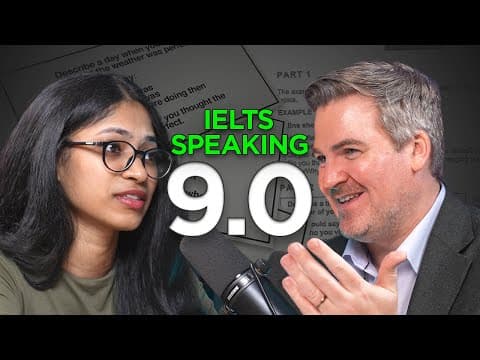
Achieving a Band 9 in IELTS Speaking hinges on focused practice, deep development of ideas, and concise, well-structured answers. The guide emphasizes sticking to one or two main points, extending them with reasoning, and avoiding listing many items. It also highlights practicing Part 1 to Part 3 responses and using targeted feedback to improve pronunciation and fluency.
Transcript
let's start off by talking about your daily routine tell me about your daily routine okay well I wake up around 8 a.m. uh every morning it's like clockwork and I brush my teeth I wash my face breakfast um and then I get in my car and I drive to work and uh yeah that's basically it I come back home and uh fix myself up some dinner and watch on Netfl... Read More
Key Insights
- Answers should be built around one or two strong ideas rather than multiple topics
- Development of ideas is key, with reasoning and examples to support claims
- Under exam pressure, candidates often list items; deep explanations are preferred
- Part three requires discussing ideas beyond personal experience and addressing different viewpoints
- Feedback should target pronunciation, fluency, grammar, and vocabulary balance
- Structured practice across all parts helps build confidence and coherence
- Course promotions are used to offer additional practice materials and mentorship
- Evening and weekend routines can influence a test-taker's productivity and mindset
- More videos from this channel:
- More from this channel: IELTS Advantage
Install to Summarize YouTube Videos and Get Transcripts
Explore YouTube Video Summarizer or Get YouTube Transcript Extractor
Questions & Answers
Q: What is the recommended approach to Part 1 responses in IELTS Speaking?
Part 1 responses should be natural and conversational, but the key is to avoid listing too many items. Focus on one or two ideas and explain them with brief, clear reasoning. This approach demonstrates control of language, keeps the dialogue engaging, and lays a strong foundation for deeper Parts 2 and 3 discussions.
Q: Why should a candidate avoid listing many items in answers?
Listing many items signals to the examiner that the speaker may not have a solid grasp of sentence construction. Instead, selecting one or two focal points and expanding on them shows stronger grammar, vocabulary, and coherence. This depth helps demonstrate linguistic range and the ability to sustain a topic.
Q: How does the video suggest handling Part 3 discussions?
Part 3 should explore ideas beyond personal experience and present multiple perspectives. You should argue a point while also acknowledging counterarguments, which demonstrates critical thinking and the ability to articulate nuanced views. This balance strengthens coherence and argumentative skills.
Q: What role does feedback play in achieving Band 9, according to the video?
Feedback helps identify weaknesses in pronunciation, fluency, grammar, and vocabulary, providing concrete targets for improvement. Regular, actionable feedback allows a candidate to refine delivery, adjust pacing, and expand lexical range, contributing to a more confident and coherent performance across all parts.
Q: What is emphasized about daily routines and weekend differences in the transcript?
The transcript notes that weekday routines focus on productivity and work, while weekends offer freedom to pursue personal interests. This contrast can help a speaker generate authentic and varied responses in Part 1 by drawing on real-life patterns and emotions related to routine changes.
Q: How does the video describe learning from dreams for IELTS speaking preparation?
The video suggests that dreams can reveal repressed emotions and stress, and may even provide insights or imagery. Incorporating personal reflections about dreams can help demonstrate a broader range of vocabulary and the ability to discuss abstract topics, which can strengthen speaking responses.
Q: What listening-to-sources suggests for managing emails in a speaking task?
The transcript mentions managing work emails and prioritizing tasks. In speaking, you could reference related experiences about communication, responsiveness, and time management to create authentic examples while maintaining relevance to everyday professional life.
Q: What promotional content is included in the video description?
The description offers a VIP course discount of 10 percent and provides a Band 9 Speaking Frameworks PDF. It positions the course as highly successful with many success stories and invites viewers to sign up for feedback and practice, which can be used as additional study materials for learners.
Summary & Key Takeaways
-
The video outlines practical strategies for improving IELTS Speaking performance, including how to structure answers, develop ideas, and avoid overloading responses with multiple lists. It also stresses practice under exam-like pressure and using feedback to refine pronunciation and fluency. The content centers on real-world techniques for higher band scores.
-
The presenter reviews parts of the speaking test, highlighting timing, depth of response, and linking ideas. It stresses the importance of presenting a clear stance and exploring both sides of an argument in Part 3. The description promotes a VIP course and a short practice PDF.
-
The overall message is to practice consistently, refine delivery, and use feedback to reach Band 9 by focusing on depth over breadth and effective communication.
Read in Other Languages (beta)
Share This Summary 📚
Summarize YouTube Videos and Get Video Transcripts with 1-Click
Try YouTube Summary with ChatGPT & Claude or YouTube Transcript Generator
Explore More Summaries from IELTS Advantage 📚

Summarize YouTube Videos and Get Video Transcripts with 1-Click
Try YouTube Summary with ChatGPT & Claude or YouTube Transcript Generator