How to study IELTS reading question types effectively
TL;DR
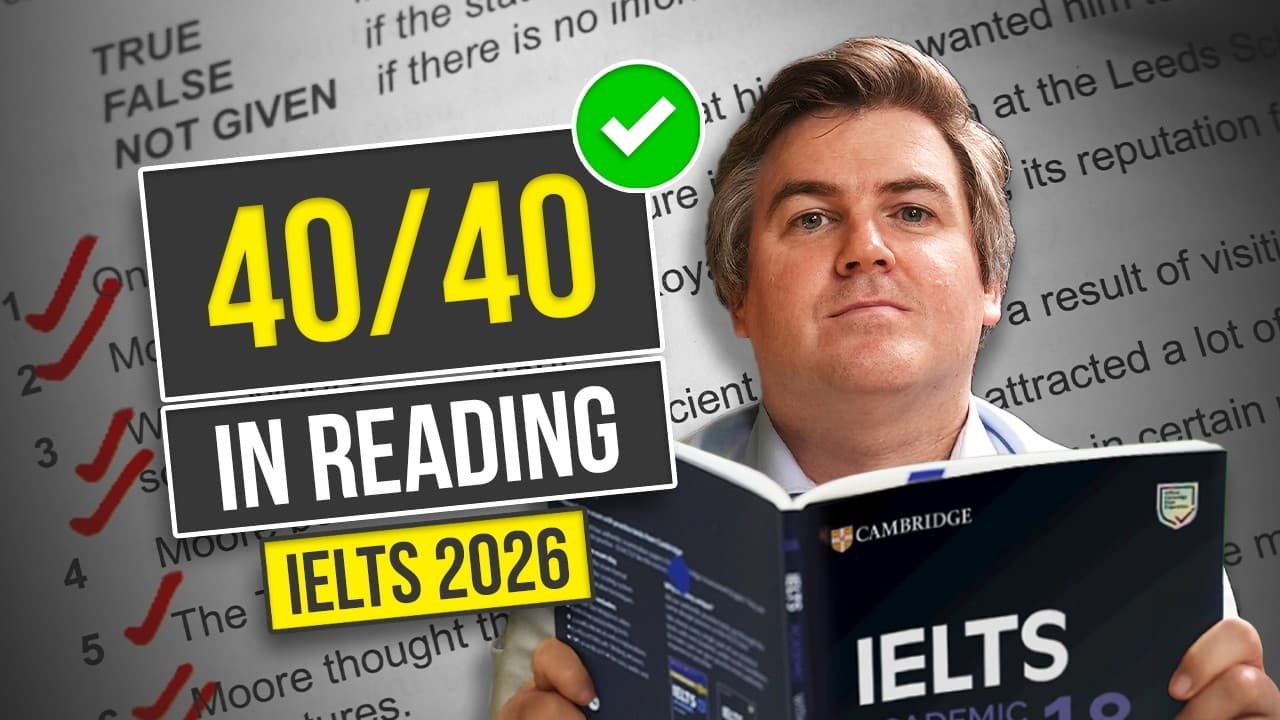
Knowing there are 11 distinct IELTS reading question types and using a separate strategy for each type is essential for a high score. Relying on one blanket method hurts performance; instead, study the differences between question types, and use targeted skimming or scanning techniques as appropriate to each task. Practical steps include reviewing official guidelines from IDP and British Council and avoiding generic tricks.
Transcript
I researched the most popular reading tips and tricks so that you don't have to I'm going to show you exactly what the British Council and IDP have to say about these very very popular reading tricks and I'm also going to show you exactly how to use them and show you if they lower your score or improve your score so without further Ado let's get in... Read More
Key Insights
- 11 question types exist in IELTS reading and each type needs its own strategy.
- Official resources from IDP and British Council align teaching plans with testing subskills.
- One universal strategy for all questions is considered ineffective by experienced teachers.
- Matching headings requires understanding paragraph main ideas before headings.
- True false not given tests location and verification of specific information.
- Skimming and scanning are useful tools when applied correctly according to official guidance.
- Many popular videos oversell simple tricks, causing cognitive overload and poor results.
- Structured, type-specific practice yields better results than generic tips or myths.
- More videos from this channel:
- More from this channel: IELTS Advantage
Install to Summarize YouTube Videos and Get Transcripts
Explore YouTube Video Summarizer or Get YouTube Transcript Extractor
Questions & Answers
Q: What is the core reason to have a separate strategy for each IELTS reading question type
The core reason is that each question type tests different subskills and functions, so a universal approach cannot efficiently target the specific reading skills each type requires. By using a dedicated strategy for every type, test takers focus on the precise steps needed to locate, interpret, and verify information, improving accuracy and speed on exam day.
Q: How do IDP and British Council contribute to understanding IELTS reading question types
IDP provides guidance on the variety of task types likely to appear on the academic reading test and explains how these tasks test different subskills. The British Council offers lesson plans for each question type, reinforcing that teachers should tailor instruction to the specific skills each type assesses. Together, they promote a structured, type-specific approach over generic tips.
Q: Why is one strategy for all questions viewed as ineffective by experts
Experts argue that different question types demand different cognitive processes, such as skimming and scanning for certain tasks or careful verification for others. A single strategy fails to address these varied demands, leading to slower progress on some tasks and incorrect answers on others, ultimately lowering overall test performance.
Q: What does matching headings test and how should a student approach it
Matching headings tests the ability to understand the general meaning of each paragraph. The recommended approach is to read the paragraphs first to grasp main ideas and then consider headings only after forming an overall sense of the text, which helps select the most fitting headings based on paragraph content.
Q: What is the key difference between skimming and scanning in IELTS reading
Skimming is used to grasp the overall gist or main idea of a passage, while scanning is used to locate specific details or information. Official guidance supports both techniques, but they must be applied to the correct task: skimming for general understanding and target locating for precise information, not as a universal shortcut.
Q: Why does the video criticize popular true false not given tips
The video argues that many popular tips for true false not given rely on oversimplified tricks instead of clear, reliable strategies. It emphasizes that true false not given tests precise information location and careful verification, which cannot be achieved by vague shortcuts, and suggests learners should follow proven methods linked to official guidance.
Q: What role do Pauline Cullen and Cambridge play in this context
Pauline Cullen and Cambridge are cited as authorities on IELTS reading, underscoring that every question has a clear purpose to test specific reading skills. Their work supports the idea of using distinct strategies for different question types, reinforcing the credibility of a structured, type-specific study approach.
Q: What additional resource does the speaker promise for learners
The speaker promises access to a follow up resource offering step-by-step strategies for all reading questions. This resource is intended to provide a comprehensive study plan, enabling learners to practice and implement type-specific techniques across the full range of IELTS reading tasks.
Summary & Key Takeaways
-
The video emphasizes that IELTS reading must be approached with a strategy for each of the 11 question types, arguing that one strategy for all types is ineffective. It contrasts guidance from IDP and British Council with common YouTube tips, highlighting the need to tailor approaches to subskills tested. Practical advice includes using official resources and recognizing the purpose of each question type.
-
The speaker explains true false not given as testing distinct subskills, requiring careful location and verification of information rather than general understanding. Skimming and scanning are presented as useful tools when applied correctly, not as universal shortcuts, and are supported by official guidance from IDP. The overall message is to replace hype with structured, type-specific strategies to improve accuracy and speed on test day.
-
The guidance also covers the importance of not relying on a single overall strategy for all questions, and it explains that matching headings tests main ideas while true false not given tests precision. It references credible sources like Pauline Cullen and Cambridge, and it promises a follow up resource with step-by-step strategies for all reading questions, reinforcing the need for a comprehensive study plan.
Read in Other Languages (beta)
Share This Summary 📚
Summarize YouTube Videos and Get Video Transcripts with 1-Click
Try YouTube Summary with ChatGPT & Claude or YouTube Transcript Generator
Explore More Summaries from IELTS Advantage 📚
Summarize YouTube Videos and Get Video Transcripts with 1-Click
Try YouTube Summary with ChatGPT & Claude or YouTube Transcript Generator