How to Use IELTS Sample Essays to Improve Writing
TL;DR
Use real, examiner-checked IELTS essays as active practice material, not as text to memorize or copy. Compare your own ideas, development, structure, and linking choices with responses written by students who later achieved Bands 7, 8, or 9, then concentrate on the weakest part of your writing before moving to another skill.
Transcript
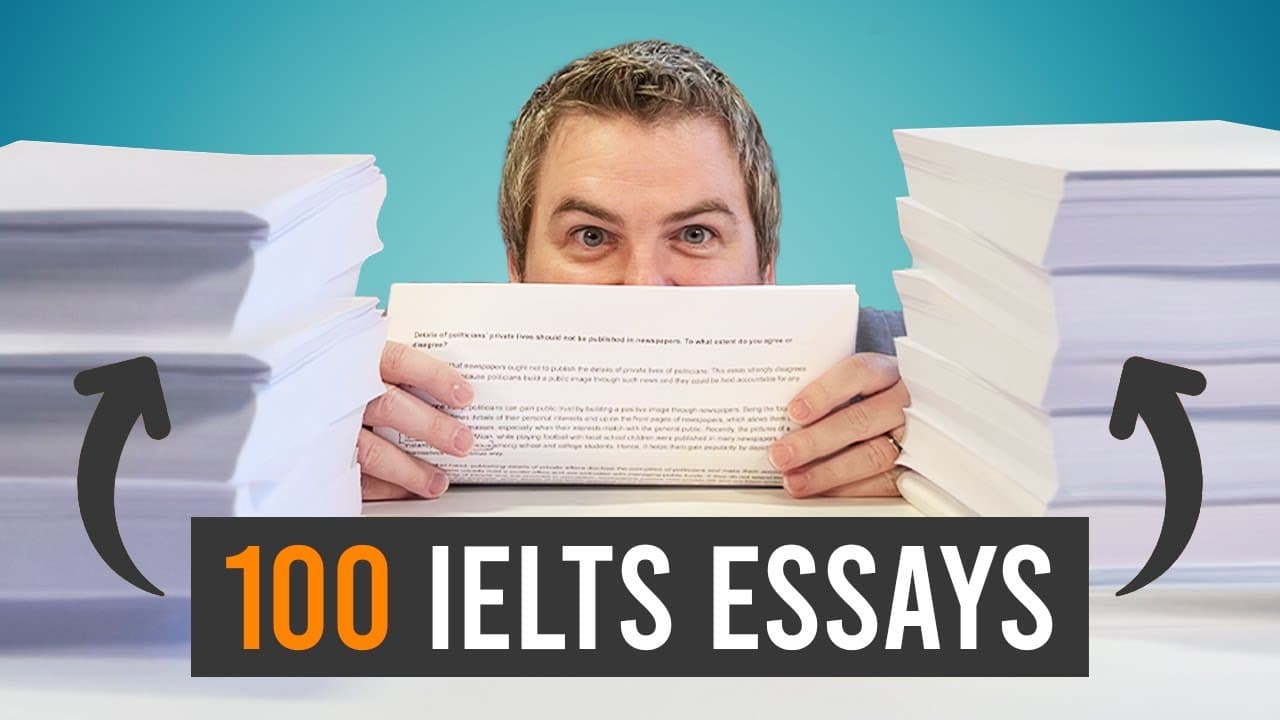
- In this video I'm gonna share with you 100 real band seven, These essays have been marked and the students that wrote them all went on to get either or nine in the real test. But our goal is not to just Our goal is to help you So on top of giving you these essays, what we're gonna do is do two more things that are going to help you improve your w... Read More
Key Insights
- Authentic sample essays are essential because copying language and habits from writers who did not achieve the desired score can reinforce weak writing. The provided collection consists of essays marked before their writers went on to receive Bands 7, 8, or 9 in the real test.
- Passive reading is not writing practice because simply looking through many essays does not develop the ability to generate, organize, and express an answer. Improvement requires an active task, such as predicting ideas, writing explanations, mapping structure, or evaluating how a specific linking expression functions.
- Band 9 writing is often simple and easy to understand, while apparently complicated vocabulary does not prove that an essay deserves a high score. Students may misjudge performance because they are not trained examiners, so samples should be studied for useful patterns rather than informally regraded.
- Memorization is not the purpose of sample essays because IELTS writing tests whether a candidate can communicate an answer in English. Samples can support improvement in grammar and vocabulary, but memorized passages may not address the actual question and cannot replace relevant, independent writing.
- The best improvement target is a weakness rather than an existing strength. Students do not need to apply every suggested technique at once. They should identify the area causing the greatest difficulty, select the matching sample-based exercise, and move to another area after making progress.
- Effective idea generation starts with the simplest relevant answer to the question. A student can hide the model response, predict obvious and straightforward ideas, and then compare them with the introduction and body paragraphs of several successful essays to identify irrelevant or unnecessarily complicated thinking.
- Idea development improves through independent explanation and comparison. After identifying a sample essay's main ideas, a student can write possible reasons or examples on a blank page, reveal the original development, and evaluate whether the response was relevant, clear, and sufficiently explained.
- Coherence and cohesion depend on purposeful linking rather than a large number of linking words. The example analysis identifies only a small set of devices, including phrases used to clarify, illustrate, or conclude, and warns that excessive linking words can lower rather than increase a writing score.
Install to Summarize YouTube Videos and Get Transcripts
Explore YouTube Video Summarizer or Get YouTube Transcript Extractor
Questions & Answers
Q: How should I use IELTS sample essays to improve my writing?
Use each essay as material for an active exercise. First, choose a weakness such as idea generation, idea development, structure, or coherence. Attempt the relevant part of the task without viewing the response, then compare your work with several essays written by students who later achieved Bands 7, 8, or 9. Identify recurring choices and apply them in your own writing.
Q: Why does passively reading sample essays fail to improve IELTS writing?
Passive reading does not require you to generate ideas, develop explanations, organize paragraphs, or make language choices. The transcript compares this expectation with watching a football final and expecting to become an excellent player afterward. Reading becomes useful when it is combined with deliberate analysis, independent attempts, comparison, and practice focused on a specific weakness.
Q: How can sample essays improve IELTS idea generation?
Cover the response and examine only the question. Write down the simplest, most obvious, and most straightforward ideas that answer it, then reveal the essay and locate its main ideas in the introduction and body paragraphs. Similar ideas suggest that you are on the right track. Different ideas should be checked for relevance and unnecessary complexity rather than rejected automatically.
Q: How can I practice developing ideas with IELTS essays?
Read the question and identify the sample writer's main ideas, but do not immediately study the supporting explanation. On a blank page, develop those ideas yourself with a reason, explanation, or example. Next, compare your development with the student's version. Repeating this process across five, six, or seven essays can reveal clearer and more relevant ways to support a point.
Q: How can I study essay structure from high-scoring samples?
Read the question and the complete essay, then label the function of each section and sentence. Identify where the writer paraphrases the question, gives an opinion, introduces a point, supplies a reason, and concludes. Compare several responses to the same question type, including discussion or causes-and-solutions tasks, to find structural similarities that you can internalize and use independently.
Q: Should I memorize Band 7, 8, or 9 sample essays?
No. The transcript states that IELTS is a writing test in English, not a memorization test. Memorized passages may not answer the question presented on test day, so they do not demonstrate relevant communication. Samples should instead be used to improve grammar, vocabulary, ideas, development, structure, and cohesion through analysis and independent practice rather than word-for-word recall.
Q: Why should I avoid judging whether a sample essay deserves its band?
Students are not IELTS examiners and may associate complicated vocabulary with high performance even when that judgment is unreliable. The transcript describes students repeatedly rating Band 6 essays above Band 9 essays, while viewing simpler Band 9 writing as lower level. Study verified samples to understand effective choices instead of spending practice time trying to disprove their assessed quality.
Q: How should linking words be studied in IELTS sample essays?
Identify every linking expression in the response and ask what function it serves, such as giving an example, clarifying a point, or signaling a conclusion. Then decide whether it was used correctly. Compare several Band 7, 8, and 9 essays to observe that successful writing may contain relatively few linking words. Adding many devices can lower rather than increase the score.
Summary & Key Takeaways
-
Real sample essays are valuable only when used actively. The recommended process is to attempt part of the writing task first, inspect how a successful student handled it, and compare the two approaches. This turns each sample into focused practice for idea generation, development, organization, vocabulary, grammar, or cohesion rather than passive reading.
-
Five practices should be avoided: relying on fake samples, reading without analysis, trying to prove successful essays are weak, memorizing passages, and copying an entire response during the test. These habits either teach poor patterns or fail to develop the ability to communicate a relevant answer independently in English under test conditions.
-
Students should begin with their weakest writing area and study several relevant essays for recurring patterns. Useful exercises include predicting simple ideas before revealing a response, developing identified ideas independently, mapping paragraph functions across question types, and examining each linking expression. Comparison across multiple Band 7, 8, and 9 responses reveals practical choices.
Read in Other Languages (beta)
Share This Summary 📚
Summarize YouTube Videos and Get Video Transcripts with 1-Click
Try YouTube Summary with ChatGPT & Claude or YouTube Transcript Generator
Explore More Summaries from IELTS Advantage 📚

Summarize YouTube Videos and Get Video Transcripts with 1-Click
Try YouTube Summary with ChatGPT & Claude or YouTube Transcript Generator