How to Use Synonyms to Boost IELTS Writing Score
TL;DR
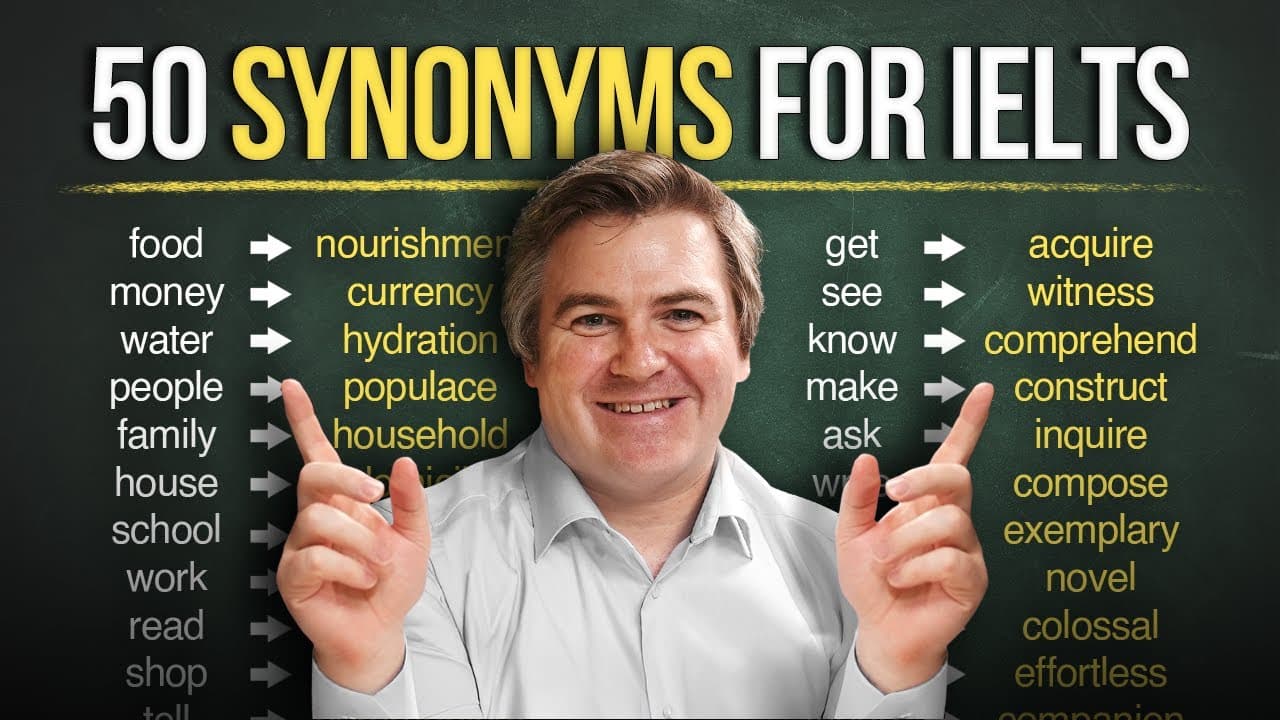
To improve your IELTS writing score, learn and use synonyms for common words used in Band 7-9 essays. Utilizing a varied vocabulary demonstrates linguistic range and can make your essays more persuasive and sophisticated. Avoid simply memorizing lists; instead, understand the context and appropriate use of each synonym.
Transcript
I took 100 real band 7 8 and N essays from our VIP students and found the 50 most common words used in them. You see, if we can find the 50 most common words, we can then learn great synonyms for each word and massively boost our writing scores quickly and easily. And as my gift to you, I've added all 50 words and their synonyms and lots of words n... Read More
Key Insights
- Synonyms enhance writing by providing linguistic variety and sophistication.
- Common words like 'people', 'important', and 'good' can be replaced with 'individuals', 'crucial', and 'beneficial'.
- Using synonyms correctly requires understanding their specific meanings and context.
- Avoid memorizing lists; focus on learning and applying vocabulary accurately.
- The use of varied vocabulary can demonstrate linguistic range to examiners.
- Simple synonyms can still be effective if they show variety and context understanding.
- Misusing advanced words can lower scores, as examiners value accuracy over complexity.
- Downloadable resources and guided practice can aid in mastering vocabulary use.
Install to Summarize YouTube Videos and Get Transcripts
Explore YouTube Video Summarizer or Get YouTube Transcript Extractor
Questions & Answers
Q: How to improve IELTS writing with synonyms?
Improving IELTS writing with synonyms involves replacing common words with more varied vocabulary to demonstrate linguistic range. For instance, use 'individuals' instead of 'people' or 'crucial' instead of 'important'. It's vital to understand the context and specific meanings of synonyms to use them effectively and avoid repetition.
Q: What are effective synonyms for 'important' in IELTS essays?
Effective synonyms for 'important' in IELTS essays include 'crucial', 'vital', and 'essential'. These words convey a stronger sense of necessity and significance, enhancing the persuasiveness of your arguments. Ensure the chosen synonym fits the context to maintain accuracy and clarity in your writing.
Q: Why is it important to use synonyms correctly in IELTS?
Using synonyms correctly in IELTS is important because it demonstrates your ability to vary vocabulary and express ideas more precisely. Correct usage shows examiners a higher level of language proficiency, which can lead to higher scores. Misusing synonyms, however, can confuse meaning and lower your score.
Q: What common mistakes should be avoided when using synonyms?
Common mistakes when using synonyms include using them inaccurately or out of context, which can alter the intended meaning. Avoid memorizing lists without understanding the nuances of each word. Incorrect spelling or grammar associated with synonyms can also negatively impact your score.
Q: How does varied vocabulary affect IELTS writing scores?
Varied vocabulary positively affects IELTS writing scores by showcasing a range of language skills and the ability to express ideas clearly and persuasively. It demonstrates to examiners that you can use different words appropriately in context, which is a key criterion for higher scores in the lexical resource category.
Q: What resources can help in learning IELTS synonyms effectively?
Resources such as downloadable PDFs with lists of common words and their synonyms, online vocabulary exercises, and guided practice videos can help in learning IELTS synonyms effectively. These resources provide structured learning and context, aiding in the accurate application of vocabulary.
Q: How can synonyms enhance the persuasiveness of an essay?
Synonyms enhance the persuasiveness of an essay by allowing you to choose words that convey more precise or stronger connotations. For example, 'crucial' instead of 'important' emphasizes necessity, making arguments more compelling. This variety in vocabulary helps maintain reader interest and reinforces the essay's arguments.
Q: Why should students avoid just memorizing lists of synonyms?
Students should avoid just memorizing lists of synonyms because it often leads to misuse without understanding the specific meanings and contexts. Effective writing requires knowing when and how to use synonyms appropriately, which involves learning their nuances and practicing their application in varied contexts.
Summary & Key Takeaways
-
Improving your IELTS writing involves using synonyms for common words to demonstrate a range of vocabulary. For example, replace 'people' with 'individuals' or 'public' to avoid repetition. Understanding the specific meanings and contexts of synonyms is crucial for their effective use.
-
Synonyms such as 'crucial' for 'important' and 'beneficial' for 'good' can make essays more persuasive. Avoid memorizing lists; instead, focus on learning words in context to use them accurately. This approach helps in achieving higher scores by showcasing linguistic variety.
-
Advanced vocabulary should be used accurately to avoid lowering your score. Examiners look for a range of vocabulary but prioritize correct usage over complexity. Resources like downloadable PDFs can support learning by providing structured guidance and practice.
Read in Other Languages (beta)
Share This Summary 📚
Summarize YouTube Videos and Get Video Transcripts with 1-Click
Try YouTube Summary with ChatGPT & Claude or YouTube Transcript Generator
Explore More Summaries from IELTS Advantage 📚






Summarize YouTube Videos and Get Video Transcripts with 1-Click
Try YouTube Summary with ChatGPT & Claude or YouTube Transcript Generator