How to Get Band 9 Using the IELTS Speaking Strategy from IELTS Advantage

TL;DR
To improve your IELTS Speaking band score, answer directly, develop relevant ideas, and speak naturally without memorizing responses or forcing complex language. In Part 2, focus on the main topic and continue until the examiner stops you at around 2 minutes. The section-by-section guidance explains how comfortable ideas, clear pronunciation, and manageable language can support stronger fluency.
Transcript
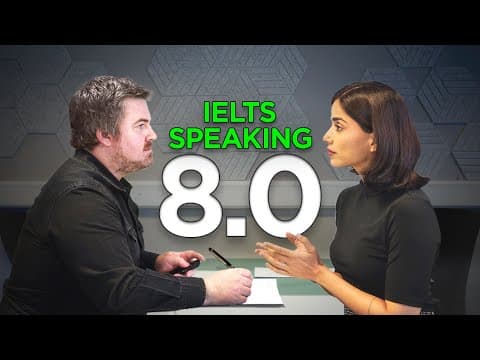
I recently took the IEL speaking test and got band nine. Well, of course I'm going to get band nine. I'm a native English speaker. But here's what surprised me the most. I intentionally tried to use [music] simpler vocabulary than most of the band six students that we work with. I made some grammar mistakes on purpose and I didn't memorize anything... Read More
Key Insights
- Part 1 answers are most effective when they give a direct response followed by relevant detail, an explanation, or an example. The purpose of that added material is to help the examiner understand the answer, not to reach a predetermined number of sentences.
- Memorized Part 1 responses can prevent natural communication because candidates concentrate on reproducing prepared material. Since Part 1 concerns the candidate personally, the recommended approach is to answer from genuine knowledge and expand only as much as the question requires.
- Part 2 performance should remain centered on the cue card's main topic rather than rigidly covering every supplied bullet point. Candidates can introduce additional related points that feel easier to discuss, and they do not need to address every prompt in order.
- Time management in Part 2 is simplified by continuing to speak naturally until the examiner stops the response at around two minutes. Monitoring time, counting sentences, and tracking every bullet point simultaneously can consume attention that would otherwise support fluent speech.
- Part 3 answers require more development than Part 1 answers. A strong response states a position directly, explains why that position is reasonable, and includes a relevant example when one is available, while still attempting every question, including difficult or unusual ones.
- Clear pronunciation matters more than adopting a British or American accent. The stated target for Band 8 or Band 9 is for the examiner to understand 100% of the candidate's words, while features such as intonation and stress often emerge naturally at that level.
- Coherence is demonstrated by answering the precise question and developing the response appropriately. It includes giving some detail in Part 1, sustaining the main topic in Part 2, and providing fuller explanations and examples in Part 3.
- Fluency improves when candidates use natural speech, manageable ideas, and language they can produce comfortably. Trying to make ideas, vocabulary, and grammar complex at the same time increases mental processing demands and can cause unnatural hesitation, pausing, or robotic delivery.
Install to Summarize YouTube Videos and Get Transcripts
Explore YouTube Video Summarizer or Get YouTube Transcript Extractor
Questions & Answers
Q: What strategy can help you get Band 9 in IELTS Speaking?
Answer each question directly, add relevant development, and speak naturally as you would with friends in a bar or coffee shop. Avoid memorization, sentence counting, and unnecessary complexity because these demands can interfere with fluent communication.
Q: How should I answer IELTS Speaking Part 1 questions?
Give a direct answer, then add detail that helps the examiner understand it. That detail can be an explanation, further information, or an example, and it does not need to follow a fixed sentence count.
Q: Should I memorize answers for IELTS Speaking Part 1?
No, the recommended strategy is to answer naturally rather than reproduce memorized material. Part 1 is about you, so you already have the knowledge needed to give a direct answer and relevant detail.
Q: Do I need to cover every bullet point in IELTS Speaking Part 2?
No, focus on the cue card's main topic and use the supplied points that you can discuss comfortably. You can add related points of your own and do not need to follow every bullet point in order.
Q: How should I manage the 2 minutes in IELTS Speaking Part 2?
Keep discussing the main topic naturally until the examiner stops you in and around 2 minutes. Do not divide your attention among time, sentence counts, and bullet points, because trying to process all of them simultaneously can weaken fluency.
Q: How should I develop answers in IELTS Speaking Part 3?
Answer the question directly, explain why you hold that view, and develop the reasoning more fully than in Part 1. Add a relevant example when possible, but you do not have to provide one if you cannot think of one.
Q: Does an IELTS candidate need a British or American accent?
No, a British or American accent is not presented as necessary for a high pronunciation score. The priority is complete clarity, with the stated Band 8 or Band 9 target being that the examiner understands 100% of the candidate's words.
Q: Why can simpler vocabulary and grammar support IELTS Speaking fluency?
Simpler language reduces the number of demanding tasks the candidate must manage while speaking. The speaker received Band 9 after intentionally using simpler vocabulary than many Band 6 students, making some grammar mistakes, and speaking naturally without memorization.
Summary & Key Takeaways
-
Definition: The core strategy is to answer directly, add relevant development, and speak naturally without memorized responses or special techniques.
-
Number: The speaker received Band 9 after intentionally using simpler vocabulary and making some grammar mistakes.
-
Who: IELTS Advantage has helped thousands of students achieve Band 7, Band 8, or Band 9 in IELTS Speaking.
-
Definition: Part 1 answers should combine a direct response with useful detail, an explanation, or an example.
-
Compare: Natural Part 1 answers are preferred to memorized responses and fixed sentence counts.
-
Definition: Part 2 should stay focused on the cue card's main topic, using comfortable supporting points.
-
Compare: Part 2 candidates may add related points and do not need to follow every supplied bullet point in order.
-
When: Continue speaking naturally in Part 2 until the examiner stops you in and around 2 minutes.
-
Definition: Part 3 requires a direct answer followed by fuller reasoning and, when available, a relevant example.
-
Number: The four assessment areas discussed are pronunciation, fluency and coherence, grammar, and vocabulary.
-
Definition: Coherence means answering the actual question and developing relevant ideas appropriately.
-
Number: For Band 8 or Band 9 pronunciation, the stated target is for the examiner to understand 100% of the candidate's words.
Read in Other Languages (beta)
Share This Summary 📚
Summarize YouTube Videos and Get Video Transcripts with 1-Click
Try YouTube Summary with ChatGPT & Claude or YouTube Transcript Generator
Explore More Summaries from IELTS Advantage 📚




Summarize YouTube Videos and Get Video Transcripts with 1-Click
Try YouTube Summary with ChatGPT & Claude or YouTube Transcript Generator