How to ace IELTS Speaking Part 2 with a simple strategy

TL;DR
The key is to use a flexible strategy that allows skipping bullet points and speaking confidently for two minutes. Don’t force every cue card point; focus on fluency and coherence and cover the most relevant parts while avoiding common pitfalls like running out of things to say. This examiner-driven approach builds overall scoring across fluency, coherence, pronunciation, grammar, and vocabulary.
Transcript
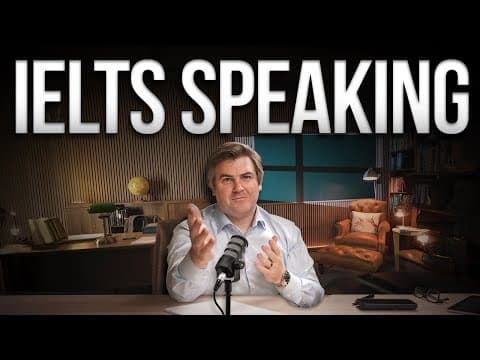
- Part two of the IELTS speaking test, for a long time, has caused a huge number of problems for students, but it doesn't have to be that way. What I'm going to tell you in this video is a little secret that most students don't know about part two of the speaking test, and understanding this information will mean the difference between you getting ... Read More
Key Insights
- The secret is you do not have to speak about all four bullet points.
- Running out of things to say is a major failure mode in Part 2.
- Getting stuck on one bullet point causes anxiety and reduces quality of speech.
- Examiners judge fluency and coherence first, then pronunciation, grammar, and lexicon.
- You should speak to achieve a two-minute fluency window, not necessarily to cover every point.
- Avoid shortcuts that promise easy gains like PPF past-present-future thinking.
- Bullet points are guidance, not a strict script to copy word-for-word.
- The strategy is examiner-driven and aims for natural, two-minute speech.
- More videos from this channel:
- More from this channel: IELTS Advantage
Install to Summarize YouTube Videos and Get Transcripts
Explore YouTube Video Summarizer or Get YouTube Transcript Extractor
Questions & Answers
Q: A real search query question about the video (e.g. 'How to...', 'What is...', 'Why does...', 'When should...'). Question 1
This video shows that you can succeed in IELTS Speaking Part 2 by using a flexible strategy that does not require you to mention every bullet point. The key is to prioritize fluency and coherence over rigidly covering all four prompts. By focusing on delivering a natural two-minute speech, you align with what examiners are evaluating.
Q: Question 2
The answer explains the common failure modes: running out of things to say and getting stuck on bullet points. These issues undermine fluency, coherence, and confidence. By recognizing these pitfalls, learners can adjust their approach, skip or combine points as needed, and maintain a steady, fluid delivery within the two-minute limit.
Q: Question 3
The video emphasizes that the IELTS examiner uses the four bullets as guidance rather than a mandatory checklist. This means candidates can choose which points to discuss and for how long, as long as their overall speech remains fluent, coherent, and within the time frame. This flexibility reduces pressure and improves performance.
Q: Question 4
PPF, or past present future, is discouraged because it can fail if the topic doesn’t align with those time frames. The strategy presented is designed to avoid overreliance on a fixed scheme and instead encourage adaptable speech that fits the topic and showcases all four scoring criteria without being trapped by a rigid template.
Q: Question 5
The two-minute target is central to the strategy. Learners should aim to speak continuously and logically for about two minutes, which allows the examiner to assess fluency, coherence, pronunciation, grammar, and lexicon. Practicing longer, natural responses helps build confidence and ensures you meet the time requirement.
Q: Question 6
The video frames exam preparation around what examiners are looking for, not quick tips. By understanding examiner expectations, learners can structure their responses to demonstrate clear topic development, varied vocabulary, accurate grammar, and smooth pronunciation. This approach yields better scores across all criteria instead of chasing shortcuts.
Q: Question 7
It recommends avoiding equal-time distribution across bullet points as it is nearly impossible to achieve naturally. Instead, focus on speaking about the most relevant points with appropriate depth and transition smoothly between ideas. This prevents filler and awkward pauses and sustains flow throughout the response.
Q: Question 8
The material underscores that the cue card format exists to guide you, not enslave you. By treating bullet points as flexible prompts and prioritizing fluency, learners can produce a cohesive narrative that satisfies the examiner’s requirements while staying relaxed and confident during the two-minute speech.
Summary & Key Takeaways
-
The video explains that you do not have to talk about every bullet point on a cue card, which changes how you plan your answer. It emphasizes a two minute fluent and coherent delivery and warns against rigidly covering all four bullets or following shortcut methods. The content centers on examiner expectations and practical strategy.
-
The presenter identifies two common failure modes: running out of things to say and getting stuck on one bullet point, which hurts fluency and coherence. It provides a step-by-step approach to avoid these issues, focusing on natural, extended speech rather than memorized points.
-
The material stresses avoiding incorrect strategies like forcing equal time on each bullet, and discourages popular shortcuts such as PPF. It argues that examiner-driven methods yield better scores by showcasing fluency, coherence, pronunciation, grammar, and lexical resource through a two-minute speech.
Read in Other Languages (beta)
Share This Summary 📚
Summarize YouTube Videos and Get Video Transcripts with 1-Click
Try YouTube Summary with ChatGPT & Claude or YouTube Transcript Generator
Explore More Summaries from IELTS Advantage 📚



Summarize YouTube Videos and Get Video Transcripts with 1-Click
Try YouTube Summary with ChatGPT & Claude or YouTube Transcript Generator