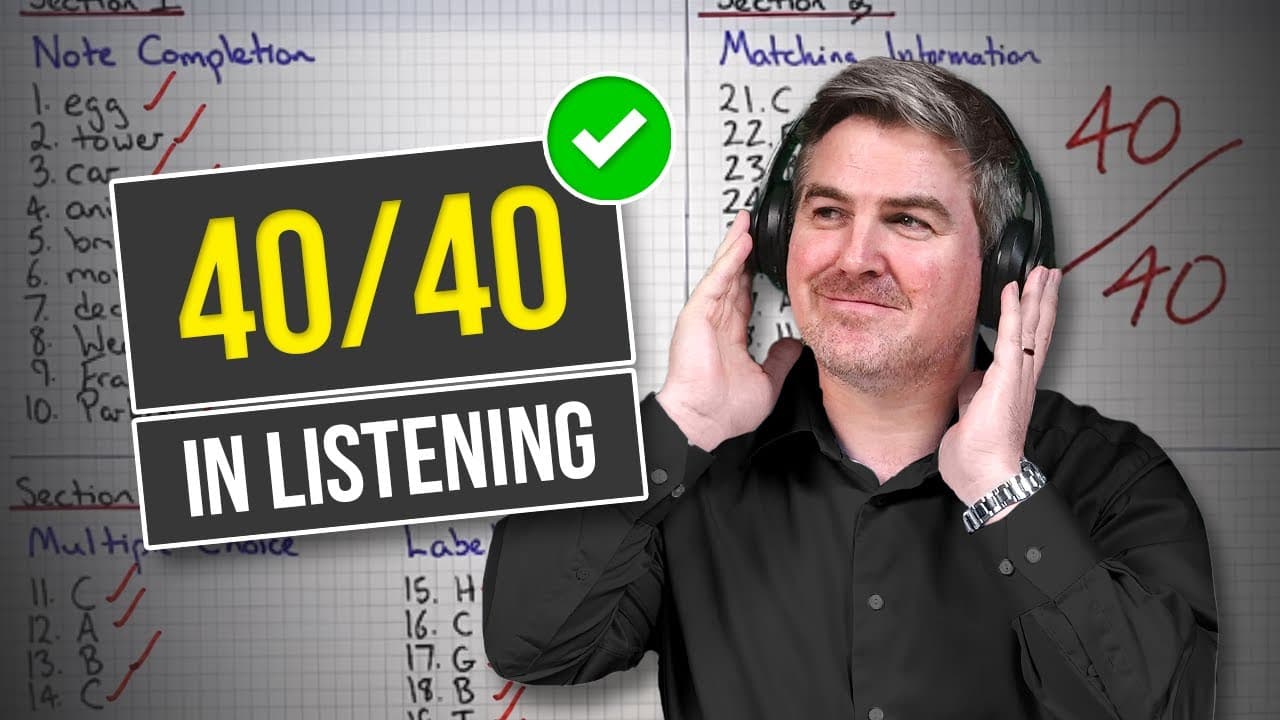
How to score band 9 in IELTS Listening fast
TL;DR
Identify your weakest question types and practice with real Cambridge tests under exam conditions. Analyze the mistakes, then tailor targeted strategies for those types. Use two to three full practice tests, review audio scripts, and focus on spelling and vocabulary where needed to raise your score quickly.
Transcript
We've helped thousands of students get a band nine in the IELTS listening test. So, in this video, I'm going to show you a simple technique that we've used to improve the listening scores of thousands of students to a band 9. I'm also going to give you a free IELTS course at the end of the video that has helped thousands of students get a band 7, 8... Read More
Key Insights
- The key to improving IELTS Listening is to identify your weaknesses through wrong answers.
- Real practice should use official Cambridge tests under exam conditions.
- Different sections and question types often reveal distinct weaknesses that need targeted work.
- Spelling and vocabulary issues can be a bottleneck even when answers are correct.
- Section three requires exposure to multiple speakers to train listening in crowded conversations.
- Section four demands familiarity with academic style language and vocabulary.
- Two or three full practice tests help reveal stable patterns of errors.
- Reviewing audio scripts is essential to understand why a chosen answer was wrong.
- More videos from this channel:
- More from this channel: IELTS Advantage
Install to Summarize YouTube Videos and Get Transcripts
Explore YouTube Video Summarizer or Get YouTube Transcript Extractor
Questions & Answers
Q: How can I determine my main weakness in IELTS Listening quickly
To determine your main weakness, use a single full practice test and mark every wrong answer. Notice which sections or question types repeat as errors, such as multiple choice or map labeling. This pattern points to where you should focus your study, rather than broadly practicing all question types without analysis.
Q: Why is practicing with official Cambridge tests recommended
Official Cambridge tests provide authentic test construction, pacing, and language difficulty mirroring real exam conditions. Using these tests helps you experience the exact format, timing, and question types you will face on test day, making your practice more predictive of your actual score and ensuring the strategies you learn are transferable.
Q: What role does spelling play in IELTS Listening
Spelling issues can negate correct answers in IELTS Listening because markers may require exact word forms. If you consistently misspell a familiar word, you lose points even when you hear it correctly. Focused spelling practice, especially for commonly tested terms, can convert correct recognition into correct scoring.
Q: How should I handle section three which involves multiple speakers
Section three tends to be challenging due to overlapping speech. To adapt, expose yourself to dialogues with multiple speakers through podcasts or videos and practice identifying key information from simultaneous talk. This builds familiarity and reduces mishearing when the speakers overlap in the exam.
Q: What is the benefit of taking two to three full practice tests
Taking two to three full practice tests helps you see consistent error patterns, prevents bottlenecks from minor differences, and reinforces pacing. It also accelerates familiarization with the exam rhythm, enabling you to plan how long to spend per section and how to allocate attention to tricky items.
Q: How can I use audio scripts effectively in practice
Audio scripts enable you to verify why an answer was wrong by reading the exact spoken content. Use them after a practice test to match what you heard with the script, identify misheard phrases, and update your listening strategies. This reflection turns errors into concrete improvements.
Q: What if I get most sections right but still miss some questions
If most sections are correct but some remain wrong, analyze the missed items specifically to understand whether the issue is vocabulary, recognition, or context. Target those gaps with focused vocabulary work and listening practice that stresses similar language or topic areas to reinforce understanding.
Q: Is there a faster way to raise my score using the strategy
A faster uplift comes from concentrating intense, targeted practice on your identified weak areas, rather than broad, unfocused study. Use official tests, review the wrong answers with scripts, and practice under exam conditions to reproduce the test day environment, which accelerates learning and leads to quicker score improvements.
Summary & Key Takeaways
-
This video presents a single, repeatable strategy used by Band 9 students to improve IELTS Listening scores. It emphasizes practicing with real Cambridge tests under exam conditions and analyzing wrong answers to identify persistent weaknesses. The approach is practical, data driven, and designed to convert weaknesses into strengths.
-
The core idea is to treat listening like a skill that can be trained through focused practice on specific question types. By isolating problems such as spelling, map labeling, or section three dialogue, learners can craft targeted improvements and see faster gains.
-
A free VIP style PDF and personalized offers are promoted, showing how additional feedback and study plans can accelerate progress. The content blends strategy with resources, encouraging disciplined practice and self analysis to reach higher bands.
Read in Other Languages (beta)
Share This Summary 📚
Summarize YouTube Videos and Get Video Transcripts with 1-Click
Try YouTube Summary with ChatGPT & Claude or YouTube Transcript Generator
Explore More Summaries from IELTS Advantage 📚



Summarize YouTube Videos and Get Video Transcripts with 1-Click
Try YouTube Summary with ChatGPT & Claude or YouTube Transcript Generator