How to Reach Band 8.5 in IELTS Speaking
TL;DR
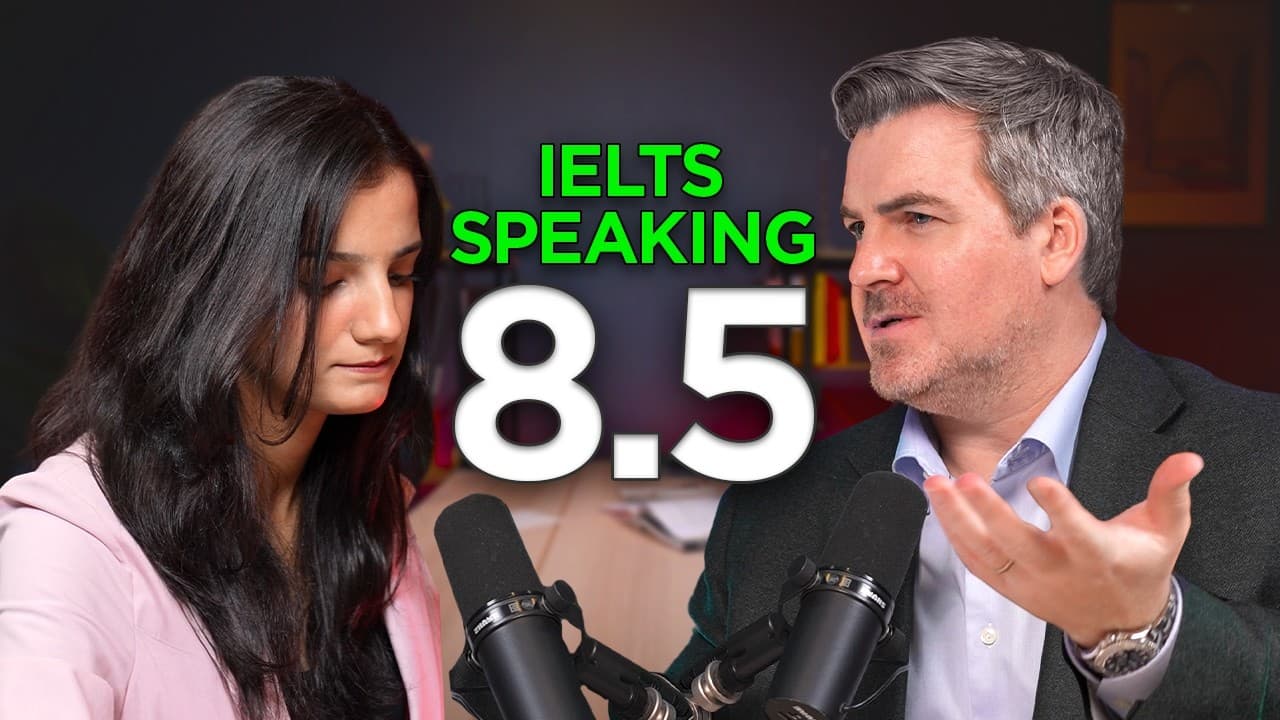
Natural, informal English, idiomatic phrases, detailed answers, and expressive delivery helped this candidate achieve Band 8.5 in the IELTS Speaking test. Her responses sound conversational because she develops ideas with personal examples and phrases such as “on my toes” and “I kid you not,” while small mistakes prevented a Band 9 result.
Transcript
Let's start off by talking about your job. Do you work or do you study? Um, I work as a cabin crew. It's been two years that I've been working as a flight attendant. It's good. What do you enjoy about your job? So, I feel like there's a lot of perks, but there are a lot of negatives to it as well. Like, it's a physical job. It requires you to be a ... Read More
Key Insights
- Natural informal language is a major strength in IELTS Speaking because it makes an answer resemble a genuine conversation. The examiner praises expressions such as “I’m not a foodie,” “it gets to you,” and “what’s the hype” instead of recommending highly academic or formal phrasing.
- Idiomatic phrases are difficult to use naturally because they are closely associated with everyday native-speaker conversation. The candidate integrates phrases such as “on my toes” and “I kid you not” into relevant personal stories, which the examiner identifies as evidence of advanced speaking ability.
- Detailed personal examples are an effective way to develop answers. The candidate supports her opinions with concrete experiences, including walking 10,000 to 15,000 steps, enjoying Stockholm’s slow atmosphere, organizing her own birthday party, and attending a yoga class during a Singapore layover.
- Cabin crew work is physically demanding because it involves constant movement, substantial walking, travel through airports, and activity after landing. The candidate says she may walk about 6,000 steps during a flight and typically reaches 10,000 to 15,000 steps across an average day.
- Travel benefits are the candidate’s favorite aspect of working as a flight attendant. The job allows her to visit places, see landmarks she knew about as a child, and meet different people, although repeated cities, layovers, and hotels can eventually feel similar and exhausting.
- ClassPass is valuable to the candidate because it lets her book yoga classes in different locations without repeatedly searching for studios. She used it for a yoga class in Singapore after returning at about 2:00 a.m. and believes bookings could motivate her during future layovers.
- Online complaints are easier to publish because review platforms provide convenient ways for customers to share opinions and feelings. The candidate believes people are more likely to complain than praise a service, while negative reviews can strongly influence a potential customer’s first impression and purchasing decision.
- Negative reviews are important sources of improvement for young or developing companies, but customer opinions should not control every business decision. The candidate argues that companies should examine complaints while preserving management’s authority to determine how the organization should operate.
Install to Summarize YouTube Videos and Get Transcripts
Explore YouTube Video Summarizer or Get YouTube Transcript Extractor
Questions & Answers
Q: How can you reach Band 8.5 in IELTS Speaking?
A Band 8.5 performance can be supported by natural, conversational answers that use informal and idiomatic language appropriately. The candidate develops her ideas with personal experiences, clear opinions, specific details, and visible enthusiasm. The examiner particularly praises phrases such as “on my toes,” “I’m not a foodie,” “what’s the hype,” and “I kid you not,” while noting that small mistakes kept the performance from Band 9.
Q: Why is informal language useful in IELTS Speaking?
Informal language is useful because the speaking test is a conversation rather than an academic essay. The examiner says the candidate sounds like a native English speaker when she uses everyday expressions naturally. He also explains that anyone can memorize a list of academic phrases, while learning to use idiomatic conversational phrases accurately and appropriately is much more difficult.
Q: What kinds of examples improve IELTS Speaking answers?
Specific personal examples help turn short opinions into developed, memorable answers. The candidate explains her workload through daily step counts, describes Stockholm through its atmosphere and late summer sunsets, and supports her ClassPass review with a yoga class in Singapore. These details give each response context and show that she can continue speaking naturally about familiar experiences.
Q: Why does cabin crew work require physical fitness?
Cabin crew work requires fitness because employees must remain active and spend considerable time walking. The candidate estimates that she walks about 6,000 steps on a flight and completes roughly 10,000 to 15,000 steps on an average day after moving through airports, hotels, and destinations. She also emphasizes exercise, diet, personal care, constant movement, tiredness, and physical exhaustion.
Q: What are the main benefits and drawbacks of cabin crew work?
The main benefit is access to destinations, landmarks, and people that might otherwise remain distant dreams. The candidate values being able to travel widely through her job. The drawbacks include physical exhaustion, constant movement, repeated layovers, similar hotels, and time away from home. She sometimes wants to sleep in her own bed and spend time with her family.
Q: Why does the candidate recommend ClassPass for travelers?
ClassPass is convenient for someone who travels frequently because it allows classes to be booked in different places without searching separately for studios. The candidate wanted to build a yoga routine and was considering yoga certification. After finding positive reviews, she joined the service and booked an energetic yoga class in Singapore, which encouraged her to consider using it on future layovers.
Q: How should companies respond to negative online reviews?
Companies should take negative reviews seriously, particularly when they are young, developing, and trying to grow. Complaints can reveal areas where products or services need improvement. However, the candidate argues that customers should not receive complete authority over company decisions. Business leaders must consider criticism while retaining responsibility for determining how their companies should be managed.
Q: Why do online review platforms influence customer decisions?
Online review platforms influence decisions because they often provide a customer’s first impression of a product or service. The candidate says that reading three or four negative reviews may persuade someone not to proceed with a purchase. She views the platforms’ power as a 50/50 issue because consumers ultimately decide, but prominently displayed criticism can shape that decision.
Summary & Key Takeaways
-
The candidate discusses working as cabin crew, explaining that the job offers opportunities to visit places and meet people but also requires fitness, frequent walking, and careful attention to health. Although she enjoys the travel benefits, constant layovers, repeated hotel stays, exhaustion, and separation from family make it unsuitable as a lifelong career.
-
Her personal answers cover travel and birthdays with specific, memorable details. She identifies Stockholm as her favorite destination, prefers restful mountain holidays, and describes organizing her first birthday party in Pakistan. She also explains that handwritten letters are an important birthday tradition and imagines paying for friends to attend a destination celebration.
-
In the longer discussion, she describes discovering ClassPass through colleagues, social media, Google, Instagram, and online reviews. Its ability to book yoga classes while traveling is especially useful for cabin crew. The examiner praises her informal, idiomatic language and explains that conversational expressions are more valuable than memorized lists of academic phrases.
Read in Other Languages (beta)
Share This Summary 📚
Summarize YouTube Videos and Get Video Transcripts with 1-Click
Try YouTube Summary with ChatGPT & Claude or YouTube Transcript Generator
Explore More Summaries from IELTS Advantage 📚



Summarize YouTube Videos and Get Video Transcripts with 1-Click
Try YouTube Summary with ChatGPT & Claude or YouTube Transcript Generator