How to Craft Top IELTS Task 1 Introductions
TL;DR
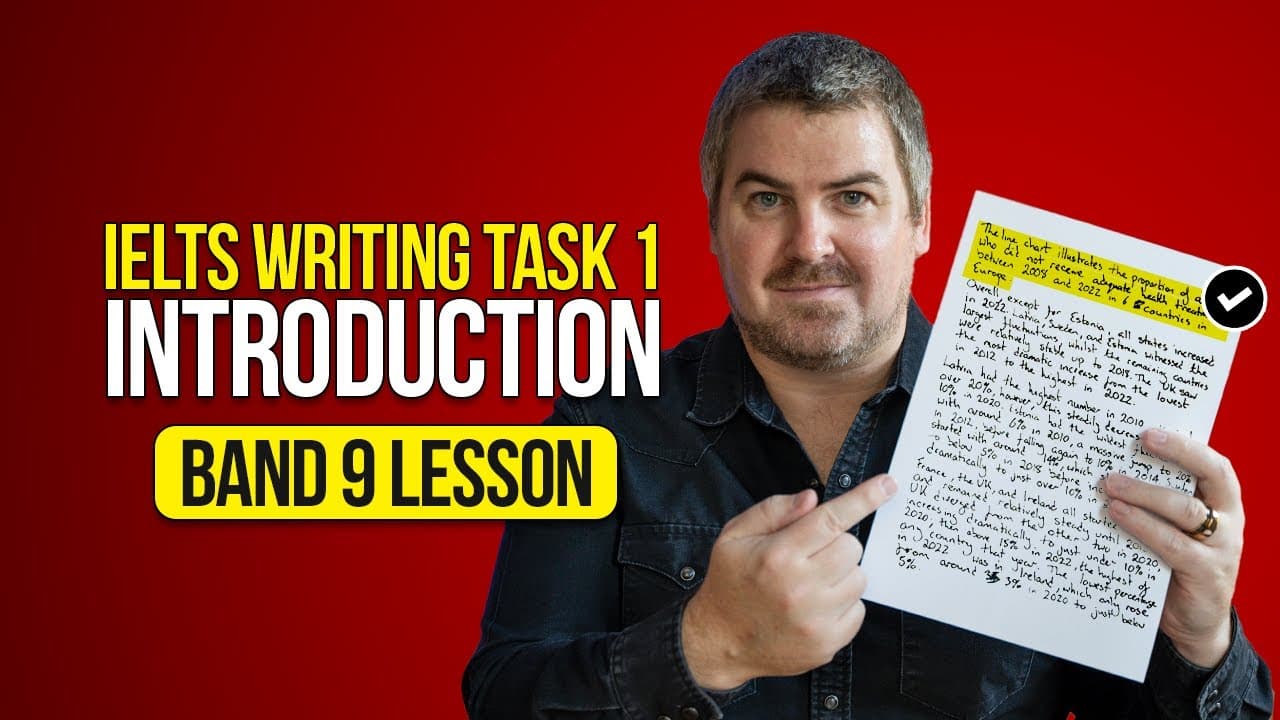
Effective IELTS Task 1 introductions demand concise paraphrasing of the question statement. Focus on simplifying your phrasing while accurately reflecting the data type and context. Avoid overcomplication and aim for clear communication to maximize your score.
Transcript
I took all the IELTS Cambridge books and looked at all of the task one questions to see if there were any patterns you see if there are any common patterns we can use these to write great introductions quickly and easily so in this video I'll answer two questions are there any common questions and common patterns for task one academic and h... Read More
Key Insights
- The introduction for IELTS Task 1 should be concise and involve paraphrasing the question statement using different words.
- Common types of data visualization in Task 1 include charts, tables, graphs, and diagrams, with charts being the most frequent.
- Paraphrasing involves replacing words like 'shows' with 'presents' or 'displays' and changing 'below' to 'data.'
- Time references in Task 1 questions often involve specific years or periods, which should be accurately paraphrased.
- It's essential to understand the context of the data, such as the subjects involved, to use appropriate synonyms.
- Avoid overcomplicating paraphrasing by trying to change every word; focus on simplicity and accuracy.
- Writing one sentence is usually sufficient for the introduction, and it's crucial to avoid inserting unnecessary information.
- Perfect practice, involving feedback from experts, is key to mastering the introduction writing for IELTS Task 1.
Install to Summarize YouTube Videos and Get Transcripts
Explore YouTube Video Summarizer or Get YouTube Transcript Extractor
Questions & Answers
Q: What is the main focus of the video?
The main focus of the video is to teach viewers how to write effective introductions for IELTS Academic Task 1 by using paraphrasing techniques. It emphasizes the importance of understanding the question context and using simple, accurate language to convey the same meaning as the original question statement.
Q: What are the common data visualization types mentioned?
The video mentions several common data visualization types used in IELTS Task 1, including charts, tables, graphs, and diagrams. Charts are highlighted as the most frequent type, appearing in 44% of questions, followed by tables, graphs, and diagrams.
Q: How should time references be handled in Task 1 questions?
Time references in Task 1 questions, such as specific years or periods, should be accurately paraphrased. For example, 'between X and Y' can be changed to 'from X to Y' and vice versa. It's important to maintain the same time frame while using different expressions.
Q: Why is it important to understand the question context?
Understanding the question context is crucial because it helps in selecting appropriate synonyms and expressions for the subjects being discussed. For instance, knowing whether the data involves people, countries, or households allows for more precise paraphrasing, ensuring that the introduction remains relevant and accurate.
Q: What are some tips for effective paraphrasing?
Effective paraphrasing involves keeping the language simple and accurate, focusing on changing key words rather than every word. It's important to avoid overcomplicating the introduction by trying to use complex vocabulary unnecessarily. The goal is to convey the same meaning as the original question statement in a clear and concise manner.
Q: How many sentences are usually needed for the introduction?
Typically, one sentence is sufficient for the introduction in more than 90% of IELTS Task 1 questions. It's important to avoid adding extra sentences or unnecessary information, as the introduction should be a concise paraphrase of the question statement.
Q: What is the significance of perfect practice?
Perfect practice is crucial for mastering IELTS Task 1 introductions. It involves practicing with a variety of questions and receiving feedback from experts to improve accuracy and clarity. This approach helps in developing the skills needed to write effective introductions consistently.
Q: What should be avoided when preparing for IELTS Task 1?
When preparing for IELTS Task 1, it's important to avoid treating it as a memorization test. Instead, focus on understanding the question and using clear communication. Additionally, relying on a single resource or video for preparation is insufficient. Comprehensive learning and practice are necessary for achieving a high score.
Summary & Key Takeaways
-
The video provides strategies for writing effective introductions for IELTS Academic Task 1, focusing on paraphrasing the question statement. Common data types and visualization methods are discussed, along with tips for using synonyms and time references.
-
Viewers are advised to keep introductions simple and avoid overcomplicating paraphrasing. Understanding the question context is emphasized, with guidance on using appropriate synonyms for subjects like people, countries, and households.
-
The importance of perfect practice with expert feedback is highlighted, as well as the need to avoid memorization and instead focus on clear communication. The video also warns against relying on a single resource for a high score.
Read in Other Languages (beta)
Share This Summary 📚
Summarize YouTube Videos and Get Video Transcripts with 1-Click
Try YouTube Summary with ChatGPT & Claude or YouTube Transcript Generator
Explore More Summaries from IELTS Advantage 📚



Summarize YouTube Videos and Get Video Transcripts with 1-Click
Try YouTube Summary with ChatGPT & Claude or YouTube Transcript Generator