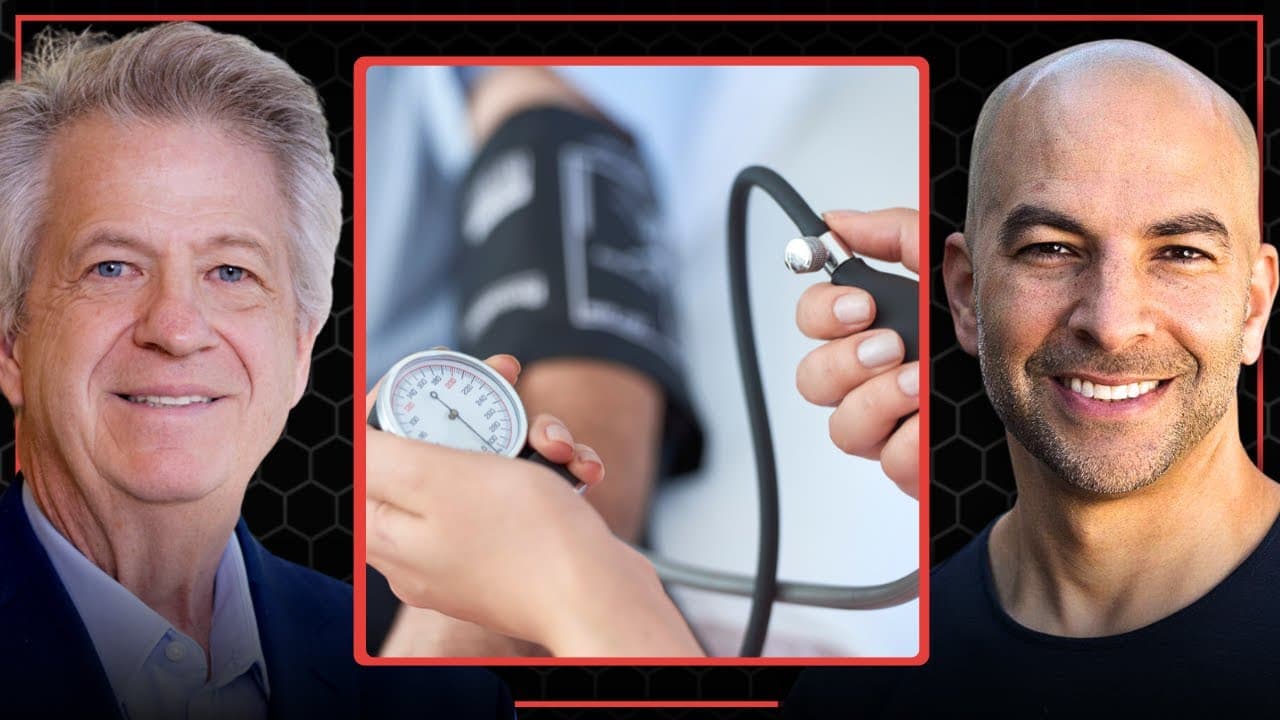
How to lower blood pressure to cut chronic disease risk
TL;DR
High blood pressure drives stroke, heart failure, and kidney disease. Managing blood pressure through diet and exercise can delay or reduce risk, especially before reaching high levels where medications become more clearly beneficial. The discussion weighs lower thresholds for treatment against lifestyle approaches and long term outcomes.
Transcript
so let's talk a little bit about blood pressure um it seems to play a very important role in really all of the major chronic diseases except for cancer and if there's a role in cancer I don't know what it is but there who knows maybe somebody knows that but certainly when we come to neurodegenerative disease cardiovascular disease cerebrovascular d... Read More
Key Insights
- Blood pressure influences stroke, heart failure, and kidney disease, and higher systolic values markedly increase risk for these conditions.
- There is a suggested turning point in risk around 160-180 systolic, beyond which the likelihood of pressure-related diseases rises dramatically.
- A linear relationship exists between blood pressure and risk extending down to 120 over 80, which informs debates on optimal targets.
- 140 over 90 is presented as a traditional cutoff for active hypertension management, with nuance about lower targets.
- 135 over 85 may not justify immediate medication without lifestyle changes, depending on individual circumstances.
- Dietary and exercise interventions can lower blood pressure and may be preferable for some individuals before pharmacotherapy.
- The evidence base for treating lower thresholds is limited, so clinical decisions balance potential benefits against the burden of lifelong medication.
- Long term outcomes depend on lifetime health management, not just a single point in time, underscoring the value of preventive strategies
- More videos from this channel:
- More from this channel: Peter Attia MD
Install to Summarize YouTube Videos and Get Transcripts
Explore YouTube Video Summarizer or Get YouTube Transcript Extractor
Questions & Answers
Q: What is the relationship between high blood pressure and major chronic diseases?
High blood pressure is described as a major driver for stroke, heart failure, and kidney disease. The risk increases with higher blood pressure levels, and these conditions are identified as the primary pressure related diseases. The discussion emphasizes that the kidneys may be particularly sensitive to blood pressure changes, underscoring the importance of managing hypertension to protect multiple organ systems over time.
Q: Why is 140 over 90 used as a cutoff, and what about lower targets like 120 over 80 or 135 over 85?
Historically, 140 over 90 has been used as a cutoff to define hypertension, reflecting a level at which population data showed clearer risk increases. There is discussion about lower targets, recognizing a linear relationship between blood pressure and risk that extends to 120 over 80. However, the speakers note that evidence for long term benefit of medications at 135 over 85 is not definitive, suggesting lifestyle interventions may be preferable initially.
Q: When should someone consider antihypertensive medication according to the dialogue?
Antihypertensive medication is considered more strongly when blood pressure reaches or exceeds 140 over 90 and lifestyle changes do not adequately lower it. In cases of 135 over 85, the speakers advocate for dietary measures and exercise first, given the potential lifelong burden of medication, while acknowledging that individual risk profiles may justify earlier pharmacotherapy.
Q: How do the speakers view lifestyle changes in blood pressure management?
The speakers prioritize dietary maneuvers, reducing salt intake, and healthier eating combined with exercise as first line strategies for managing blood pressure around 135 over 85. They argue these lifestyle changes can lower blood pressure and may reduce long term health risks, potentially delaying or avoiding medication when possible.
Q: What role does kidney health play in hypertension discussions?
The kidney is described as highly sensitive to blood pressure, potentially the first organ where damage from hypertension becomes evident. This supports the argument for early intervention to protect renal function, alongside reducing risks for stroke and heart failure, and frames hypertension as a key factor in long term kidney outcomes.
Q: Why is there difficulty proving long term benefits of treating mildly elevated blood pressure with drugs?
Studying lifetime outcomes is challenging because long term randomized trials would require monitoring individuals for decades, which is impractical. The dialogue notes this limitation, explaining that while epidemiology and physiology imply benefits from lowering pressure, definitive long term pharmacotherapy benefits for 135 over 85 are hard to prove empirically.
Q: What is the significance of lifetime health goals like GFR and longevity in hypertension strategy?
A clinician expresses the goal of optimizing health and kidney function across a lifetime, aiming for a high GFR at older ages and overall longevity. This perspective shapes decisions about when to start medications, emphasizing preservation of kidney health and function to maximize years of good health rather than focusing solely on short term blood pressure targets.
Q: How does the episode relate ApoB and other risk factors to blood pressure management?
The discussion compares the effects of risk factors like ApoB with blood pressure, noting that lifetime risk cannot be easily captured in short studies. Both factors contribute to cardiovascular risk, and the speakers argue that understanding long term outcomes requires considering how multiple risks interact over decades, reinforcing a preventive approach to health.
Summary & Key Takeaways
-
Hypertension is linked to major chronic diseases like stroke, heart failure, and kidney disease, with risk rising as blood pressure increases. The speakers highlight the importance of addressing blood pressure earlier through lifestyle changes before considering medications.
-
There is debate about treating mildly elevated blood pressure, such as 135 over 85, with drugs versus prioritizing diet, salt reduction, and exercise. The goal is long term health, not quick fixes, recognizing the limitations of existing studies.
-
A key point is that long term outcomes depend on lifetime risk factors and interventions. While random trials for lifetime benefits are impractical, physiology and epidemiology support early, preventive measures to preserve kidney and cardiovascular health.
Read in Other Languages (beta)
Share This Summary 📚
Summarize YouTube Videos and Get Video Transcripts with 1-Click
Try YouTube Summary with ChatGPT & Claude or YouTube Transcript Generator
Explore More Summaries from Peter Attia MD 📚




Summarize YouTube Videos and Get Video Transcripts with 1-Click
Try YouTube Summary with ChatGPT & Claude or YouTube Transcript Generator