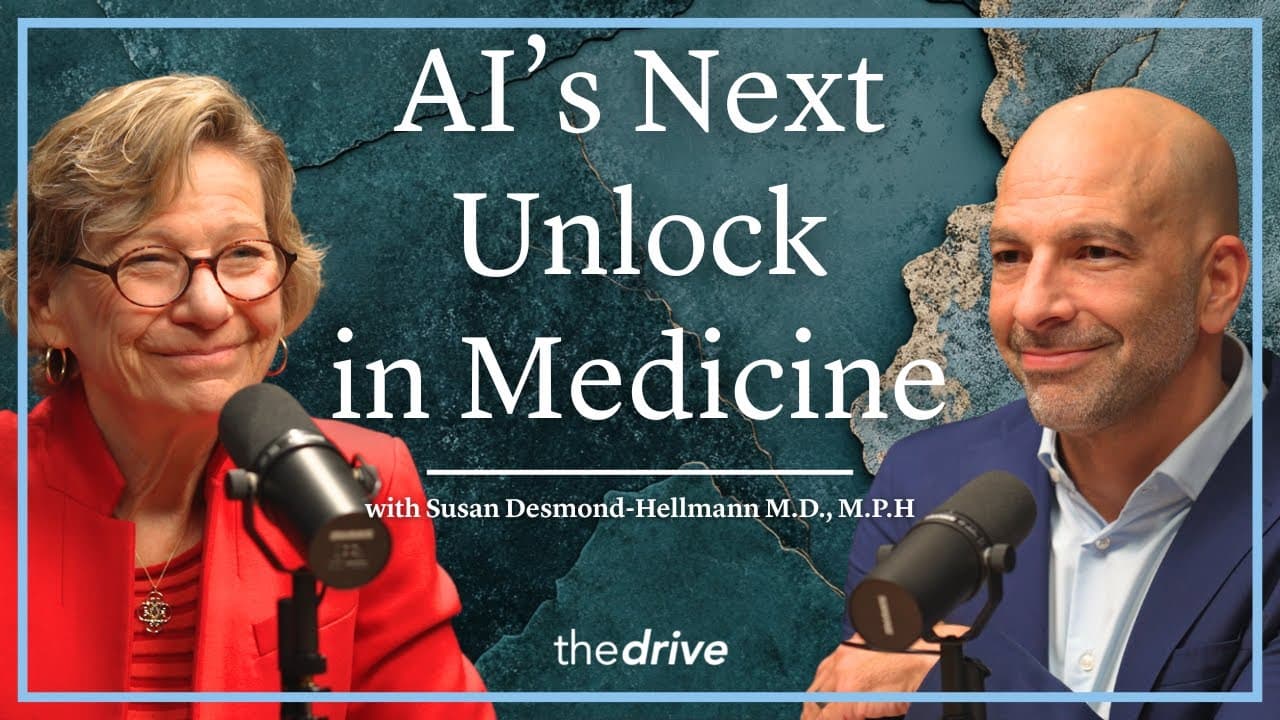
How will AI unlock new breakthroughs in medicine?
TL;DR
AI can accelerate early drug discovery by interpreting complex data and highlighting opportunities that speed up development. It can help identify better biomarkers, enable data driven trial designs, and potentially shorten trials by substantial margins. The next big unlock may come from predictive models and outcome measures that guide personalized treatments.
Transcript
So the Nobel Prize last year was awarded for protein folding. Yeah. AIdriven um analysis. How explain to people why that is significant and and where do you how much do you think that particular achievement is is is going to advance biotechnology and what remains ahead of it as far as even greater molecule selection. Yeah. No, the these guys what w... Read More
Key Insights
- AI enables faster preclinical decision making by showing which opportunities are most actionable.
- Biomarkers comparable to viral load are crucial for broad AI assisted disease tracking and trial outcomes.
- AI could reduce clinical trial time by enabling more efficient outcome measures and targeted patient selection.
- Liquid biopsies face sensitivity barriers; AI may help improve interpretation but real world data is currently limited.
- Protein signals remain a promising area for early cancer detection and guiding therapy decisions.
- Disease subtyping with AI could create many more precise trials, matching therapies to patient types.
- Preventive strategies and early detection programs are essential complements to AI driven treatment advances.
- A shift toward measuring switch on and off biomarkers could transform how benefits are observed in trials.
- More videos from this channel:
- More from this channel: Peter Attia MD
Install to Summarize YouTube Videos and Get Transcripts
Explore YouTube Video Summarizer or Get YouTube Transcript Extractor
Questions & Answers
Q: A real search query question about the video (e.g. 'How to...', 'What is...', 'Why does...', 'When should...'). Question 1
What is the potential impact of AI on early stage drug discovery and how does it differ from traditional approaches in identifying viable therapeutic targets? AI changes the speed and focus of discovery by analyzing large data sets to highlight promising opportunities, effectively lightening a mounta in front of researchers and enabling faster preclinical decisions.
Q: Question 2
How could AI help shorten clinical trials and improve outcome measures in medicine, and what examples are discussed in the interview that illustrate this potential? The speaker suggests AI could shorten trials by 60 percent through better outcome measures and predictive modeling, enabling more efficient trial design and faster data interpretation.
Q: Question 3
Why are biomarkers like viral load so important for AI driven medicine, and what analogy is used to describe their role in disease monitoring? The conversation emphasizes a viral load like biomarker as a powerful, simple measure that can guide treatment decisions and help evaluate efficacy across diseases.
Q: Question 4
What are the challenges mentioned regarding liquid biopsies and AI, and how might AI help despite current limitations? The speakers note sensitivity and DNA shedding issues as key hurdles, but they consider AI as a possible tool to improve data interpretation and predictive accuracy in liquid biopsy contexts.
Q: Question 5
How does the idea of disease subtyping relate to AI assisted trials, and what example is given for breast cancer? The discussion describes potentially 15 disease subtypes, each with a matched trial and therapy, illustrating how AI could enable highly targeted and efficient clinical testing.
Q: Question 6
What is the role of protein signals in early detection and AI guided treatment decisions, according to the conversation? Proteins are highlighted as a promising avenue for early breast cancer detection and guiding personalized treatments, suggesting a biomarker focus for AI driven strategies.
Q: Question 7
What did the speakers say about prevention and early detection in oncology, and how could AI contribute? The dialogue emphasizes preventive therapy and early detection as essential, noting that breakthroughs often come from small, incremental successes, with AI potentially accelerating identification and validation of early indicators.
Q: Question 8
What does the interview imply about the next mega unlock in medicine beyond the current achievements, and which areas are highlighted as promising? The discussion points to data frontiers, predictive models, and outcome driven trial designs as the next major advances where AI could deliver substantial improvements in clinical research and care.
Summary & Key Takeaways
-
The clip discusses how AI driven analysis was recognized for protein folding and how it accelerates preclinical decision making, revealing opportunities faster. It emphasizes lighting up a mountain of opportunity and focusing on the most impactful directions in biotechnology.
-
It investigates the need for reliable biomarkers like viral load equivalents across diseases, and questions how AI could improve detection and monitoring in clinical practice and trials.
-
It explores the idea of highly stratified patient subgroups, potentially 15 breast cancer types, each with tailored trials and therapies, and discusses the ongoing challenges of liquid biopsies and early detection to scale precision medicine.
Read in Other Languages (beta)
Share This Summary 📚
Summarize YouTube Videos and Get Video Transcripts with 1-Click
Try YouTube Summary with ChatGPT & Claude or YouTube Transcript Generator
Explore More Summaries from Peter Attia MD 📚
Summarize YouTube Videos and Get Video Transcripts with 1-Click
Try YouTube Summary with ChatGPT & Claude or YouTube Transcript Generator