How Rapamycin Led to the Discovery of mTOR
TL;DR
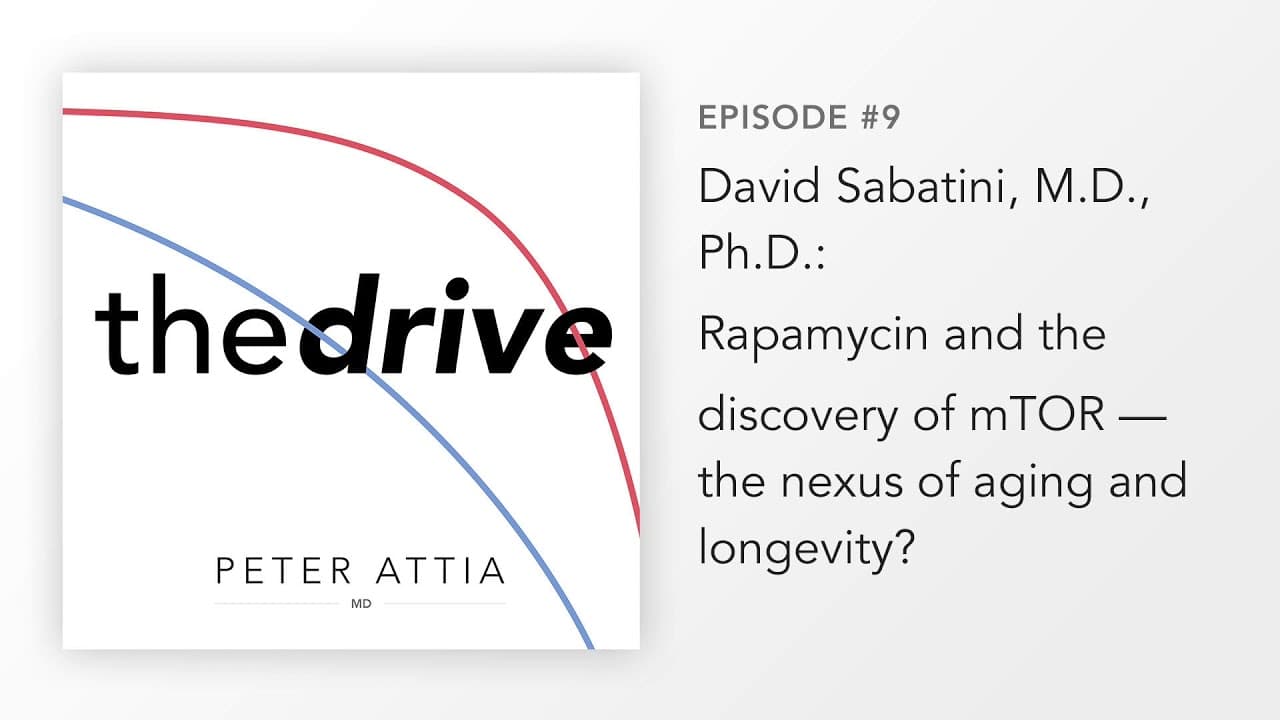
Rapamycin acts through mTOR, a protein that helps cells respond to nutrients and is closely connected to fasting, autophagy, and longevity research. David Sabatini discovered mTOR in mammalian cells after choosing rapamycin as his graduate research subject, then continued studying the same protein throughout his academic career, including its links to aging and major diseases.
Transcript
Hey, everyone. Welcome to the Peter Attia Drive. I'm your host, Peter Attia. The Drive is a result of my hunger for optimizing performance, health, longevity, critical thinking, along with a few other obsessions along the way. I've spent the last several years working with some of the most successful top-performing individuals in the world, and thi... Read More
Key Insights
- Rapamycin acts through the mTOR protein, which David Sabatini identified in mammalian cells while he was a graduate student. His investigation began when rapamycin was being used as a control molecule in laboratory research on FK506 rather than as the project’s central subject.
- Scientific freedom was crucial to Sabatini’s development because Solomon Snyder gave him broad latitude to devise his own graduate project. Although the lack of a defined assignment initially caused anxiety, Sabatini later regarded that freedom as foundational to becoming an independent scientist.
- Rapamycin attracted Sabatini’s attention because the limited literature available in late 1991 to 1992 associated the molecule with antifungal, immunosuppressive, and anticancer effects. These varied biological properties made it appear more interesting to him than FK506, the laboratory’s principal drug of interest.
- FK506 and cyclosporine are structurally different immunosuppressants that work mechanistically on the same target, calcineurin. Snyder’s laboratory studied FK506 as a tool for examining calcineurin modulation in the brain, while rapamycin served as a comparison molecule that looked related but acted differently.
- mTOR is a central nutrient-sensing protein discussed in relation to glucose, insulin, amino acids, and methionine. The conversation frames mTOR as a cellular coordinator whose activity connects nutrient availability with broader biological processes, including the responses associated with fasting and autophagy.
- Rapamycin is described as the only known pharmacological agent to extend lifespan from yeast through mammals, spanning a billion years of evolution. That broad association with lifespan makes the rapamycin-mTOR pathway especially relevant to research on aging, fasting, and interventions intended to influence longevity.
- Sabatini’s academic path is unusual because he continued studying the principal subject of his graduate work throughout his later career. Rather than changing topics completely during subsequent stages of training, he built a sustained research program around mTOR while also pursuing other scientific questions.
- Rapamycin research extends beyond longevity because the discussion considers possible effects involving cancer, cardiovascular disease, and neurodegeneration. The interview also examines intermittent use and proposes comparative thought experiments, while treating these issues as research questions rather than presenting rapamycin as a proven universal solution.
Install to Summarize YouTube Videos and Get Transcripts
Explore YouTube Video Summarizer or Get YouTube Transcript Extractor
Questions & Answers
Q: How was mTOR discovered in mammalian cells?
David Sabatini identified mTOR in mammalian cells while investigating how rapamycin worked during his graduate studies at Johns Hopkins. Rapamycin was initially present in Solomon Snyder’s laboratory as a control for research involving FK506 and calcineurin. Sabatini found rapamycin’s reported antifungal, immunosuppressive, and anticancer effects compelling, made it his project, and methodically pursued the protein through which it acted.
Q: Why did David Sabatini choose to study rapamycin?
David Sabatini chose rapamycin because the available reports suggested that it produced several distinct effects, including antifungal, immunosuppressive, and anticancer activity. He had recently completed the first two medical-school years of his MD-PhD program and recognized the potential significance of those properties. Although Snyder’s laboratory focused on FK506, Sabatini concluded that its control molecule, rapamycin, presented the more interesting research problem.
Q: What is the relationship between rapamycin and mTOR?
Rapamycin acts through the protein called mTOR, whose name reflects its role as the mechanistic target of rapamycin. Sabatini’s graduate research sought to determine how the drug produced its biological effects and led him to identify this target in mammalian cells. The resulting work connected rapamycin with a nutrient-sensing system relevant to fasting, autophagy, longevity, and several major categories of disease research.
Q: How does mTOR relate to nutrient sensing?
mTOR is presented as a central nutrient-sensing protein that integrates signals associated with glucose, insulin, amino acids, and methionine. The discussion portrays it as a cellular coordinator that helps connect nutrient conditions with downstream biological activity. This role provides the basis for examining how fasting, amino-acid availability, methionine restriction, and rapamycin may influence cellular processes associated with autophagy and longevity.
Q: Why is rapamycin important to longevity research?
Rapamycin is important to longevity research because the description identifies it as the only known pharmacological agent to extend lifespan across organisms ranging from yeast to mammals, representing a billion years of evolution. It acts through mTOR, a protein with a central role in nutrient sensing. These features connect rapamycin research with questions about fasting, autophagy, aging, and the biological regulation of lifespan.
Q: What role did Solomon Snyder play in Sabatini’s research?
Solomon Snyder accepted Sabatini into his Johns Hopkins laboratory and gave him unusually broad freedom to determine his own graduate project. Snyder said that the laboratory worked on the brain but did not assign a specific investigation. Although this initially made Sabatini anxious, it forced him to formulate an independent question. Sabatini later described that freedom as one of the most influential contributions to his scientific development.
Q: How were FK506 and rapamycin used in Snyder’s laboratory?
Snyder’s laboratory primarily used FK506 to study the modulation of calcineurin in the brain, including questions involving cytotoxicity. FK506 was already known as an immunosuppressant and shared a mechanistic target, calcineurin, with the structurally different drug cyclosporine. Rapamycin served as a control because it resembled the type of molecule under study but did not produce its effects through the same mechanism.
Q: What health topics are connected to rapamycin and mTOR?
The discussion connects rapamycin and mTOR with longevity, fasting, autophagy, cancer, cardiovascular disease, and neurodegeneration. It also considers glucose, insulin, amino acids, methionine sensing, methionine restriction, and an intermittent approach to rapamycin. These subjects are explored through mechanistic discussion, thought experiments, and proposed research, including an imagined experiment without resource constraints, rather than as individualized treatment instructions.
Summary & Key Takeaways
-
David Sabatini entered the MD-PhD program at Johns Hopkins and joined Solomon Snyder’s laboratory after two years of medical school. Although initially interested in neuroscience, Sabatini received broad freedom to choose his own project. That independence pushed him toward rapamycin and helped establish the scientific direction he continued throughout his academic career.
-
Rapamycin was initially used in Snyder’s laboratory as a control for FK506, another small molecule being studied for its effects involving calcineurin. Sabatini became more interested in rapamycin because early reports associated it with antifungal, immunosuppressive, and anticancer effects. Investigating its mechanism eventually led him to identify mTOR in mammalian cells.
-
mTOR is presented as a central coordinator of nutrient sensing, with glucose, insulin, amino acids, and methionine among the relevant signals discussed. The conversation connects mTOR and rapamycin to fasting, autophagy, longevity, cancer, cardiovascular disease, and neurodegeneration, while also considering intermittent rapamycin use and experiments that could test its broader effects.
Read in Other Languages (beta)
Share This Summary 📚
Summarize YouTube Videos and Get Video Transcripts with 1-Click
Try YouTube Summary with ChatGPT & Claude or YouTube Transcript Generator
Explore More Summaries from Peter Attia MD 📚



Summarize YouTube Videos and Get Video Transcripts with 1-Click
Try YouTube Summary with ChatGPT & Claude or YouTube Transcript Generator