10 Best OverSimplified History Videos

Sep 15, 2026
16 min read
106 views
Last updated: September 2026
This is a ten-video sequence from the OverSimplified channel, ordered as a path rather than a ranking. It is for viewers who want a broad introduction to wars, revolutions, political leaders, and the consequences of public policy.
The full set runs for just under three and a half hours. Some of the most enduring entries are OverSimplified's videos on World War II, the Cold War, and the American Civil War.
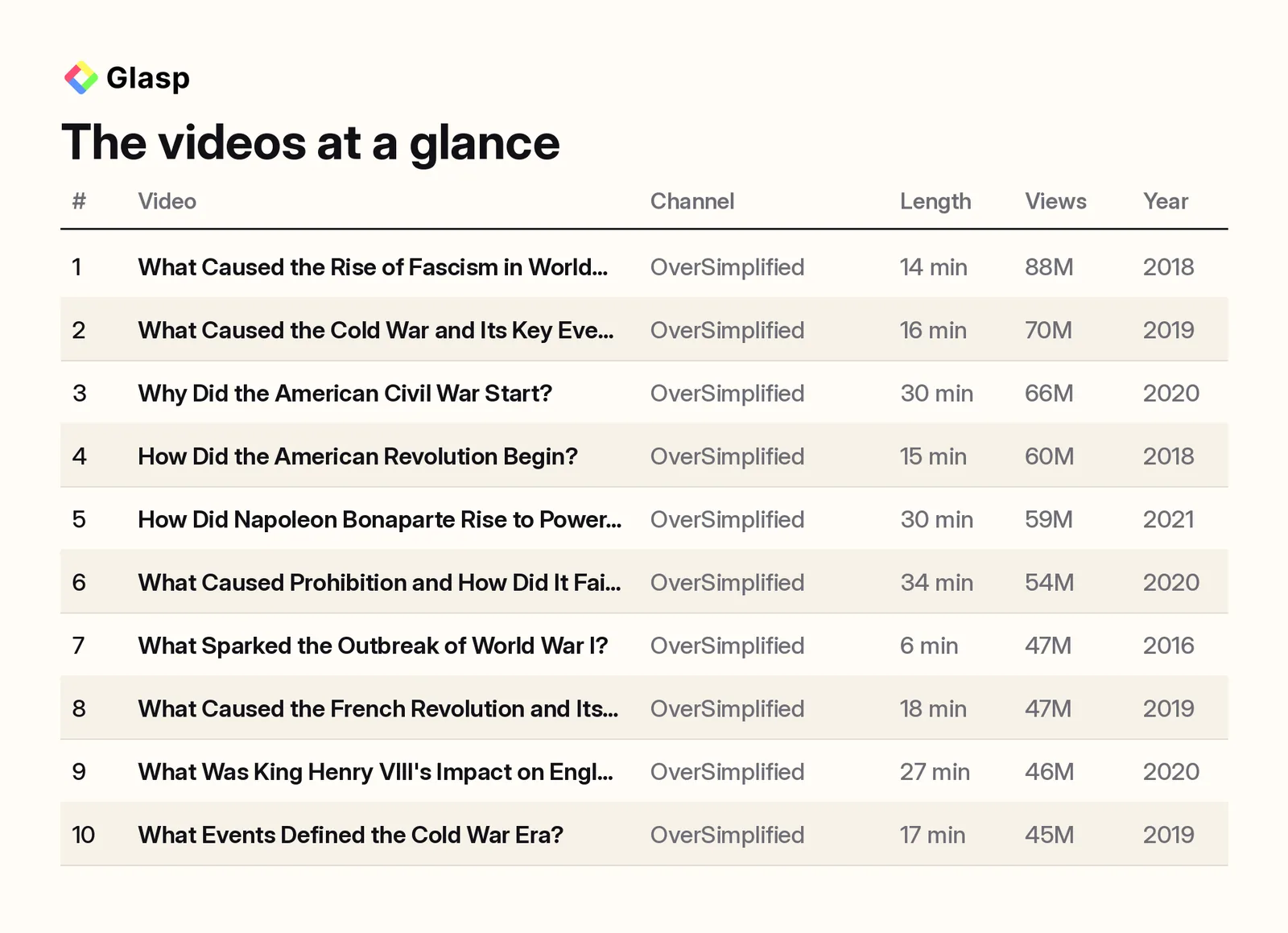
The videos on this list, in the order to watch them, are:
What Caused the Rise of Fascism in World War II? (OverSimplified)
What Caused the Cold War and Its Key Events? (OverSimplified)
Why Did the American Civil War Start? (OverSimplified)
How Did the American Revolution Begin? (OverSimplified)
How Did Napoleon Bonaparte Rise to Power in France? (OverSimplified)
What Caused Prohibition and How Did It Fail? (OverSimplified)
What Sparked the Outbreak of World War I? (OverSimplified)
What Caused the French Revolution and Its Key Events? (OverSimplified)
What Was King Henry VIII's Impact on England? (OverSimplified)
What Events Defined the Cold War Era? (OverSimplified)
Total: 10 videos, 207 minutes of watch time (3 hours 27 minutes), and 582.3M combined views.
1. What Caused the Rise of Fascism in World War II?
"WW2 - OverSimplified (Part 1)" · OverSimplified · 14 min · 88M views · 2018
In short: Political and economic instability helped fascist leaders in Italy and Germany gain support, while Japan pursued militaristic expansion in search of resources and power.
Start here because the video shows several national crises converging into one global conflict. It introduces the list's recurring questions about how instability, ideology, resentment, and ambition turn into political action. Its argument moves across Italy, Germany, and Japan, showing that the outbreak of World War II grew from the expansionist goals and ideological conflicts of fascist nations rather than from a single isolated cause.
The clearest evidence comes from the different routes each country took. Mussolini moved from socialism to fascism as he embraced national unity and Italian dominance. Hitler used resentment over the Treaty of Versailles and economic hardship to promise restored German power. Japan, struggling economically and seeking resources, expanded into China and East Asia. The Allies' policy of appeasement then delayed decisive action and gave Hitler room to increase his territorial demands.
Key takeaways
Mussolini's disillusionment with socialism and desire for national unity led him to embrace fascism.
Hitler gained support by promising to undo the Treaty of Versailles and restore Germany's power and honor.
Japan's economic struggles and search for resources drove its militaristic expansion across East Asia.
The Allies' policy of appeasement enabled further German aggression by delaying decisive opposition.
Watch on YouTube · Read the summary and Q&A
2. What Caused the Cold War and Its Key Events?
"The Cold War - OverSimplified (Part 1)" · OverSimplified · 16 min · 70M views · 2019
In short: The ideological struggle between capitalism and communism turned postwar cooperation into decades of confrontation, proxy conflict, espionage, and technological competition.
This follows World War II because it traces how cooperation among the Allies quickly gave way to a new struggle after the war. The video reaches back to Lenin's return and Stalin's rise, then follows the ideological contest between communism and capitalism through the early Cold War. It argues that political repression, economic rivalry, proxy war, and the movement of Eastern Europeans toward the West all exposed the depth of the divide.
Stalin's Five-Year Plans transformed the Soviet economy while a reign of terror made opponents disappear or led to their deaths. The Berlin Airlift became a Western victory against Stalin's blockade, and the Korean War became a proxy battle that ended in stalemate. Khrushchev pursued de-Stalinization but brutally suppressed Eastern European uprisings. The Berlin Wall then became a symbol of communism's failure as people fled from East Berlin to the West.
Key takeaways
Stalin's Five-Year Plans transformed the Soviet economy but were accompanied by a reign of terror.
The Berlin Airlift demonstrated Western resolve against Stalin's blockade and marked an important Western victory.
The Korean War became a proxy conflict between communism and capitalism and ended in a stalemate.
The Berlin Wall highlighted the contrast between the two systems as East Berliners fled to the West.
Watch on YouTube · Read the summary and Q&A
3. Why Did the American Civil War Start?

"The American Civil War - OverSimplified (Part 1)" · OverSimplified · 30 min · 66M views · 2020
In short: Escalating conflict over slavery and states' rights, followed by Lincoln's election and Southern secession, pushed the United States into civil war.
After two videos about rival states and political systems, this section brings the same questions inside one divided country. It follows the long dispute over slavery and states' rights through repeated political compromises, violence, Abraham Lincoln's election, and the formation of the Confederacy. The video argues that the war emerged from tensions that new territories and elections repeatedly sharpened until Southern states chose secession.
The Missouri Compromise tried to preserve a balance between free and slave states, but the Kansas-Nebraska Act let territories decide the issue and helped produce Bleeding Kansas. John Brown's attempted raid at Harper's Ferry ended with his execution. Once war began, the Union planned to blockade Southern ports and control the Mississippi River. The Battle of Antietam then gave Lincoln the opportunity to issue the Emancipation Proclamation and discourage European intervention.
Key takeaways
Slavery and states' rights created the central political tension between Northern and Southern states.
The Kansas-Nebraska Act allowed territories to decide on slavery and contributed to the violence of Bleeding Kansas.
Lincoln's election prompted Southern states to secede and organize the Confederacy.
The Battle of Antietam enabled Lincoln to issue the Emancipation Proclamation and redefine the war's purpose.
Watch on YouTube · Read the summary and Q&A
4. How Did the American Revolution Begin?

"The American Revolution - OverSimplified (Part 1)" · OverSimplified · 15 min · 60M views · 2018
In short: British taxes and control drove colonial protest toward armed conflict at Lexington and Concord and, eventually, a formal declaration of independence.
This video steps back from the Civil War to the earlier break that created the United States. Its position makes the contrast clear: the previous entry follows a nation splitting apart, while this one follows colonies separating from British rule. The video argues that taxation and political control steadily converted resentment into boycotts, organized resistance, armed militias, and open conflict before the colonies formally declared independence.
Britain's victory in the Seven Years' War left it in debt and encouraged new colonial taxes. The Stamp Act brought protests and boycotts, while the Boston Massacre intensified anti-British feeling. Colonists answered the tea tax with the Boston Tea Party, and the First Continental Congress met to address grievances and prepare for possible conflict. Fighting at Lexington and Concord began the armed struggle, and the Declaration of Independence formalized the break from Britain.
Key takeaways
Debt from the Seven Years' War prompted Britain to impose new taxes on its American colonies.
The Stamp Act, the Boston Massacre, and the Boston Tea Party each deepened colonial resistance.
The First Continental Congress gathered to address grievances and prepare for possible conflict.
The battles of Lexington and Concord began armed conflict before the Declaration of Independence formalized the separation.
Watch on YouTube · Read the summary and Q&A
5. How Did Napoleon Bonaparte Rise to Power in France?
"The Napoleonic Wars - OverSimplified (Part 1)" · OverSimplified · 30 min · 59M views · 2021
In short: Napoleon used the upheaval of the French Revolution, military skill, strategic relationships, and domestic reform to rise from Corsica to become Emperor of France.
At the midpoint, the list moves from two revolutions to a leader whose opportunity came from revolutionary disorder. The video follows Napoleon from an anti-French Corsican background through military school, the French Revolution, and his ascent to emperor. It argues that his rise depended on military ability and adaptability, but also on social strategy, political ambition, and reforms that stabilized France while expanding French influence across Europe.
Napoleon was bullied at military school for his Corsican accent and lack of family wealth, yet excelled in mathematics and geography. His marriage to Josephine helped his social position, although both partners had affairs. Speed and surprise supported victories at Marengo and Austerlitz. At home he stabilized the economy, codified law, and improved education, though women's rights were curtailed. His conquests expanded French control and contributed to the dissolution of the Holy Roman Empire.
Key takeaways
The French Revolution gave Napoleon an opportunity to rise through the military ranks and gain recognition.
Speed and surprise were central to his battlefield success at Marengo and Austerlitz.
His reforms addressed France's economy, legal system, and education while reducing some rights, especially for women.
His diplomacy and conquests expanded French influence and helped dissolve the Holy Roman Empire.
Watch on YouTube · Read the summary and Q&A
6. What Caused Prohibition and How Did It Fail?

"Prohibition - OverSimplified" · OverSimplified · 34 min · 54M views · 2020
In short: Prohibition tried to curb drinking but weak enforcement, loopholes, corruption, and organized crime helped turn the policy into a widely disobeyed law.
This entry follows military and political power with a domestic policy whose effects ran against its purpose. It shows how temperance activism and organized political pressure secured prohibition, then how implementation changed public opinion. The argument is that a law meant to reduce alcohol consumption failed because enforcement was underfunded, exceptions weakened the rules, illegal markets expanded, and corruption spread through law enforcement and government.
Women were central to the early temperance campaign through groups such as the Woman's Christian Temperance Union, though many later supported repeal. The Anti-Saloon League used pressure politics and propaganda to advance prohibition. Once the law took effect, loopholes allowed some legal consumption, speakeasies served alcohol illegally, and bootlegging helped organized crime figures such as Al Capone. The Great Depression and growing public disillusionment contributed to prohibition's repeal in 1933.
Key takeaways
Temperance groups and the Anti-Saloon League used activism, political pressure, and propaganda to build support for prohibition.
Underfunded enforcement and legal loopholes produced widespread lawbreaking and corruption.
Speakeasies and bootlegging helped organized crime flourish during prohibition.
The Great Depression and public disillusionment contributed to repeal in 1933.
Watch on YouTube · Read the summary and Q&A
7. What Sparked the Outbreak of World War I?

"WW1 - Oversimplified (Part 1)" · OverSimplified · 6 min · 47M views · 2016
In short: The assassination of Archduke Franz Ferdinand activated a volatile mix of rivalries, militarism, territorial disputes, and alliances that expanded into World War I.
After the longest video on the list, this six-minute overview returns to international conflict and isolates the chain reaction that starts a war. It places the assassination within existing tensions among Austria-Hungary, Germany, Serbia, France, Russia, and Britain. The video argues that the killing was a spark rather than the sole cause, since long-standing rivalries, territorial disputes, militarism, and interlocking alliances had already made Europe ready for escalation.
In 1914, Serbian nationalists assassinated Archduke Franz Ferdinand in Sarajevo. Austria-Hungary used the killing as a reason to declare war on Serbia, and the alliance system drew Germany, France, Britain, and Russia into the conflict. On the Western Front, artillery and machine-gun fire made attacks extremely difficult, so trench warfare produced a prolonged stalemate with devastating consequences. Governments also used propaganda to demonize enemies, encourage patriotism, and build support for the war.
Key takeaways
The assassination of Archduke Franz Ferdinand triggered the declarations that began World War I.
Rivalries, territorial disputes, militarism, and a complex alliance system made the conflict escalate.
Trench warfare, artillery, and machine guns produced a deadly stalemate on the Western Front.
Propaganda shaped public opinion by demonizing enemies and promoting patriotism.
Watch on YouTube · Read the summary and Q&A
8. What Caused the French Revolution and Its Key Events?

"The French Revolution - OverSimplified (Part 1)" · OverSimplified · 18 min · 47M views · 2019
In short: Financial crisis, social inequality, weak royal leadership, and Enlightenment ideas drove the Third Estate from demands for reform toward revolution.
The list now moves from war between nations to the internal pressures that can overturn a political order. This video also supplies the revolutionary setting behind Napoleon's rise in the fifth entry. It argues that France's financial ruin and unequal social hierarchy became explosive under Louis XVI, while Enlightenment thought encouraged people to question the monarchy and the Third Estate found that the existing voting system blocked meaningful reform.
Peasants made up 80% of the population, yet the Third Estate could still be outvoted by the clergy and nobility in the Estates General, which had not met for 175 years. The Third Estate responded by forming the National Assembly and demanding equality and economic reform. The storming of the Bastille marked a turn toward revolution, while the women's march on Versailles forced Louis XVI to acknowledge popular grievances and move the royal family to Paris.
Key takeaways
Financial crisis, monarchical spending, and Louis XVI's weak leadership intensified pressure for political change.
Social inequality burdened the peasantry, which made up 80% of France's population.
The Estates General's voting structure allowed the clergy and nobility to outvote the Third Estate.
The Bastille and the women's march on Versailles reflected popular anger and desperation for change.
Watch on YouTube · Read the summary and Q&A
9. What Was King Henry VIII's Impact on England?
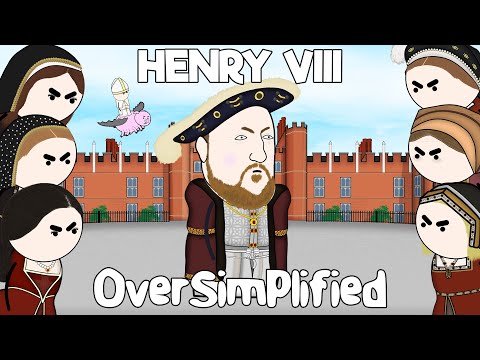
"Henry VIII - OverSimplified" · OverSimplified · 27 min · 46M views · 2020
In short: Henry VIII's pursuit of a male heir drove six marriages, a break with the Catholic Church, and changes that reshaped England's religious and economic life.
After a revolution driven by structural crisis, this video examines how one ruler's personal aims can transform national institutions. It follows Henry VIII's six marriages, search for a male heir, religious break, military campaigns, and increasingly tyrannical later rule. The central argument is that his personal life and political decisions were inseparable, with the quest for succession producing changes whose effects reached far beyond his household.
Henry's desire for a male heir led him to break from the Catholic Church and establish the Church of England. His dissolution of the monasteries then altered both the religious and economic structure of the country. Campaigns against France and Scotland drained money and did not always succeed. In later life, health problems may have worsened his paranoia and tyranny. Despite his repeated efforts to secure succession, none of his children produced heirs.
Key takeaways
Henry's pursuit of a male heir led to multiple marriages and the creation of the Church of England.
The dissolution of the monasteries changed England's religious and economic landscape.
His campaigns against France and Scotland were costly and not always successful.
His health, relationships, and growing paranoia affected political decisions during his later rule.
Watch on YouTube · Read the summary and Q&A
10. What Events Defined the Cold War Era?
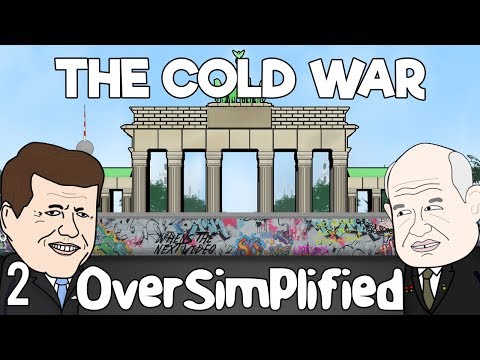
"The Cold War - OverSimplified (Part 2)" · OverSimplified · 17 min · 45M views · 2019
In short: Nuclear confrontation, the Vietnam War, proxy conflicts, detente, and Gorbachev's reforms defined the later Cold War and its eventual end.
The sequence closes by returning to the Cold War story introduced in the second video. This second part moves from the intense divisions of the 1960s through proxy wars and the arms race, then into the reduced tensions of the 1970s and the Soviet reforms of the 1980s. It argues that the period was shaped both by repeated risks of wider war and by later attempts to limit nuclear weapons and change the Soviet system.
Fidel Castro and Che Guevara's revolution in Cuba led to US attempts to overthrow the communist regime, culminating in the failed Bay of Pigs Invasion. The Cuban Missile Crisis then brought the United States and Soviet Union close to nuclear conflict before a resolution. The Vietnam War and proxy conflicts across the Middle East, Africa, and Latin America caused widespread suffering. Later, SALT supported detente, while Gorbachev's openness and restructuring helped lead to the Berlin Wall's fall and the Soviet Union's dissolution.
Key takeaways
The Cuban Missile Crisis brought the United States and Soviet Union close to nuclear war before they reached a resolution.
The Vietnam War and other proxy conflicts extended the superpower struggle across several regions.
SALT formed part of the 1970s policy of detente aimed at limiting nuclear weapons and improving relations.
Gorbachev's reforms contributed to the fall of the Berlin Wall and the dissolution of the Soviet Union.
Watch on YouTube · Read the summary and Q&A
Frequently asked questions
What are the best OverSimplified history videos?
Three strong places to start are What Caused the Rise of Fascism in World War II?, What Caused the Cold War and Its Key Events?, and Why Did the American Civil War Start? They introduce conflicts shaped by ideology, political division, economic pressure, and competing systems, and they have the three highest view counts on this list.
How long does it take to watch all ten videos?
The complete set takes 207 minutes, or 3 hours 27 minutes. The shortest entry is What Sparked the Outbreak of World War I? at 6 minutes, while What Caused Prohibition and How Did It Fail? is the longest at 34 minutes. The other eight videos range from 14 to 30 minutes.
Why did fascism rise before World War II?
Political and economic instability made nationalist promises more appealing. Mussolini abandoned socialism for fascism and emphasized Italian unity and dominance. Hitler used anger over the Treaty of Versailles and Germany's economic problems to promise restored power. Japan sought resources and influence through military expansion in East Asia, while Allied appeasement delayed a forceful response to Hitler.
Why did the American Civil War begin?
Conflict over slavery and states' rights intensified as the country expanded. The Missouri Compromise tried to balance free and slave states, while the Kansas-Nebraska Act shifted the decision to territories and helped produce Bleeding Kansas. Lincoln's election was seen as an anti-slavery threat by Southern states, which then seceded and formed the Confederacy.
Why did Prohibition fail?
The law was underfunded, difficult to enforce, and filled with loopholes that allowed alcohol in some circumstances. Illegal speakeasies spread, corruption affected law enforcement and officials, and bootlegging helped organized crime grow. As those consequences became visible, some early supporters changed sides, and the Great Depression and wider disillusionment contributed to repeal in 1933.
How did one assassination lead to World War I?
The assassination of Archduke Franz Ferdinand by Serbian nationalists gave Austria-Hungary a reason to declare war on Serbia. Because Europe already faced rivalries, territorial disputes, militarism, and a complex system of alliances, that local confrontation expanded. Germany, France, Britain, and Russia entered as declarations and obligations turned the crisis into a large international war.
Which OverSimplified video should I watch first?
Start with What Caused the Rise of Fascism in World War II? It shows how political instability, economic pressure, nationalism, territorial ambition, and delayed opposition converged across Italy, Germany, and Japan. That multi-country view sets up the list's later studies of ideological conflict, revolution, divided societies, policy failure, and individual rulers.
Are the older OverSimplified videos still worth watching?
Yes. The oldest entry here, What Sparked the Outbreak of World War I?, dates to 2016, while the World War II and American Revolution videos date to 2018. Their subjects are established historical causes and events, including alliances, taxation, revolution, and fascist expansion, which remain central to what each video explains.
What is the difference between the two Cold War videos?
Part 1 covers the conflict's origins and early events, including Lenin, Stalin, the Berlin Airlift, the Korean War, Khrushchev, and construction of the Berlin Wall. Part 2 focuses on the Cuban Missile Crisis, Vietnam, global proxy wars, detente, Gorbachev's reforms, the fall of the Berlin Wall, and the dissolution of the Soviet Union.
How to use this list
Watch the videos in the listed order. The sequence begins with fascist expansion and the early Cold War, turns to civil conflict, revolutions, rulers, and a failed domestic policy, then returns to global war before closing the Cold War story. If you only have twenty minutes, start with What Caused the Cold War and Its Key Events?, a 16-minute overview that connects ideology to the Berlin Airlift, Korean War, and Berlin Wall. If you want the single video that most clearly shows how an immediate event can activate deeper pressures, choose What Sparked the Outbreak of World War I?
Related lists
💡 Want summaries and transcripts for any YouTube video? Try YouTube Summary with ChatGPT & Claude.