What Caused the Cold War and Its Key Events?
TL;DR
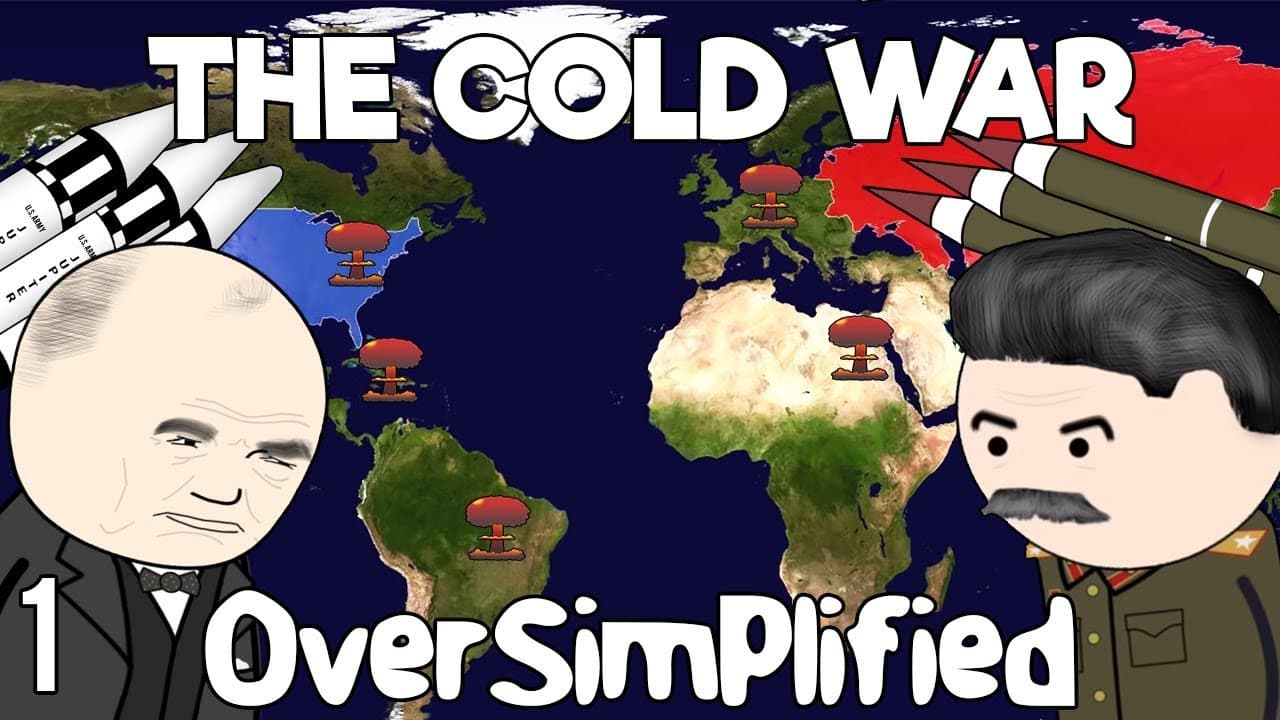
The Cold War began due to the ideological conflict between capitalism and communism, primarily after Lenin's return and Stalin's rise to power. Key events include the Berlin Airlift, the Korean War, and the construction of the Berlin Wall, which highlighted the escalating tensions and failures of communism as Eastern Europeans sought freedom in the West.
Transcript
I've decided that in order to sell more merch, I should do a face reveal wearing it. So are you ready? Here we go! Boom. New minimalist and Cold War merch available now. And get the new limited edition Churchill character pin before it sells out, with more characters coming in the future. Link in the description down below. The year is 1917. Fighti... Read More
Key Insights
- The video uses humor to explain the complex historical events leading to the Cold War, including Lenin's return to Russia and Stalin's rise to power.
- Stalin's Five-Year Plans transformed the Soviet economy but were accompanied by a reign of terror, with opponents disappearing or being killed.
- The video highlights the post-World War II conferences and the initial cooperation between the Allies, which quickly deteriorated into Cold War tensions.
- The Berlin Airlift was a significant Western victory, demonstrating resolve against Stalin's blockade and highlighting the economic battle between capitalism and communism.
- Khrushchev's de-Stalinization campaign aimed to reform the Soviet Union, but uprisings in Eastern Europe were brutally suppressed, revealing the limits of his policies.
- The Korean War is depicted as a proxy battle between communism and capitalism, with major powers backing opposing sides, leading to a stalemate.
- The construction of the Berlin Wall symbolized the failure of communism, as East Berliners fled to the West, highlighting the stark contrast between the two systems.
- The video touches on espionage and technological competition during the Cold War, including the space race and nuclear arms race, which heightened global tensions.
Install to Summarize YouTube Videos and Get Transcripts
Explore YouTube Video Summarizer or Get YouTube Transcript Extractor
Questions & Answers
Q: What role did Lenin play in the early events leading to the Cold War?
Lenin was instrumental in establishing the Soviet Union by leading the Bolshevik Revolution, overthrowing the provisional government in Russia. His policies laid the foundation for a communist state, which later became a central player in the Cold War. Lenin's actions, including pulling Russia out of World War I, led to a civil war and the eventual rise of Stalin, setting the stage for future East-West tensions.
Q: How did Stalin consolidate power in the Soviet Union?
Stalin consolidated power by eliminating his political rivals through arrests and disappearances, ensuring his dominance in the Communist Party. He implemented Five-Year Plans to rapidly industrialize the Soviet Union, transforming it from an agricultural economy to an industrial powerhouse. However, his reign was marked by terror, as dissenters were killed or sent to labor camps, solidifying his authoritarian rule.
Q: What was the significance of the Berlin Airlift during the Cold War?
The Berlin Airlift was a critical moment in the Cold War, demonstrating Western resolve against Soviet aggression. When Stalin blockaded supply routes to West Berlin, the Allies responded by airlifting essential goods to sustain the city. This successful operation highlighted the ideological struggle between capitalism and communism, as Western Allies showcased their commitment to supporting democratic West Berlin against Soviet pressure.
Q: How did Khrushchev's policies differ from Stalin's?
Khrushchev's policies marked a shift from Stalin's authoritarian rule through his de-Stalinization campaign. He sought to reform the Soviet Union by allowing greater cultural freedom and reducing the oppressive political climate. However, his attempts were limited, as uprisings in Eastern Europe were still violently suppressed. Khrushchev's leadership aimed to present a more positive image of communism while maintaining control over Soviet satellite states.
Q: What impact did the Korean War have on the Cold War dynamics?
The Korean War was a significant proxy conflict in the Cold War, with the North backed by the Soviet Union and China, and the South supported by the United States and its allies. It exemplified the global struggle between communism and capitalism, leading to a military stalemate. The war intensified Cold War tensions, as both superpowers avoided direct confrontation while influencing regional conflicts through their respective allies.
Q: Why was the Berlin Wall constructed, and what did it symbolize?
The Berlin Wall was constructed to prevent East Berliners from fleeing to West Berlin, highlighting the failure of the communist system. It symbolized the stark contrast between the prosperous West and the struggling East, as many sought to escape the economic hardships of East Germany. The wall became a powerful symbol of the Cold War, representing the division between the capitalist and communist worlds and the oppressive nature of the Soviet regime.
Q: How did espionage play a role in the Cold War?
Espionage was a crucial aspect of the Cold War, with both sides engaging in extensive intelligence-gathering operations. The KGB infiltrated Western governments, while the CIA and other agencies attempted to gather information on Soviet activities. Technological advancements, such as U-2 spy planes, enhanced surveillance capabilities. Espionage fueled mistrust and paranoia, contributing to the heightened tensions and competitive nature of the Cold War era.
Q: What were the key technological competitions during the Cold War?
Key technological competitions during the Cold War included the space race and the nuclear arms race. The Soviet Union's launch of Sputnik and the successful manned spaceflight of Yuri Gagarin shocked the world, prompting the U.S. to accelerate its space program. Both superpowers also developed hydrogen bombs, escalating the arms race. These competitions showcased the technological prowess of each side and intensified the ideological battle for global supremacy.
Summary & Key Takeaways
-
The video humorously explores the origins of the Cold War, beginning with Lenin's return to Russia and Stalin's subsequent rise to power, which led to the establishment of a communist regime.
-
It covers key events such as Stalin's Five-Year Plans, the Berlin Airlift, and the Korean War, highlighting the ideological battle between communism and capitalism.
-
The narrative includes Khrushchev's de-Stalinization efforts and the construction of the Berlin Wall, illustrating the ongoing tensions and conflicts that defined the early Cold War era.
Read in Other Languages (beta)
Share This Summary 📚
Summarize YouTube Videos and Get Video Transcripts with 1-Click
Try YouTube Summary with ChatGPT & Claude or YouTube Transcript Generator
Explore More Summaries from OverSimplified 📚





Summarize YouTube Videos and Get Video Transcripts with 1-Click
Try YouTube Summary with ChatGPT & Claude or YouTube Transcript Generator