What Was the Great Emu War and Why Did It Fail?
TL;DR
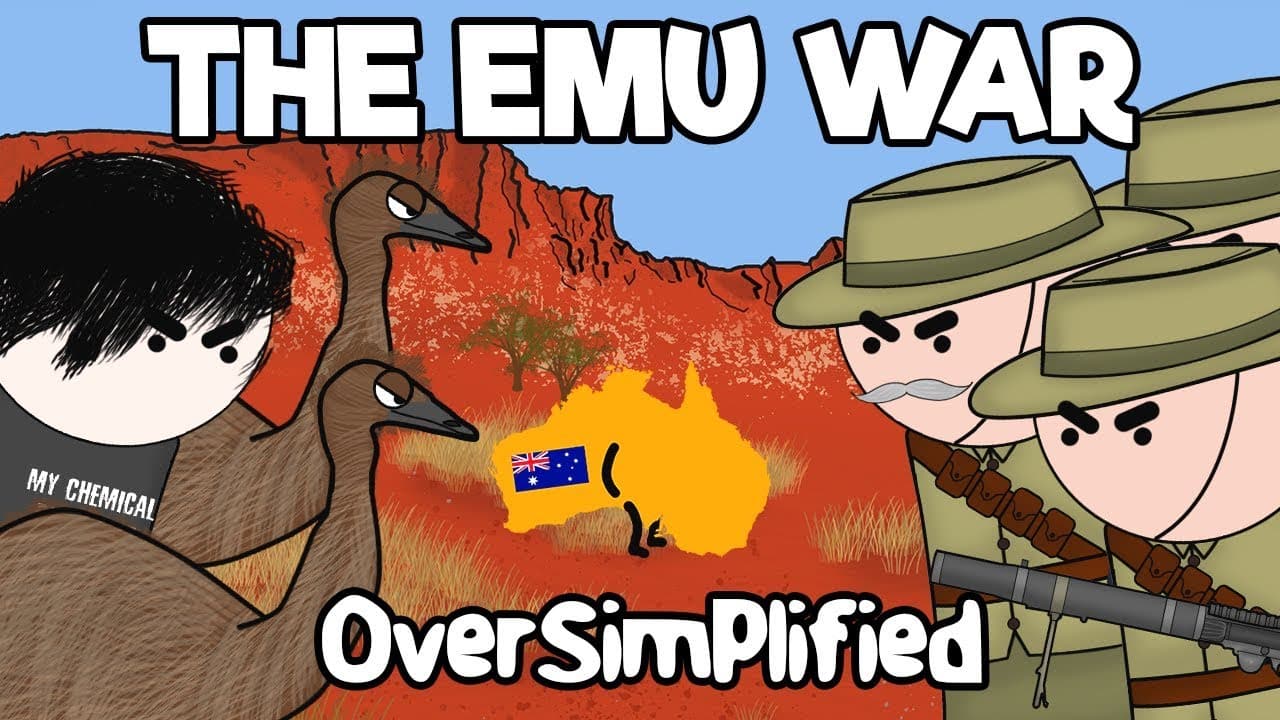
The Great Emu War of 1932 was an Australian military operation aimed at controlling an overpopulation of emus that were damaging crops. Despite using machine guns, the operation failed to significantly reduce the emu population, with frustratingly low success rates contributing to media mockery. Ultimately, better fencing and a bounty system proved more effective solutions to the problem.
Transcript
This, is Australia. For the man who imagines being strangled by a tarantula while a kangaroo breaks his kneecaps and thinks, Mmm. Yes please. For the man who pictures himself being eaten by a snake in the burning Outback while eating a Vegemite sandwich and thinks: "MMM YES, PLEASE!" And that man was governor Arthur Phillip who landed in eastern Au... Read More
Key Insights
- Australia faced severe economic challenges during the Great Depression, heavily impacting its agricultural sector and leading to significant farmer distress.
- The emu population in Western Australia exploded, causing extensive damage to crops and exacerbating the farmers' struggles.
- Farmers sought military intervention to control the emus, leading to the infamous 'Great Emu War' of 1932.
- The military operation involved using machine guns against emus, but the birds proved surprisingly resilient, evading capture and gunfire.
- The emu war was largely unsuccessful, with only a small fraction of the emu population being culled despite significant resources expended.
- The media ridiculed the military's efforts, and the emus were humorously suggested to be awarded medals for their 'victory.'
- A bounty system was later introduced to control the emu population, which saw more success than the military intervention.
- The emu crisis was eventually solved with improved fencing, highlighting a simpler solution to the complex problem.
Install to Summarize YouTube Videos and Get Transcripts
Explore YouTube Video Summarizer or Get YouTube Transcript Extractor
Questions & Answers
Q: What was the economic context in Australia during the Great Emu War?
During the Great Emu War, Australia was experiencing severe economic hardship due to the global Great Depression. The country relied heavily on its export industries, and with the economic downturn, there was a significant drop in demand for Australian exports. This situation was further complicated by the introduction of Australia's own currency pegged to the British pound, which suffered due to the UK's alterations to the gold standard. Consequently, Australian farmers were hit particularly hard, with many struggling to maintain their livelihoods.
Q: Why did the farmers turn to the military for help with the emus?
The emu population in Western Australia had grown significantly, causing widespread destruction of crops and exacerbating the financial difficulties faced by farmers. The farmers, desperate for a solution, believed that military intervention could effectively control the emus. They approached the Minister of Defense, George Pearce, for assistance, hoping that the use of machine guns would quickly and efficiently reduce the emu numbers. This decision reflected the farmers' desperation and the unusual nature of the problem they faced.
Q: How effective was the military operation against the emus?
The military operation against the emus was largely ineffective. Despite deploying machine guns and significant resources, the emus proved resilient and adept at evading capture and gunfire. The birds' ability to take multiple bullets and still escape led to a minimal reduction in their numbers. The operation was ridiculed by the media, and the emus were humorously suggested to be awarded medals for their 'victory.' Ultimately, the military intervention failed to achieve its objectives, highlighting the complexity of the problem.
Q: What was the public and media reaction to the Great Emu War?
The public and media reaction to the Great Emu War was largely one of ridicule and mockery. The military's inability to effectively control the emu population, despite significant resources and effort, led to widespread criticism. The operation was seen as a fiasco, and the media had a field day with the story, portraying the emus as victorious and suggesting they be awarded medals for their resilience. The situation was seen as an absurd and humorous episode in Australian history.
Q: What strategies were eventually successful in controlling the emu population?
After the failure of the military operation, a bounty system was introduced to control the emu population, which achieved more success than the earlier efforts. Additionally, the emu crisis was eventually resolved with improved fencing, which effectively prevented the birds from accessing and damaging crops. This solution demonstrated that simpler, non-military strategies could be more effective in managing such wildlife issues, highlighting the importance of practical and sustainable approaches to environmental challenges.
Q: What were some of the humorous elements highlighted in the Great Emu War story?
The Great Emu War story is filled with humorous elements, such as the military's decision to use machine guns against emus and the birds' surprising resilience and ability to evade capture. The media's mockery of the operation, suggesting that the emus be awarded medals for their 'victory,' added to the absurdity of the situation. The portrayal of the emus as cunning adversaries and the military's repeated failures contributed to the comedic nature of the story, making it a memorable and amusing episode in history.
Q: How did the emu population affect Australian farmers during the Great Depression?
During the Great Depression, Australian farmers were already struggling with economic challenges, and the emu population exacerbated their difficulties. The emus invaded farmlands in Western Australia, causing extensive damage to crops and leading to significant financial losses for the farmers. The situation was dire, as the farmers' livelihoods were heavily dependent on their agricultural output, and the emu infestation threatened their survival. This prompted the farmers to seek drastic measures, including military intervention, to protect their crops and secure their economic future.
Q: What lessons can be learned from the Great Emu War?
The Great Emu War offers several lessons, including the importance of understanding and respecting wildlife behavior when addressing environmental challenges. The military's failure to control the emu population highlighted the need for practical and sustainable solutions, such as improved fencing, rather than relying solely on force. Additionally, the episode underscores the value of considering non-lethal and ecologically sound strategies in wildlife management. The story also serves as a reminder of the potential for unintended consequences when addressing complex problems with overly simplistic approaches.
Summary & Key Takeaways
-
Australia's economic downturn during the Great Depression severely affected its farmers, who were already struggling with crop losses due to an overpopulation of emus. In response, the government deployed military forces to control the emu population, leading to the infamous 'Great Emu War.'
-
The military operation against the emus proved ineffective, as the birds managed to evade capture and gunfire, resulting in minimal reduction of their numbers. The media mocked the operation, and the emus were humorously suggested to be awarded medals for their resilience.
-
Despite the military's failure, a bounty system later helped manage the emu population more effectively. Eventually, the emu crisis was resolved with improved fencing, demonstrating a simpler and more efficient solution to the problem.
Read in Other Languages (beta)
Share This Summary 📚
Summarize YouTube Videos and Get Video Transcripts with 1-Click
Try YouTube Summary with ChatGPT & Claude or YouTube Transcript Generator
Explore More Summaries from OverSimplified 📚





Summarize YouTube Videos and Get Video Transcripts with 1-Click
Try YouTube Summary with ChatGPT & Claude or YouTube Transcript Generator