How Big Bazaar Fell and India’s Growth Story?
TL;DR
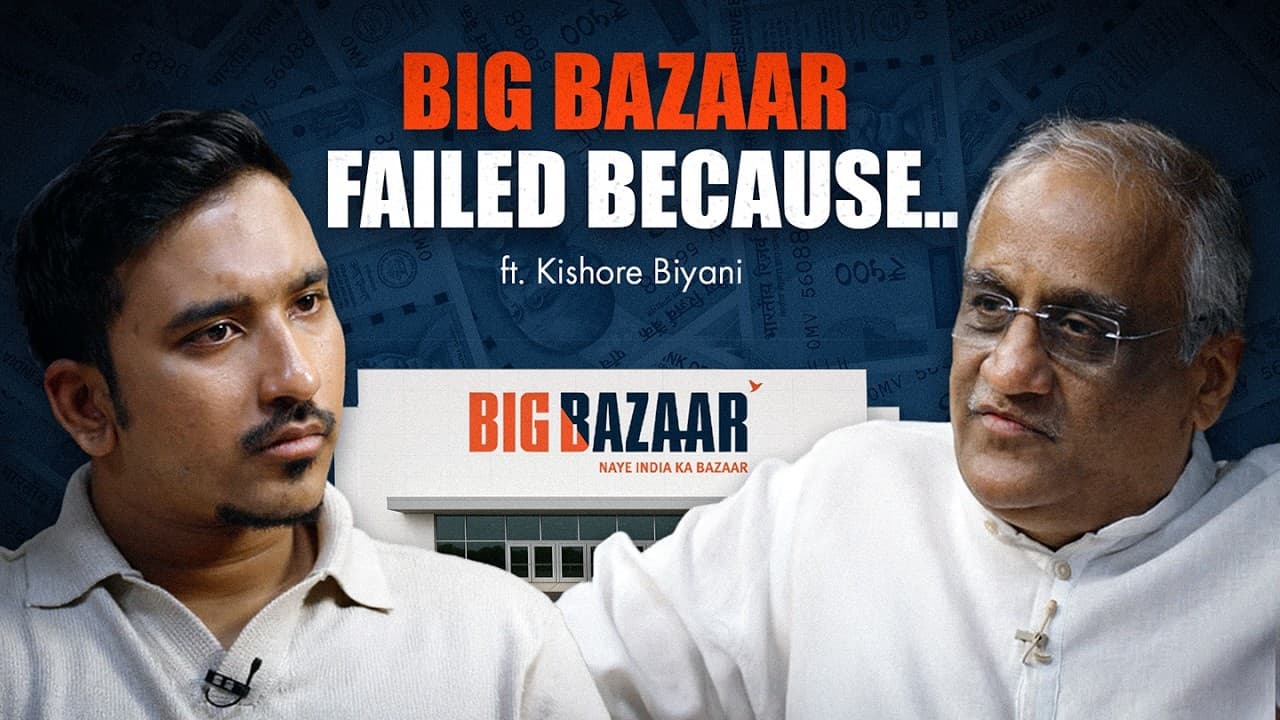
The founder explains why India must build a new growth narrative by rethinking consumer segments and logistics. He contrasts India with China’s long term planning, highlights India 1, 2, and 3 consumption, and discusses how entrepreneurship, trust, and storytelling shape modern retail. The path to scale involves addressing land, logistics, and changing consumer habits.
Transcript
Our goods trains they move at a speed that is slower than an activa whereas in China it's three times faster. China is a very different country. China plans for 100 years. But how do they do that? India 1 consumes maybe 100,000 items in their lifetime. India 2 consumes 10,000 items in their lifetime. India 3 consumes not more than thousand items in... Read More
Key Insights
- India needs new stories of entrepreneurship and growth to drive development.
- The speaker distinguishes India 1, India 2, and India 3 as separate consumer segments for targeted strategies.
- China’s long term planning is used as a benchmark for strategic investment and design-led growth.
- Logistics and land acquisition are the core bottlenecks hindering supply chain efficiency in India.
- The cost of logistics in India is presented as a major hurdle to GDP efficiency.
- Trust between government and citizens is portrayed as essential for a thriving economy.
- The speaker emphasizes the role of branding and customer communication in reaching Bharat.
- Bringing together infrastructure, entrepreneurship, and cultural narratives is key to India’s growth story.
- More videos from this channel:
- More from this channel: Think School
Install to Summarize YouTube Videos and Get Transcripts
Explore YouTube Video Summarizer or Get YouTube Transcript Extractor
Questions & Answers
Q: What is India 1, 2, and 3 in consumer segments and why does it matter for startups?
India 1, 2, and 3 represent distinct consumer segments that require different product offerings and communication strategies. Understanding these segments helps startups tailor pricing, distribution, and branding to match diverse aspirations and income levels across Bharat. This segmentation informs which channels, formats, and messages will resonate most with each group, improving market fit and growth prospects.
Q: Why does the founder compare India to China in terms of growth planning?
The comparison to China is used to illustrate a difference in planning horizons and execution. China plans for 100 years, reorganized its past, and built an economy through designled growth and deep tech. The speaker suggests India should adopt longer term thinking and more structured sectoral planning to accelerate development while acknowledging India’s unique land and cultural context.
Q: What challenges to India’s logistics and supply chain does the speaker highlight?
The speaker notes that India’s logistics cost is high and that the logistics system is broken, with a need to reduce costs from current levels to improve GDP contribution. Land acquisition is identified as a fundamental constraint, and the lack of a design to match China’s industrial cities is seen as a barrier to efficient supply chains and modern retail growth.
Q: How does the episode view storytelling and trust in business growth?
The episode argues that new stories of entrepreneurship and development are essential to change mindsets and spur growth. Trust is highlighted as a critical social and governmental factor; a trusted environment between government, parents, and communities can unlock entrepreneurial risk taking and scale. Without trust, growth and brand-building are harder across India.
Q: What lessons does Kishore Biyani share about building a brand in India?
Lessons include the importance of aligning branding with Bharat’s diverse consumer base, designing communication to resonate with local habits, and leveraging the right distribution and retail formats. He emphasizes understanding India’s three consumer segments, avoiding simplistic franchising models, and building brands that connect with everyday realities and aspirations.
Q: Why is land a recurring problem for Indian development, according to the speaker?
Land acquisition is presented as a fundamental bottleneck due to India’s limited land mass relative to population and the complexities of securing land for large-scale projects. This constraint makes it difficult to replicate the scale of land-intensive models seen elsewhere and requires innovative planning and policy measures to accelerate infrastructure and warehousing development.
Q: What does the speaker say about the role of government and public trust in growth?
The speaker argues trust is essential for growth, stating that the government must trust its citizens and vice versa. Building trust across communities and stakeholders is seen as crucial for enabling entrepreneurship, reducing friction in business operations, and supporting a climate where new business models can thrive.
Q: How did Covid impact Big Bazaar and what does it imply for retail resilience?
According to the discussion, the crisis hit malls hard and changed consumer behavior, forcing retailers to adapt quickly. The implication for retail resilience is that businesses must diversify channels, adjust portfolios, and rethink consumer engagement strategies to survive disruptions and maintain relevance in changing marketplaces.
Summary & Key Takeaways
-
The episode argues that India needs new growth stories and entrepreneurship to unlock scale, contrasting India with China’s long term planning and designled growth.
-
It explains India’s three consumer segments, India 1, 2, and 3, and why startups must tailor strategies to Bharat and evolving consumer behavior.
-
It highlights challenges like logistics costs, land acquisition, and the importance of trustworthy government-citizen relations for growth.
Read in Other Languages (beta)
Share This Summary 📚
Summarize YouTube Videos and Get Video Transcripts with 1-Click
Try YouTube Summary with ChatGPT & Claude or YouTube Transcript Generator
Explore More Summaries from Think School 📚






Summarize YouTube Videos and Get Video Transcripts with 1-Click
Try YouTube Summary with ChatGPT & Claude or YouTube Transcript Generator