How Does Spring Boot Simplify Java Apps and Microservices?
TL;DR
Spring Boot simplifies Java apps and microservices by replacing extensive manual configuration with component scanning, dependency injection, auto-configuration, and an embedded Tomcat server. Annotations identify controllers, services, repositories, and JPA entities, while application.properties or application.yml centralizes database, server, JPA, and logging settings. Read on to see how these features work across each application layer.
Transcript
Spring framework has been a staple for Java development since the early 2000s. But traditional Spring wasn't always easy to work with. In its early days, Spring required a lot of verbosity in configuration. Developers had to define beans and wiring in bulky XML files which often spanned hundreds or even thousands of lines. This XML-driven setup, wh... Read More
Key Insights
- Spring MVC applications use a layered request flow: a client calls a controller, the controller delegates business logic to a service, and the service accesses persistence through a repository before the response travels back through the same layers.
- Spring Boot component scanning discovers classes marked with annotations such as REST controller, service, and repository. Developers therefore do not need to define those beans manually, provided the components are located within the package structure Boot scans.
- Spring Boot auto-configuration examines the libraries on the classpath and supplies appropriate defaults. Spring MVC can trigger web configuration, a dispatcher servlet, JSON conversion, and an embedded server, while an H2 dependency can trigger an in-memory database setup.
- Spring Data JPA can generate a repository implementation from an interface that extends a built-in repository type. Entity annotations map model objects to database tables, identify primary keys, and configure generated identifiers without requiring developers to write mapping SQL.
- Spring Boot configuration is stored in application.properties or application.yml. These files can define the application name, database connection, JPA and Hibernate behavior, server port, REST base path, and logging levels in a centralized and maintainable format.
- Spring Boot starters are curated dependency packages for common application capabilities. The web starter brings together Spring MVC, Jackson, validation, and an embedded server, while other starters cover areas such as security, JPA, and RabbitMQ.
- Embedded servers allow Spring Boot applications to run as standalone Java programs. A packaged application can be started with Java JAR, with its bundled server listening on port 8080 by default, which supports portability, cloud deployment, containers, and microservices.
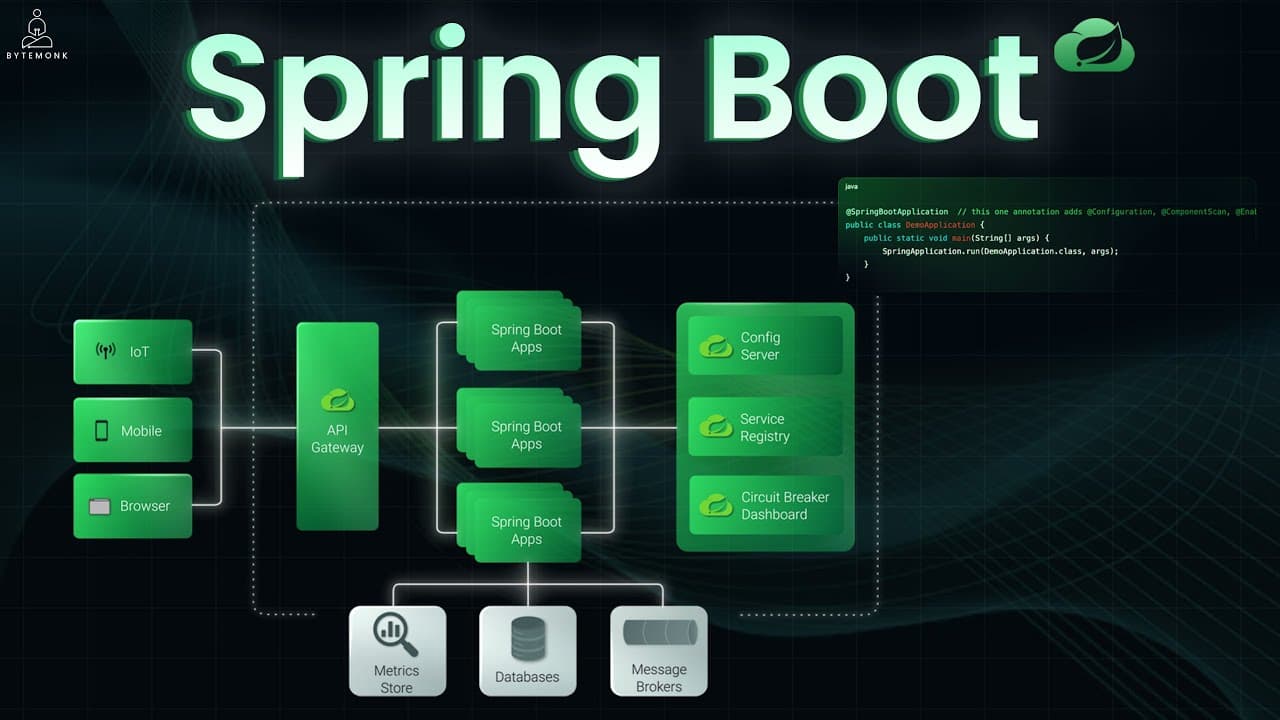
- Spring Boot supports observable and resilient microservices through Spring Cloud components and Actuator. Gateways route traffic, registries enable discovery, config servers centralize settings, circuit breakers provide fallbacks, and Actuator exposes operational metrics and health checks.
Install to Summarize YouTube Videos and Get Transcripts
Explore YouTube Video Summarizer or Get YouTube Transcript Extractor
Questions & Answers
Q: How does Spring Boot simplify Java apps and microservices?
Spring Boot automatically handles much of the bean registration, dependency wiring, web infrastructure, and server setup that traditional Spring applications configured manually. Its annotations, component scanning, auto-configuration, embedded server, and centralized configuration files let developers spend less time on boilerplate and more time on business logic.
Q: How does a request move through a Spring Boot application?
A client request enters through a controller, which delegates business logic to a service. When data is required, the service calls a repository that interacts with the database or another persistence mechanism. The response then travels back through the repository, service, and controller to the client.
Q: What does Spring Boot auto-configuration do?
Auto-configuration sets up supporting infrastructure behind the scenes based on the application and its components. For a REST controller, Spring Boot can configure the dispatcher servlet and JSON converters. Running the main application also creates the Spring context, starts embedded Tomcat, and discovers components through scanning.
Q: How does Spring Boot discover controllers, services, and repositories?
Developers mark classes with annotations such as REST controller, service, or repository. Spring Boot finds these classes during component scanning and registers them, removing the need to define each bean manually in XML or Java configuration.
Q: How does dependency injection work in Spring Boot?
A service can receive its repository automatically through constructor injection. Spring handles that connection at runtime, so developers do not need to instantiate the repository manually. This keeps business logic separate from data-access setup.
Q: How does Spring Data JPA simplify database access?
A repository interface can extend a built-in JPA repository, and Spring Boot generates its implementation. An entity class maps to a database table, each instance becomes a row, and its ordinary fields become columns. ID marks the primary key, while generated value tells JPA to create the identifier using the database's identity strategy.
Q: What can be configured in application.yml or application.properties?
These files can define the application name, JDBC URL, database credentials, and driver class. They can also control Hibernate schema behavior, SQL logging, database dialect, server port, REST base path, and logging verbosity. This centralizes settings needed for local or production environments.
Q: Why does Spring Boot use an embedded server?
Spring Boot starts an embedded Tomcat server when the application runs. This removes the need to configure and deploy the app to a separate server before it can handle requests. The main application class can start the server, create the Spring context, and find application components with minimal setup.
Summary & Key Takeaways
-
Traditional Spring applications organize requests through controller, service, repository, and database layers, but historically required extensive XML or Java configuration. Spring Boot preserves this layered design while using annotations, component scanning, dependency injection, and auto-configuration to discover application components and connect them with much less manual setup.
-
Spring Boot applications start through a main class marked with Spring Boot application configuration. At runtime, Boot creates the Spring context, scans for components, configures web infrastructure, and launches an embedded server. Starters provide compatible dependency bundles for capabilities such as web APIs, JPA, security, and messaging.
-
Spring Boot also supports microservices through API gateways, service discovery, centralized configuration, circuit breakers, health checks, metrics, and distributed tracing. Individual services can remain focused on narrow responsibilities while shared infrastructure handles routing, discovery, configuration, resilience, and observability across the wider system.
Read in Other Languages (beta)
Share This Summary 📚
Summarize YouTube Videos and Get Video Transcripts with 1-Click
Try YouTube Summary with ChatGPT & Claude or YouTube Transcript Generator
Explore More Summaries from ByteMonk 📚

Summarize YouTube Videos and Get Video Transcripts with 1-Click
Try YouTube Summary with ChatGPT & Claude or YouTube Transcript Generator