How to design REST APIs with correct methods and resources
TL;DR
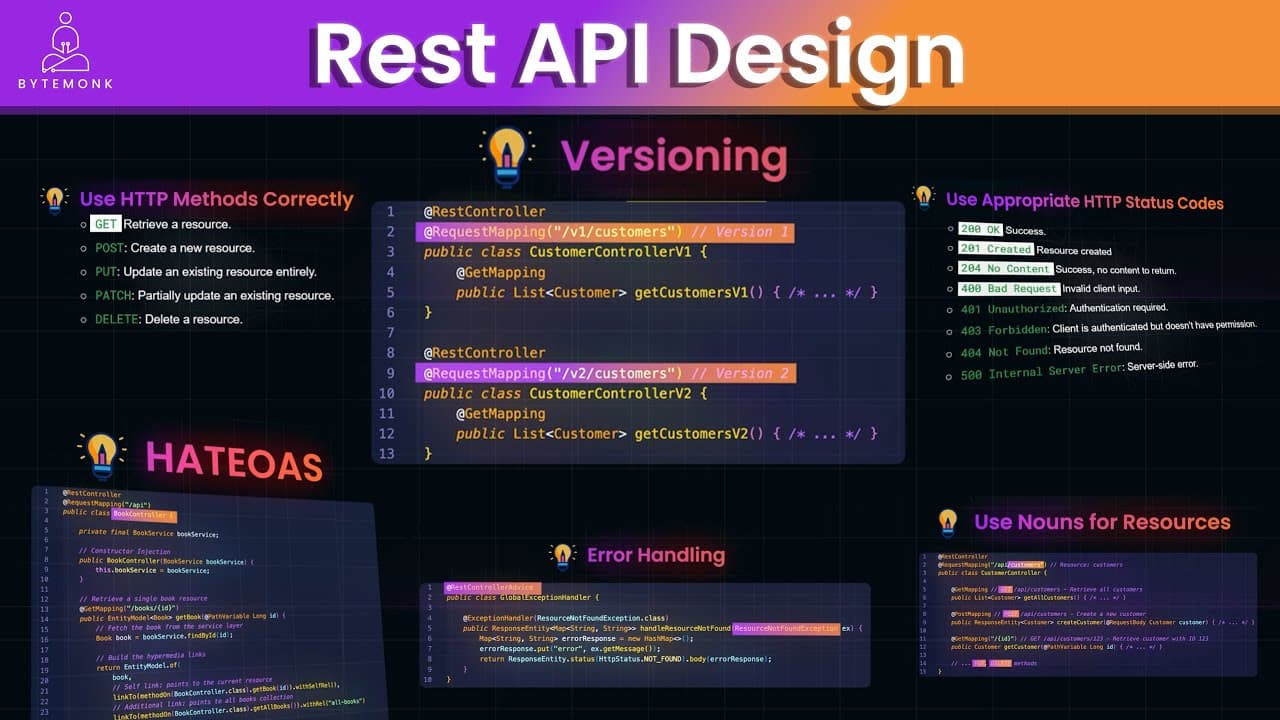
HTTP methods must map to actions and resources must be nouns. Use proper status codes and clear error handling, implement validation, versioning, pagination, filtering, sorting, and optional hypermedia with HATEOAS, then secure APIs with HTTPS and OAuth 2.0 or JWT.
Transcript
hey bite monks in my previous video I explained why rest apis have become the standard for building web services they are lightweight scalable and easy to use in this video I'll break down the top and must know best practices when designing and implementing rest apis with Java examples so let's get started first of all use HTTP methods correctly no... Read More
Key Insights
- HTTP methods are the verbs of REST and determine the action performed on a resource
- URIs should identify resources with nouns and use hierarchical structure to represent relationships
- Status codes like 200, 201, 204, 400, 401, 403, 404, 500 communicate outcomes clearly
- Error handling should be global and provide informative messages without cryptic failures
- Validation with frameworks like Hibernate Validator ensures incoming data meets expectations
- API versioning can be done via URI or header based approaches to maintain backward compatibility
- Pagination, filtering, and sorting help manage large data sets and refine results
- HATEOAS adds links to responses to guide clients on next actions and improve discoverability
Install to Summarize YouTube Videos and Get Transcripts
Explore YouTube Video Summarizer or Get YouTube Transcript Extractor
Questions & Answers
Q: A real search query question about the video (e.g. How to..., What is..., Why does..., When should...). Question 1
REST API design uses nouns for resources and HTTP methods to define actions. The method semantics are get for retrieval, post for creation, put or patch for updates, and delete for removal. URIs should represent resources, not actions, and nested resources use hierarchical paths. This approach keeps APIs intuitive and consistent across endpoints.
Q: Question 2
Status codes are essential for communicating outcomes. 200 indicates success, 201 for created resources, 204 for no content, 400 signals bad input, 401 for authentication, 403 for insufficient permissions, 404 when a resource is not found, and 500 for server errors. Consistent usage helps clients handle responses reliably.
Q: Question 3
Error handling should be descriptive and consistent across the API. Implementing centralized error responses allows clients to understand what went wrong and how to fix it. Clear messages reduce confusion and improve the reliability of API integrations.
Q: Question 4
Validation ensures incoming data meets expectations. Using a validation framework prevents invalid data from being processed and stored, reducing downstream errors. Valid requests result in appropriate HTTP status codes and helpful error messages when validation fails.
Q: Question 5
Versioning lets APIs evolve without breaking existing clients. URI based versioning uses distinct endpoints for each version while header based versioning relies on custom headers to select versions. Both approaches aim to preserve backward compatibility while enabling new features.
Q: Question 6
Pagination divides large datasets into manageable pages. Clients can specify page number and size, and servers return a page object with metadata like total pages and total elements. This approach reduces payload size and improves response times in large data scenarios.
Q: Question 7
Filtering and sorting refine results by allowing clients to specify query parameters. Filtering narrows results by fields such as name, while sorting arranges output by a chosen field. Together they enhance the usefulness of list endpoints.
Q: Question 8
HATEOAS or hypermedia links guide clients through available actions. Including links such as self and related endpoints in responses makes APIs more navigable and discoverable, reducing the need for hard coded client knowledge and improving usability.
Summary & Key Takeaways
-
REST API design focuses on using correct HTTP verbs for actions and noun based resource URIs to describe what you work with
-
Error handling should be descriptive and consistent with standard status codes, and input should be validated to ensure correct data flow
-
Advanced topics include versioning strategies, pagination for large datasets, filtering and sorting, hypermedia guided responses, and securing APIs with modern authentication/authorization mechanisms
Read in Other Languages (beta)
Share This Summary 📚
Summarize YouTube Videos and Get Video Transcripts with 1-Click
Try YouTube Summary with ChatGPT & Claude or YouTube Transcript Generator
Explore More Summaries from ByteMonk 📚






Summarize YouTube Videos and Get Video Transcripts with 1-Click
Try YouTube Summary with ChatGPT & Claude or YouTube Transcript Generator